


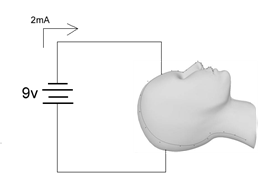
The University of New Mexico has developed a circuit that will improve human mental performance. It is simple, just apply 2mA at 9v to the cranium.
The DARPA study conducted by the university was to look at how to improve soldiers' mental performance in the battlefield, or as they put it "to sharpen soldiers' minds." Test subjects were to learn and play the game "DARWARS Ambush!" The game puts the player into a hazardous, virtual, environment littered with dilapidated buildings, wrecked cars, and civilians. The purpose of the game is to locate potential dangers like improvised explosive devices, combatants, and other battlefield dangers. (Soldiers bound for Iraq are trained with this game.) While immersed in the game, the player has a wet sponge attached to their right temple where the 2mA is trickled.
The experiment was conducted by neuroscientist Vincent Clark, and the technique is dubbed transcranial direct-current stimulation (tDCS). Clark stated that "They learned more quickly, but they don't have a good intuitive or introspective sense about why." A common side effect, aside from the itchy electrode on the side of the head, was experiencing flashing lights. The positive effects may outweigh the negative. The tDCS experiment showed improvements in working memory, word association, and complex problem-solving.
Other researchers seek to improve on Clark's tDCS system. For example, Allan Snyder, of the University of Sydney, want to make a "thinking cap" that corporate executives and creative people may use before going into a brain-storming meeting. Other researchers are predicting widespread use of such devices in academia and medicine. Many claim that a form of tDCS may help with depression.
Does this sound like old pseudoscience to you? It should. In the 1800s, Italian scientist Jean Aldini, used direct current to stimulate corpses of executed felons. Later Aldini used the method to treat the mood disorder, "melancholy." In the 1940s, patients were treated with electroshock therapy for depression. In 1964 psychiatrist Joe Redfearn applied weak currents to humans in the 50-250 micro amp range. In the experiments he claimed that patients would be "giddy and talkative" when the current was applied in one direction "withdrawn" when applied in the opposite. Redfearn also said it improved patients with depression, despite not being able to replicate the results.
Perhaps tDCS will be a future alternative to coffee or energy drinks. The following chart is from Clark's research paper. Now, is anyone brave enough to try the brain-stim?

Cabe
-

DAB
-
Cancel
-
Vote Up
0
Vote Down
-
-
Sign in to reply
-
More
-
Cancel
Comment-

DAB
-
Cancel
-
Vote Up
0
Vote Down
-
-
Sign in to reply
-
More
-
Cancel
Children