


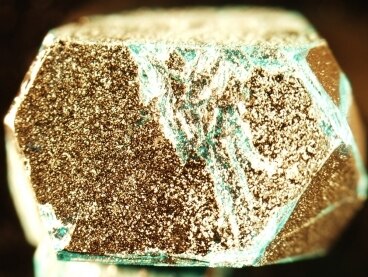
Pure crystal of herbertsmithite, 7mm, made by MIT physicists (via MIT)
Not being satisfied with only two states of magnetism, researchers from MIT set out to find another and experimentally succeeded with finding a new magnetic state known as quantum spin liquid. In one magnetic state, known as ferromagnetism, a magnetic material (iron, nickel, etc.) exhibit an ‘ordering’ phenomena on the atomic level that causes un-paired electron spins to line up with one another in tiny areas known as the domains (or highly magnetized area). Inside of each domain the electrons spin are aligned and either attract or repulse one another depending on the domains direction. The other known magnetic state, antiferromagnetism, aligns the spins of electrons in a regular pattern with other neighboring spins when exposed to low temperatures (creating the magnetism) and cancel each other out as the temperature rises. This state of magnetism has been applied to the read-heads of most modern hard-drives where the read-head moves, just above, the disks platters and alters the platters magnetic field into an electric current (reading data) or just the opposite by turning the electrical current into a magnetic field (writing data). MIT researchers, however, have theoretically found a third state, known as Quantum Spin Liquid (QSL), through a series of experiments designed to quantify the speculative state.
The team was successful at synthesizing a Herbertsmithite (ZnCu3(OH)6CI2) crystal which has the unusual property of acting as a liquid in its magnetic state. Unlike the magnetic orientation (or moments) of the electron spin in the first two states, the electron orientation in QSL fluctuates constantly which acts as though the molecules were in a true liquid or a state of disorder (think of it like disordered molecules in water which become more ordered in an ice state). The idea of QSL’s came about in the 70’s and was theorized to exist but have not yet been proven (theoretically) until now as the team succeeded in growing their own Herbertsmithite crystal (found naturally in regions of the Middle East such as Iran) and began tests to search for the elusive state. They found that by using a process known as neutron scattering (firing a neutron beam at matter to analyze its structure) they were able to collect valuable data (using a neutron spectrometer) and found that there is in fact ‘strong evidence of fractionalized excitations’ between the spin states of the electrons within the crystal which suggests the presence of a true QSL state. While it may take some time to thoroughly justify their results, the team speculates that their findings could lead to practical applications that include high-temperature super conductors, advanced PC memory storage and new communications methods using quantum long-range entanglement (physical interaction of particles).
Cabe