


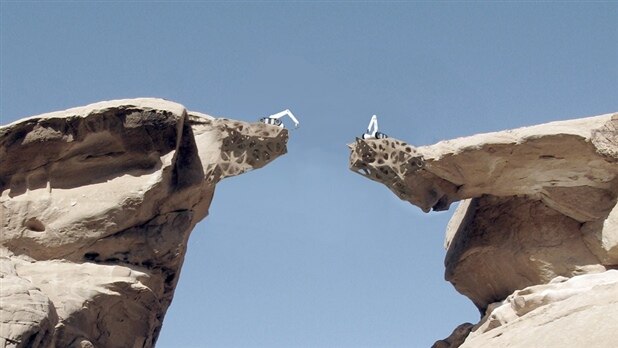
Stone Spray concept image. (via Institute for Advanced Architecture of Catalonia)
We have seen the good and the bad of 3D printer's influence on the world. Still fledgling in maturity, the devices are limited when it comes to the materials it can use to create objects. It is also limited in that it can only print in one direction (usually up) and do it in a confined area, which incidentally, limits the size of the object being created.
Architects Petr Novikov, Inder Shergill, and Anna Kulik, from the Institute for Advanced Architecture of Catalonia, have adapted 3D printing technology to design structures that are clearly constructed ‘outside the box’ (pun intended). The team's research project, known as Stone Spray, is a robotic 3D printer that is capable (albeit limited) of creating 3D structures using onsite natural soil and sand. Their robotic 3D printer design features an arm that is equipped with 3 lower joints equipped with stepper motors, enhanced (for workloads) with a gear transmission system, along with 2 other joints that use servomotors which give the arm 5-DOF of movement. The motors are controlled by an Arduino UNO unit along with three Easydriver shields (which can drive 7V-30V bipolar 2-phase magnetic-stepping motors). The system uses two tanks, one for the soil and the other for a binding agent, that send the material through 2 plastic tubes to the arms nozzle that is equipped with a distance sensor. The sensor determines the correct distance needed for the printing applications design specifications. The software that robotic printer uses was designed with the open-sourced Processing language and features a ‘manual mode’ (for pre-positioning of the nozzle) along with an ‘automatic mode’ that can print designs based off of G-code text files.
So far, the Stone Spray 3D printer is capable of small rudimentary designs, such as columns, that are constructed using an internal wire frame. Further development of the printer could see it capable of actually building larger structures (such as bridges and canopies) without the need for a frame in the not too distant future.
Cabe
