element14 Community
element14 Community
    Register Log In
  • Site
  • Search
  • Log In Register
  • Community Hub
    Community Hub
    • What's New on element14
    • Feedback and Support
    • Benefits of Membership
    • Personal Blogs
    • Members Area
    • Achievement Levels
  • Learn
    Learn
    • Ask an Expert
    • eBooks
    • element14 presents
    • Learning Center
    • Tech Spotlight
    • STEM Academy
    • Webinars, Training and Events
    • Learning Groups
  • Technologies
    Technologies
    • 3D Printing
    • FPGA
    • Industrial Automation
    • Internet of Things
    • Power & Energy
    • Sensors
    • Technology Groups
  • Challenges & Projects
    Challenges & Projects
    • Design Challenges
    • element14 presents Projects
    • Project14
    • Arduino Projects
    • Raspberry Pi Projects
    • Project Groups
  • Products & Partners
    Products & Partners
    • Arduino
    • Avnet & Tria Boards Community
    • Dev Tools
    • Manufacturers
    • Multicomp Pro
    • Product Groups
    • Raspberry Pi
    • RoadTests & Reviews
  • About Us
    About the element14 Community
  • Store
    Store
    • Visit Your Store
    • Choose another store...
      • Europe
      •  Austria (German)
      •  Belgium (Dutch, French)
      •  Bulgaria (Bulgarian)
      •  Czech Republic (Czech)
      •  Denmark (Danish)
      •  Estonia (Estonian)
      •  Finland (Finnish)
      •  France (French)
      •  Germany (German)
      •  Hungary (Hungarian)
      •  Ireland
      •  Israel
      •  Italy (Italian)
      •  Latvia (Latvian)
      •  
      •  Lithuania (Lithuanian)
      •  Netherlands (Dutch)
      •  Norway (Norwegian)
      •  Poland (Polish)
      •  Portugal (Portuguese)
      •  Romania (Romanian)
      •  Russia (Russian)
      •  Slovakia (Slovak)
      •  Slovenia (Slovenian)
      •  Spain (Spanish)
      •  Sweden (Swedish)
      •  Switzerland(German, French)
      •  Turkey (Turkish)
      •  United Kingdom
      • Asia Pacific
      •  Australia
      •  China
      •  Hong Kong
      •  India
      •  Japan
      •  Korea (Korean)
      •  Malaysia
      •  New Zealand
      •  Philippines
      •  Singapore
      •  Taiwan
      •  Thailand (Thai)
      •  Vietnam
      • Americas
      •  Brazil (Portuguese)
      •  Canada
      •  Mexico (Spanish)
      •  United States
      Can't find the country/region you're looking for? Visit our export site or find a local distributor.
  • Translate
  • Profile
  • Settings
Experts, Learning and Guidance
  • Technologies
  • More
Experts, Learning and Guidance
Ask an Expert Forum Voltage divider with resistors or inverting amplifier to reduce?
  • Blog
  • Forum
  • Documents
  • Leaderboard
  • Files
  • Members
  • Mentions
  • Sub-Groups
  • Tags
  • More
  • Cancel
  • New
Join Experts, Learning and Guidance to participate - click to join for free!
Actions
  • Share
  • More
  • Cancel
Forum Thread Details
  • State Not Answered
  • Replies 5 replies
  • Subscribers 338 subscribers
  • Views 1917 views
  • Users 0 members are here
Related
See a helpful answer?

Be sure to click 'more' and select 'suggest as answer'!

If you're the thread creator, be sure to click 'more' then 'Verify as Answer'!

Voltage divider with resistors or inverting amplifier to reduce?

A3JBNE
A3JBNE over 4 years ago

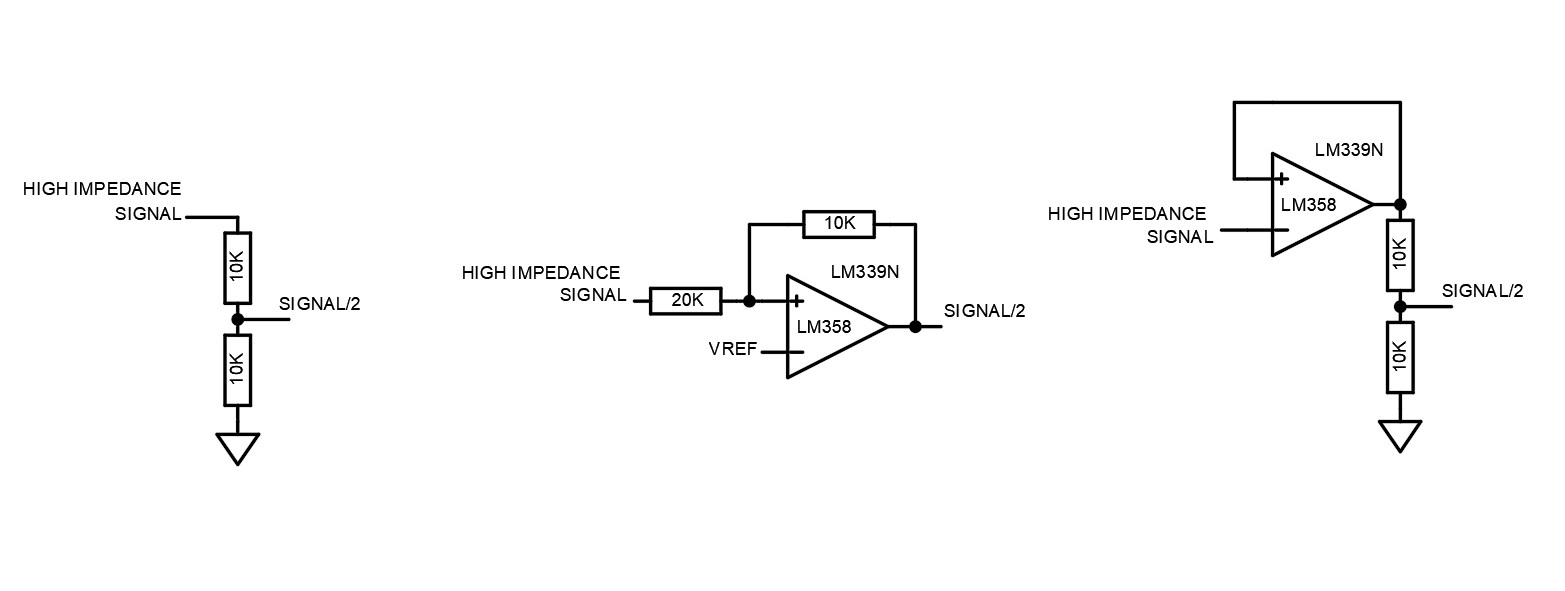
For a high impedance input signal, you want to cut the signal in half, which would be better to use, a resistive divider or an inverting amplifier? 

I think that in the case of the resistive divider and the inverting amp, its impedance depends on the resistive value, which would be the correct application for a high impedance input.
image

  • Sign in to reply
  • Cancel

Top Replies

  • A3JBNE
    A3JBNE over 4 years ago in reply to michaelkellett +1
    For a high impedance signal source, let's say my signal source is an op-amp that has an internal output resistance of 50 ohms, I'm going to overstate the value for the example I'll assume my op-amp's output…
  • dougw
    dougw over 4 years ago in reply to A3JBNE +1
    This is a reasonable approach. You could also put a second buffer on the resistor divider output, if you need a low impedance output. A BJT voltage follower might also work although you would need to…
  • michaelkellett
    0 michaelkellett over 4 years ago

    You need to provide more information.

    What is the required frequency range ?

    What do you mean by high impedance, your circuts show about 20k input impedance which is not that high.

    Electrometers offer input impedances of >10E9 ohms.

    What is the voltage range.

    The advanatge of the passive divider is that it can handle very high voltages if you choose the right kind of resistor.

    The inverting amplifier can cope with input signals bigger than its powwer supply but can be damaged by high voltages if the power is off.

    The non inverting amplifier (buffer) with divider on its output can't cope with voltages outside the common mode rnage of the amplifier.

    MK

    • Cancel
    • Vote Up 0 Vote Down
    • Sign in to reply
    • Verify Answer
    • Cancel
  • A3JBNE
    0 A3JBNE over 4 years ago in reply to michaelkellett

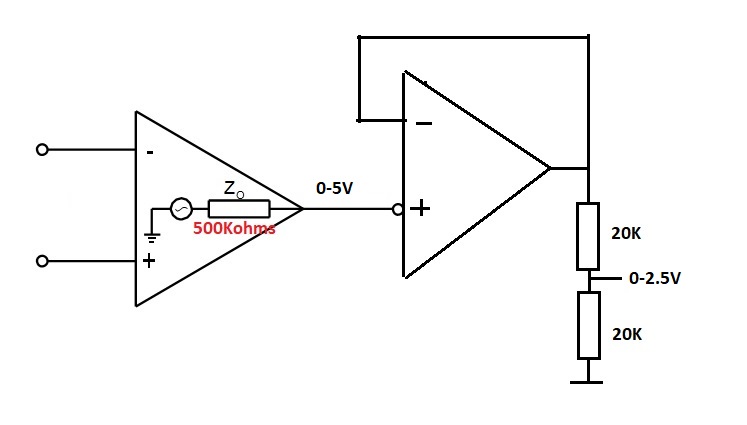
    For a high impedance signal source, let's say my signal source is an op-amp that has an internal output resistance of 50 ohms, I'm going to overstate the value for the example I'll assume my op-amp's output impedance is 500K ohms. So to reduce the signal by half using a divider with resistors would not be correct because it would affect the internal output resistance of the op-amp which is 500k as an example, it could be another signal source that has a high output impedance.
    In that case a resistive divider would not be the right choice, the correct thing would be to use a buffer, but the buffer does not reduce the signal unless you use a resistive divider on the output of the buffer to get half of the signal.
    What other techniques can be used?

    image

    • Cancel
    • Vote Up +1 Vote Down
    • Sign in to reply
    • Verify Answer
    • Cancel
  • dougw
    0 dougw over 4 years ago in reply to A3JBNE

    This is a reasonable approach. You could also put a second buffer on the resistor divider output, if you need a low impedance output.

    A BJT voltage follower might also work although you would need to be okay with the base-emitter voltage drop.

    • Cancel
    • Vote Up +1 Vote Down
    • Sign in to reply
    • Verify Answer
    • Cancel
  • michaelkellett
    0 michaelkellett over 4 years ago in reply to A3JBNE

    This isn't a rational proposition, op amps don't have output impedance that high. And if they did, how would the buffer help, it's only an op amp.

    In real life putting a passive attenuator on the output of an op amp works just fine. If the open loop output impedance of the op amp is 500R (OPA193 is 375R OPA607 is 500R),  a reasonable level of feedback will reduce this to less than 50R. So long as the total impedance of the divider is greater than 50k the error in gain is less than 0.1%. At high frequencies this may not work too well because stray capacitances will affect the frequency response of the attenuator and this effect will get worse the higher its impedance.

    This is why you need to explain what you are actually trying to do in order to get useful advice.

    MK

    • Cancel
    • Vote Up 0 Vote Down
    • Sign in to reply
    • Verify Answer
    • Cancel
  • A3JBNE
    0 A3JBNE over 4 years ago in reply to michaelkellett
    Increase exaggerate the op-amp impedance value, to represent a high-impedance source as an example only.
    • Cancel
    • Vote Up 0 Vote Down
    • Sign in to reply
    • Verify Answer
    • Cancel
element14 Community

element14 is the first online community specifically for engineers. Connect with your peers and get expert answers to your questions.

  • Members
  • Learn
  • Technologies
  • Challenges & Projects
  • Products
  • Store
  • About Us
  • Feedback & Support
  • FAQs
  • Terms of Use
  • Privacy Policy
  • Legal and Copyright Notices
  • Sitemap
  • Cookies

An Avnet Company © 2026 Premier Farnell Limited. All Rights Reserved.

Premier Farnell Ltd, registered in England and Wales (no 00876412), registered office: Farnell House, Forge Lane, Leeds LS12 2NE.

Follow element14

  • X
  • Facebook
  • linkedin
  • YouTube