element14 Community
element14 Community
    Register Log In
  • Site
  • Search
  • Log In Register
  • Community Hub
    Community Hub
    • What's New on element14
    • Feedback and Support
    • Benefits of Membership
    • Personal Blogs
    • Members Area
    • Achievement Levels
  • Learn
    Learn
    • Ask an Expert
    • eBooks
    • element14 presents
    • Learning Center
    • Tech Spotlight
    • STEM Academy
    • Webinars, Training and Events
    • Learning Groups
  • Technologies
    Technologies
    • 3D Printing
    • FPGA
    • Industrial Automation
    • Internet of Things
    • Power & Energy
    • Sensors
    • Technology Groups
  • Challenges & Projects
    Challenges & Projects
    • Design Challenges
    • element14 presents Projects
    • Project14
    • Arduino Projects
    • Raspberry Pi Projects
    • Project Groups
  • Products
    Products
    • Arduino
    • Avnet & Tria Boards Community
    • Dev Tools
    • Manufacturers
    • Multicomp Pro
    • Product Groups
    • Raspberry Pi
    • RoadTests & Reviews
  • About Us
  • Store
    Store
    • Visit Your Store
    • Choose another store...
      • Europe
      •  Austria (German)
      •  Belgium (Dutch, French)
      •  Bulgaria (Bulgarian)
      •  Czech Republic (Czech)
      •  Denmark (Danish)
      •  Estonia (Estonian)
      •  Finland (Finnish)
      •  France (French)
      •  Germany (German)
      •  Hungary (Hungarian)
      •  Ireland
      •  Israel
      •  Italy (Italian)
      •  Latvia (Latvian)
      •  
      •  Lithuania (Lithuanian)
      •  Netherlands (Dutch)
      •  Norway (Norwegian)
      •  Poland (Polish)
      •  Portugal (Portuguese)
      •  Romania (Romanian)
      •  Russia (Russian)
      •  Slovakia (Slovak)
      •  Slovenia (Slovenian)
      •  Spain (Spanish)
      •  Sweden (Swedish)
      •  Switzerland(German, French)
      •  Turkey (Turkish)
      •  United Kingdom
      • Asia Pacific
      •  Australia
      •  China
      •  Hong Kong
      •  India
      • Japan
      •  Korea (Korean)
      •  Malaysia
      •  New Zealand
      •  Philippines
      •  Singapore
      •  Taiwan
      •  Thailand (Thai)
      • Vietnam
      • Americas
      •  Brazil (Portuguese)
      •  Canada
      •  Mexico (Spanish)
      •  United States
      Can't find the country/region you're looking for? Visit our export site or find a local distributor.
  • Translate
  • Profile
  • Settings
Power & Energy
  • Technologies
  • More
Power & Energy
Alt Energy Solutions & Tech Electrical circuit runs off of tree power
  • Blog
  • Forum
  • Quiz
  • Documents
  • Polls
  • Events
  • Mentions
  • Sub-Groups
  • Tags
  • More
  • Cancel
  • New
  • Share
  • More
  • Cancel
Group Actions
  • Group RSS
  • More
  • Cancel
Engagement
  • Author Author: ZeroSizeObject
  • Date Created: 27 Jan 2011 5:57 PM Date Created
  • Views 367 views
  • Likes 0 likes
  • Comments 0 comments
  • alternative_energy
  • nature
  • organic_power
  • enery_harvast
  • microcontroller
  • organic
  • power
Related
Recommended

Electrical circuit runs off of tree power

ZeroSizeObject
ZeroSizeObject
27 Jan 2011
image
 
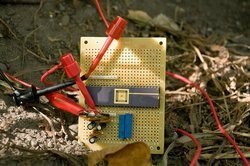
Researchers from the University of Washington have developed a completely tree-powered electrical circuit. The nano-scale device, approximately 130 nanometers in size, consumes just 10 billionths of a watt (10 nanowatts). Unlike the legendary science fair experiment in which a potato-based electric circuit is created using two electrodes (each electrode being a different metal, which react with the starch, causing a potential difference and thus a current), the UW device utilizes electrodes comprised of the same metal, and is able to generate (output) 1.1 volts. “As far as we know, this is the first peer-reviewed paper of someone powering something entirely by sticking electrodes into a tree,” according to paper co-author Babak Parviz, associate professor of electrical engineering at the UW. Recently researchers at MIT discovered that a constant current of about 200 millivolts is generated between plant and soil. But that work did not involve attempting to power any device or circuit, which would require making a device capable of running (performing some function) on exceedingly low voltages. The UW researchers sought to apply this knowledge to power an actual device. In seeking an ideal candidate power source under-graduate student Carlton Himes discovered that the broad-leaf Maple tree (common in the area) supplied a steady voltage of a few hundred millivolts. Despite this, the researchers realized that they would need a bit more juice to power such circuit. To solve this challenge, co-author and UW assistant professor of electrical engineering Brian Otis led a team that developed a ‘boost converter’ which takes the low incoming voltage and stores it to produce a stronger output. The device is able to work with voltages as low as 20 millivolts and can output 1.1 volts–enough to power a small sensor that can be used to take the ‘pulse’ of the tree (its periodic pulsing of electrical energy) which may indicate its overall health.

Zero
  • Sign in to reply
element14 Community

element14 is the first online community specifically for engineers. Connect with your peers and get expert answers to your questions.

  • Members
  • Learn
  • Technologies
  • Challenges & Projects
  • Products
  • Store
  • About Us
  • Feedback & Support
  • FAQs
  • Terms of Use
  • Privacy Policy
  • Legal and Copyright Notices
  • Sitemap
  • Cookies

An Avnet Company © 2025 Premier Farnell Limited. All Rights Reserved.

Premier Farnell Ltd, registered in England and Wales (no 00876412), registered office: Farnell House, Forge Lane, Leeds LS12 2NE.

ICP 备案号 10220084.

Follow element14

  • X
  • Facebook
  • linkedin
  • YouTube