


As much as we hope this happens to none...but we gotta be prepared. Crisis doesn't come telling.
This is about preparing for the odds that we wish never occur.. such as the ongoing pandemic, falling short of eatables in space, run out of food in a water expedition. These aren't easy situations at any level but we're exactly going to try to solve such a situation..by Tech!
So the present situation is...
I, along with my crew of 5 other people had flown using our spaceship to closely look and capture data by traveling around Mars. It went all well until we hit an unforeseen asteroid belt and got our rear part of the spaceship badly damaged. And along with that, lost a major chunk of our food supplies which we secured for the rest of our journey. Our ship can make it until the external help comes with some onboard repair. But what is concerning us more is that we aren't left with sufficient food to survive that long.
The challenge is to produce food to survive. How do we do that? And what food exactly are questions that we'll find answers today. Let's start...
To think about what kind of food should we try to produce, we remember that the goal is to produce nutrient-rich food essential for survival with whatever resources we have at the moment in hand.
Selection of the type of food to grow is to be done keeping in mind the following points:
- We should be able to grow, harvest, and process it easy with available resources.
- It should be able to produce maximum nutrients per yield
- The crop to be grown should have a repeating continuous growth cycle i.e. Plant, reap, repeat for a considerable long time.
- No. of meals to space (1-meter cube) ratio be as high as possible.
The above points lead me to the idea of going to Spirulina Farming.
Spirulina Farming is even a more convincing choice if the astronauts hadn't come prepared or not available with soil to grow rooted plants or go the Martian way growing potatoes..
For those of you crew members who do not already know what Spirulina is... Spirulina is a unicellular, filamentous blue-green edible algae grown in alkaline warm water that is very rich in proteins, vitamins, and a good anti-oxidant.
Advantages of Spirulina farming are:
- Rich in nutrition (protein, vitamins, omega) compared to any other crop. It has very high nutrition packed in small quantities.
- It has a very high growth rate on daily basis.
- It also has positive impacts on the environment. It produces oxygen.
- Requires significantly lesser water and lesser space to grow than any other crop
- Requires a small quantity of spirulina to fill up
- Doesn't need to be stocked up as it produces continuous yield.
Moving forward, I guess the above points are convincing enough to go ahead with the idea of growing Spirulina as the food of space in critical situations such as the present is.
Are you convinced? Let me know if you are or otherwise in the comments section. I wish to issue a disclaimer at this point itself, that I'm still to know how it tastes in actual. I'm hopeful it tastes fine, if not awesome (not even expecting from a survival food).
More facts:
- That Spirulina is many times called the food of the future as it is very concentrated with protein and other nutrients and has positive impacts on the environment. I would call it a full cycle while mentioning that these algaes are one of the earliest lifeforms that ever existed on Earth. They pave the way for the rest of other lifeforms including complex organisms such as humans are today.
- Spirulina is used in medicines or packaged commercially in form of capsules or powder to treat malnutrition.
Image Source: Wikipedia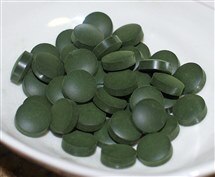
- You can research more about it by its scientific name "Arthrospira platensis".
Image Source: Wikipedia
So, we all boot up to go hydroponic in space. The next step would be to define the growing conditions required for Spirulina Farming. This will help in determining what factors are necessary to maintain while we prepare to monitor the health of our buddies (Spirulina)...
Top Comments