


 The Experimenting with Thermistors Design Challenge, sponsored by Molex and featuring Molex thermistors, has officially wrapped. We had 10 participants with 9 finishers, including the Grand Prize Winner and Runner-up. Our judges have read each blog and tallied up their final scores, and we have our official winners!
First Things: What’s a Thermistor?
 There are several types of temperature sensors; this Design Challenge featured thermistors. For those not familiar with how a thermistor works, here’s a brief primer:
The thermally sensitive resistor (thermistor) — and specifically the negative temperature coefficient (NTC) thermistor — was first described by Michael Faraday in 1833, who found that the resistance of silver sulfide decreased with increases in temperature. However, as the thermistor was difficult to produce and applications were few, commercial production began a century later when Samuel Ruben patented the thermistor in 1930.
Thermistors have continued to be popular because their higher resistance change per degree of temperature provides greater resolution. They are highly repeatable and stable, and have excellent interchangeability. They have low thermal mass, and thus, respond quickly to temperature changes. NTC thermistors are made from a pressed disc, rod, plate, bead, or cast chip of semiconducting material, such as sintered metal oxides. NTC thermistors are used primarily for precise temperature control because they can be manufactured to very tight resistance tolerances and temperature accuracy. They can be used as an inrush current limiter in power supplies, where they present a high initial resistance that prevents high current levels from flowing when the host device is turned on. After they heat up, this resistance decreases, allowing more current to flow and the host device to function without damage.
Thermistors come in a variety of shapes, including disk, chip, bead or rod, and can be surface mounted or embedded in a system. They can be encapsulated in epoxy resin, glass, baked-on phenolic, and also painted. The optimal shape often depends on whether the material being monitored is a solid, liquid or gas. They can also be connected to a cable when the device being measured is inaccessible or difficult to reach. Thermistors vary in cost, depending in part on their accuracy.
element14's Experimenting with Thermistors competition was an opportunity to provide our participants with a kit of Molex Thermistors so that they could conduct experiments and blog about what they learned. Our judges have made their decisions, so let's meet the winners!
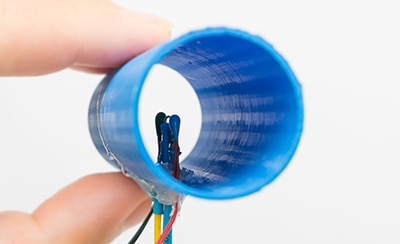 Grand Prize Winner of the Experimenting with Thermistors Challenge: Gough Lui
Gough Lui created a comprehensive course on thermistors and their testing, writing a total 13 blogs. He started by introducing thermistors and analyzing the theory behind how they work. He admitted that using thermistors was “a little mysterious”, and as such, he set out to perform a detailed series of tests that covers almost every aspect of thermistor operation.- According to Gough, “From the various Beta values that are quoted on datasheets in different ways, to the limitations of power dissipation and self-heating effects, I feel there is much to be learned from practical experimentation and characterisation.”
His early blogs cover the background and theory of operation of thermistors, including their accuracy. His tests start in Blog 5, where he learns that measuring the resistance through a thermistor’s temperature range wasn’t quite so easy; a circuit had to be created to linearize the resistance. In Blog 6, he does some tests to see if self-heating affects measurements. The temperature tests begin in Blog 7, where he puts the thermistors through the ringer. In the next few blogs, he tests a system running multiple thermistors, leading up to Blog 12, where he tests out ring thermistors and compares them to bead thermistors. The final blog takes the testing to the limits, as he overloads, crushes, and exposes the thermistors to thermal shock.
One judge called Gough Lui’s blogs, “the finest lecture on thermocouples and testing I have ever read” and another remarked that Gough’s “depth and breadth of testing and characterizing the thermistors was truly amazing. His flow meter (Calorimetric Flow Sensing) project was very interesting and informative. His work output (13 blogs) was informative and thorough, showing a ton of effort and reasoning, as he worked through issues that arose in the testing process.”
For these reasons, Gough Lui was selected as our Grand Prize Winner. You can read all of his blogs here.
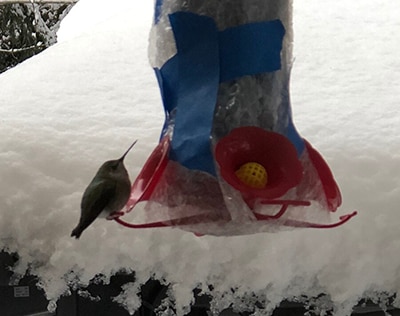 Runner Up Prize Winner of the Experimenting with Thermistors Challenge: Nico teWinkel
Our Runner Up Prize Winner decided to use the thermistor kit to build a practical application that helps some of our cutest and smallest friends: hummingbirds! Nico teWinkel lives in Canada, where cold winters require hummingbirds to depend on feeders. As such, heaters are required to keep the nectar within the feeders from freezing. When this Design Challenge came up, he thought it would be the perfect opportunity to test if thermistors could handle the temperature monitoring for the hummingbird feeders, with the goal of creating “an easily-reproducible hummingbird feeder heater / monitoring system that is reliable yet inexpensive to build for anyone else wanting to do the same for their hummingbirds.”
Nico wrote 9 blogs covering his testing. Blog 1 talks about the background and goals for his project. In Blog 2, he takes a look at the thermistors’ resistance ratings. Blog 3 discusses adding additional analog inputs to his board to support multiple thermistors. In the next few blogs, Nico wires up the thermistors for some testing, including tests with multiple thermistors. Blog 7 goes over choosing which thermistors to use, including some details on how different fixed resistor choices can affect ADC resolution. In Blog 8, Nico puts it all together and tests out temperature measurements in the hummingbird feeder. Nico also includes a bonus blog discussing whether thermistors are the right choice for the thermostat to control the hummingbird feeder heater.
The judges enjoyed learning about Nico’s project with comments such as “Very good test and very good description”, and “ntewinkel worked very hard on coming up with different ways to apply thermistors to his hummingbird feeders, while presenting some informative and entertaining blogs. I for one hope that this setup will allow him to keep feeding the little hummers through the worst the winter will throw at him!” For these reasons, he was selected as our Runner Up prize winner. See his project blogs here.
I'd like to thank all the element14 members who participated and completed this challenge, and who will receive a Finisher Prize for their work:
dougw – Thermistor Thermometer
Synopsis: using thermistors to build two devices, a thermometer (to measure human body temperatures) and a filament warmer for a 3D printer
hitesh.boghani – Profiling Heat Distribution in a Room
Synopsis: setting thermistors up in several places in a room to measure the heat distribution in the room
kmikemoo – Where’s the Heat?
Synopsis: using thermistors to measure the heat in a room containing Bitcoin and Ethereum miners, in order to determine the best method to flow heat out of the room
misaz – Thermistors Mini-tutorial
Synopsis: testing thermistors in various configurations to determine accuracy and noise levels
neuromodulator – Inexpensive Temperature Chamber
Synopsis: using thermistors to build a cost-effective temperature chamber
redcharly – Experiments on the Propagation of Heat
Synopsis: using thermistors to make accurate temperature measurements of the propagation of heat on a metal surface
rsjawale24 – Remote Temperature Transmitter and Other Experiments with Thermistors
Synopsis: using thermistors to develop three projects: a remote temperature transmitter, an analog auto-cutoff circuit, and a temperature following robot
Last Word: A Big Thank You to our Judges!
We'd like to thank Top Members Gene Breniman and Don Bertke for judging the Experimenting with Thermistors Challenge! Their input on the projects was invaluable to our final decisions.


