element14 Community
element14 Community
    Register Log In
  • Site
  • Search
  • Log In Register
  • Community Hub
    Community Hub
    • What's New on element14
    • Feedback and Support
    • Benefits of Membership
    • Personal Blogs
    • Members Area
    • Achievement Levels
  • Learn
    Learn
    • Ask an Expert
    • eBooks
    • element14 presents
    • Learning Center
    • Tech Spotlight
    • STEM Academy
    • Webinars, Training and Events
    • Learning Groups
  • Technologies
    Technologies
    • 3D Printing
    • FPGA
    • Industrial Automation
    • Internet of Things
    • Power & Energy
    • Sensors
    • Technology Groups
  • Challenges & Projects
    Challenges & Projects
    • Design Challenges
    • element14 presents Projects
    • Project14
    • Arduino Projects
    • Raspberry Pi Projects
    • Project Groups
  • Products
    Products
    • Arduino
    • Avnet & Tria Boards Community
    • Dev Tools
    • Manufacturers
    • Multicomp Pro
    • Product Groups
    • Raspberry Pi
    • RoadTests & Reviews
  • About Us
  • Store
    Store
    • Visit Your Store
    • Choose another store...
      • Europe
      •  Austria (German)
      •  Belgium (Dutch, French)
      •  Bulgaria (Bulgarian)
      •  Czech Republic (Czech)
      •  Denmark (Danish)
      •  Estonia (Estonian)
      •  Finland (Finnish)
      •  France (French)
      •  Germany (German)
      •  Hungary (Hungarian)
      •  Ireland
      •  Israel
      •  Italy (Italian)
      •  Latvia (Latvian)
      •  
      •  Lithuania (Lithuanian)
      •  Netherlands (Dutch)
      •  Norway (Norwegian)
      •  Poland (Polish)
      •  Portugal (Portuguese)
      •  Romania (Romanian)
      •  Russia (Russian)
      •  Slovakia (Slovak)
      •  Slovenia (Slovenian)
      •  Spain (Spanish)
      •  Sweden (Swedish)
      •  Switzerland(German, French)
      •  Turkey (Turkish)
      •  United Kingdom
      • Asia Pacific
      •  Australia
      •  China
      •  Hong Kong
      •  India
      • Japan
      •  Korea (Korean)
      •  Malaysia
      •  New Zealand
      •  Philippines
      •  Singapore
      •  Taiwan
      •  Thailand (Thai)
      • Vietnam
      • Americas
      •  Brazil (Portuguese)
      •  Canada
      •  Mexico (Spanish)
      •  United States
      Can't find the country/region you're looking for? Visit our export site or find a local distributor.
  • Translate
  • Profile
  • Settings
The Learning Circuit
  • Challenges & Projects
  • element14 presents
  • The Learning Circuit
  • More
  • Cancel
The Learning Circuit
Documents Inductor Project: Battery Juicer -- The Learning Circuit 39
  • Documents
  • Files
  • Members
  • Mentions
  • Sub-Groups
  • Tags
  • More
  • Cancel
  • New
Join The Learning Circuit to participate - click to join for free!
Actions
  • Share
  • More
  • Cancel
Engagement
  • Author Author: tariq.ahmad
  • Date Created: 19 Dec 2018 5:03 AM Date Created
  • Last Updated Last Updated: 30 Jan 2019 8:24 AM
  • Views 5255 views
  • Likes 9 likes
  • Comments 20 comments
Related
Recommended

Inductor Project: Battery Juicer -- The Learning Circuit 39

image
Inductor Project: Battery Juicer

The Learning Circuit | element14 presents |  Project Videos


You don't have permission to edit metadata of this video.
Edit media
x
image
Upload Preview
image

Learn how to get more bang from your battery by using an inductor to make a battery juicer that can run a flashlight off a single, used battery.


imageimage


image

Bill of Material:


Part

Bipolar (BJT) Single Transistor

Multicomp1Buy NowBuy Now

Cylindrical Core Ferrite, 7.5 mm long, 19 mm ID, 29 mm OD

Fair-rite1Buy NowBuy Now
Prototype BoardMulticomp1Buy NowBuy Now
Slide Switch, SPDT, Through HoleALCOSWITCH - TE CONNECTIVITY1Buy NowBuy Now
Hook Up Wire, Black, 22 AWG, 25 ft, solidNTE ELECTRONICS1Buy NowBuy Now
Hook Up Wire, Red, 22 AWG, 25 ft, solidNTE ELECTRONICS1Buy NowBuy Now
1K ohm resistor, 1/2WNTE ELECTRONICS1Buy NowBuy Now
Battery Holder, AA x 1, Wire LeadsKeystone1Buy NowBuy Now


Additional Parts:


Product NameQuantity

Single LED Flashlight

1


  • e14presents_makerkaren
  • hook up wire
  • the learning circuit
  • bipolar single transistor
  • ohm resistor
  • battery holder
  • thelearningcircuit
  • Share
  • History
  • More
  • Cancel
  • Sign in to reply

Top Comments

  • jw0752
    jw0752 over 7 years ago +6
    Hi Karen, Most switch mode power supplies have a common mode inductor on their power inputs to minimize EMI. I mention this as they are a good source for the toroidal transformers that you recommend for…
  • jw0752
    jw0752 over 7 years ago in reply to DAB +4
    Hi DAB, Here is a situation similar to Karen's where I am soldering and connecting a resistor to a transistor on a piece of protoboard. I am open to learning from you how you would improve this technique…
  • jw0752
    jw0752 over 7 years ago +4
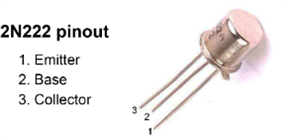
    Hi Karen, I have been experimenting with the circuit and I found that the 2N2222 will allow the battery to be drained down to about 0.6 Volts. If on the other hand you use a Germanium NPN transistor the…
  • makerkaren
    makerkaren over 7 years ago in reply to DAB

    That's really interesting. When soldering on protoboard, I hadn't heard of wrapping the leads together.  It makes plenty of sense to me if the leads are loose, but on a board I believed that soldering to the pads was reliable enough. Granted, I am making fairly simple circuits, but I have taken a lot of my soldering cues from Ben.

    • Cancel
    • Vote Up +1 Vote Down
    • Sign in to reply
    • More
    • Cancel
  • DAB
    DAB over 7 years ago in reply to jw0752

    Hi John,


    From my training, a proper connection would have you wrap the lead of one component around the lead of the other and pinch it together before you solder.

    That way you have wire on wire contact and are not relying on the solder, to support the electrical connection.


    DAB

    • Cancel
    • Vote Up +1 Vote Down
    • Sign in to reply
    • More
    • Cancel
  • jw0752
    jw0752 over 7 years ago in reply to DAB

    Hi DAB,


    Here is a situation similar to Karen's where I am soldering and connecting a resistor to a transistor on a piece of protoboard. I am open to learning from you how you would improve this technique.


    I apologize for the photos but closeups like these are at the limit of my camera and the protoboard is difficult to contrast against.


    image


    The long leads are those of a resistor and I have marked one of the lead positions with a black mark. It is my intention to connect this resistor with the lead of a transistor also marked in black. The pads are 1/10 inch spacing. In connecting the resistor to the transistor I also want to create a rail onto which other components can be connected. I begin by creating a solder joint on the transistor lead's pad.


    image


    I have also trimmed the resistor lead so that it ends right at the transistor pad. Next I tin the end of the resistor lead and hold it down as I solder it to the transistor lead pad. I have bent the lead in such a way that it does not run down the middle of the holes in the pads between the resistor and the transistor. I then solder the pad where the resistor comes through the board.


    image


    As you can see the holes are not blocked between the resistor and the transistor. Other components can then be inserted and soldered to the bent resistor lead.


    From my experience any mechanical wrapping or attaching of the leads takes up too much space and makes the possibility of shorting between pads much more likely.


    Let me know what you think.


    John

    • Cancel
    • Vote Up +4 Vote Down
    • Sign in to reply
    • More
    • Cancel
  • DAB
    DAB over 7 years ago in reply to jw0752

    Hi John,


    I have chased cold solder joints enough to know that a good solid connect is the best.

    Yes, the low lead solder gives you a better connection, but it is still better if you take the time to make good connections.


    If you rely only on the solder, you can find interesting effects invading your circuit.

    Granted it may make no difference in simple circuit, but you just never know, so play it safe.


    DAB

    • Cancel
    • Vote Up +1 Vote Down
    • Sign in to reply
    • More
    • Cancel
  • jw0752
    jw0752 over 7 years ago in reply to DAB

    Hi DAB,


    When you and I were learning the mantra was make a good mechanical connection before you solder. I have personally disowned that over the years as every time I have doe it I have regretted it when I had to modify or fix the junction in question. If making a good mechanical connection were to be a measure I would win the prize for the worst solder technique. Based on what I could see of the finished product in the fast frame sections of Karen's presentation I think everything looked good.


    John

    • Cancel
    • Vote Up 0 Vote Down
    • Sign in to reply
    • More
    • Cancel
  • DAB
    DAB over 7 years ago in reply to makerkaren

    Hi Karen,


    It looked like you just used a solder bridge on several of your board connections.

    I noticed some of the lead wires just kind of floating until you tacked them down with solder.

    I know this technique is similar to SMD attachment, but I prefer to see good solid wire twisting to make sure the wires themselves are touching.


    DAB

    • Cancel
    • Vote Up 0 Vote Down
    • Sign in to reply
    • More
    • Cancel
  • makerkaren
    makerkaren over 7 years ago in reply to DAB

    Hi DAB,


    I'm not sure which part you're talking about me using solder to make connects. Could you clarify? I keep a tiny bin of lead cutoffs for making jumpers when soldering, though I know I do sometimes take shortcuts if the connections are pretty close. Though I don't remember having to jump anything in this project.


    And yes, I love heat shrink, though I'm often a cheap skate and save it for no good reason. I actually used some on the project video we just shot for components that will be plugged and unplugged from the board. It's nice stuff, but when I don't have any on hand, tape does work in a pinch.


    Karen

    • Cancel
    • Vote Up 0 Vote Down
    • Sign in to reply
    • More
    • Cancel
  • jw0752
    jw0752 over 7 years ago

    Hi Karen,


    Most switch mode power supplies have a common mode inductor on their power inputs to minimize EMI. I mention this as they are a good source for the toroidal transformers that you recommend for this project. Here is an example that I had in the bin:


    imageimage


    This particular unit has about 26 winds as opposed to the 20 you recommended but for this application the difference is irrelevant. For the fun of it I built your circuit using the common mode inductor and this is what I got.


    image


    In this case the battery is at 0.7 volts and it is powering the Yellow LED which has a 2.1 volt energy gap. The circuit is drawing 10 MA from the battery. I used an NPN power transistor that I salvaged from a CFL light bulb circuit. When one uses a common mode inductor like this one you have to mind the polarity of the leads just as you marked your leads when you wound the transformer that you used. In this case the correct phase connections are across the toroid from one another.


    This was a fun way to introduce some important electronics basics. Thanks for your presentation.


    John

    • Cancel
    • Vote Up +6 Vote Down
    • Sign in to reply
    • More
    • Cancel
  • jw0752
    jw0752 over 7 years ago

    Hi Karen,


    Nice project and reenforcement of what you taught in the inductor episode.


    John

    • Cancel
    • Vote Up +1 Vote Down
    • Sign in to reply
    • More
    • Cancel
  • DAB
    DAB over 7 years ago

    Good episode.


    I did cringe a bit when you used solder to make your connects. Try using the component leads as soldering posts so you make good wire on wire connection. You will get better results.

    Next you need to learn how to use heat shrink tubing to cover the wires. It will work better than tape.


    Other than that, great job.


    DAB

    • Cancel
    • Vote Up +1 Vote Down
    • Sign in to reply
    • More
    • Cancel
<
element14 Community

element14 is the first online community specifically for engineers. Connect with your peers and get expert answers to your questions.

  • Members
  • Learn
  • Technologies
  • Challenges & Projects
  • Products
  • Store
  • About Us
  • Feedback & Support
  • FAQs
  • Terms of Use
  • Privacy Policy
  • Legal and Copyright Notices
  • Sitemap
  • Cookies

An Avnet Company © 2026 Premier Farnell Limited. All Rights Reserved.

Premier Farnell Ltd, registered in England and Wales (no 00876412), registered office: Farnell House, Forge Lane, Leeds LS12 2NE.

ICP 备案号 10220084.

Follow element14

  • X
  • Facebook
  • linkedin
  • YouTube