


This is my first roadtest, I am too excited and looking forward to give my best.
It wouldn't be possible without element 14, Analog Devices, Tektronix, Electrolube and Leeds Becket University, so I would like to give heartly thanks to them....
Now, Directly jumping towards the idea. There are several modules in my proposed prototype, I will be discussing each one by one. Firstly we will look at Helmet design....
The head is a very sensitive part of the body, so it needs some special attention. Head collision and heavy impact on head is very common in sports like football. Many times this impact leads to minor injuries in head and players don't have information regarding it. So, I have integrated a impact sensor in the helmet to detect the same.
Impact sensor will be placed in the back of helmet. If the acceleration exceeds a predetermined level for more than a certain amount of time. It pushes an alert to coaches application via wireless network that the player should be removed from play for a sideline evaluation. On the sideline the player can complete a brief in-app evaluation accompanied by a checklist of symptoms to look for. If even one symptom is present, the athlete should not return to activity until they've been evaluated by a trained medical professional.
Impact sensor will be based on high g accelerometer like ADXL375Z, ADXL377. These acclerometers are very low power and very very small form factor. So, they can be embedded in helmet will 3.3V coil cell which can drive the sensor for months. ADXL375Z sensor will be interfaced via I2C bus to the ADuCM350. SPI buses of ADuCM350 are reserved for nrf24l01 and nrf8001 wireless module. The digital output data is formatted as 16 bit, two's complement data. The best part is that it has an integrated memory management system with a 32 level first in, first out (FIFO) buffer to store data which will minimize the ADuCM350 activity so that chip can efficiently process the data received from other modules and ultimately it will lower overall system power consumption. Low power modes in it enables intelligent motion based power management with threshold sensing and active acceleration measurement at extremely low power dissipation. So, ADXL375Z will suiting my application in all forms.
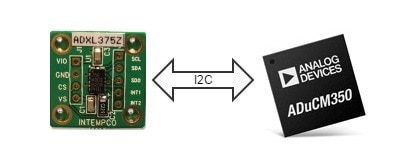
Figure 1: Impact Sensor
As we discussed just now that football players regularly exposed to violent impacts. So,mild traumatic brain injuries are one of the most common injuries experienced by football players. These concussions are often overlooked by football players themselves. The cumulative effect of these mild traumatic brain injuries can cause long-term residual brain dysfunctions. So, my though is that as impact sensor on the head gets the impact, EEG module should be triggered and should analyze whether player have a minor head injury or not.The EEG signals are classified to diagnose concussion or any abnormality of brain function.
Data collection in most EEG studies requires skin preparation and conductive gel application to ensure excellent electrical conductivity between a sensor and human skin. These procedures are time consuming, uncomfortable, and even painful for participants.
In my case for data acquisition, the EEG system, as shown in Fig.2, consists of dry electrodes, bandpass filter built around AD8232 instrumentation amplifier data acquisition module using AD1298 and processing of data is done using on board ADuCM350, nrf8001 and coin cell battery. The device is designed for quickly and conveniently recording an EEG signal of the occipital region which provides the necessary information.
As shown in Fig.3 a new dry-contact EEG device with spring-loaded sensors will be used as electrodes. They will be capable of retrieving the signals in the presence or absence of hair and without any skin contact.I will be designing a flexible substract using 15 -17 such spring contact probes,which will give the conformity between the sensor and the irregular scalp surface which is necessary to maintain low skin-sensor interface impedance. This sensor is more convenient than conventional wet electrodes in measuring EEG signals without any skin preparation or conductive gel usage.
The voltage between the electrode and the reference will be amplified using a bio-signal amplifier AD1298 (ADC with analog front end) with high input impedance. Meanwhile, the common-mode noise will be rejected to precisely detect microvolt-level brain wave signals from the scalp. The amplified signal will be digitized via an ADC AD1298 with a 24 bitresolution and 256 Hz sampling rate. The minimum input voltage of ADC ranges from to 1.94 mV. The maximum input voltage of ADC ranges from to 23.30 mV.
In the ADuCM350 unit, the power-line interface will be removed using a moving average filter with a frequency of 50 Hz.
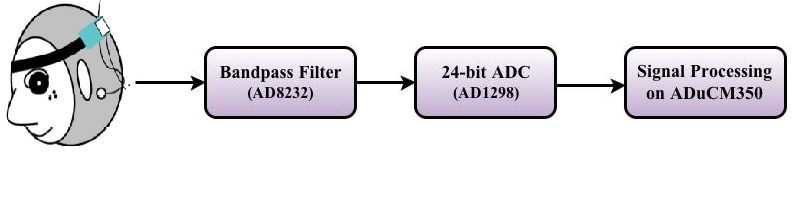
Figure 2. Block Diagram proposed EEG module for helmet
Physiological features will extracted by transforming the EEG signals of all trials, into a frequency domain using DFT to characterize the spectral dynamics of brain activities. But I think ADuCM350 will not be capable to convert time domain signal into frequency domain with required accuracy. So, all the algorithms used to detect minor traumatic disorder will done at the Receiver side itself i.e mobile application....
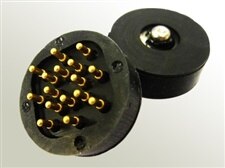
Figure 3: Spring Loaded sensor as EEG electrodes
Looking forward towards the arrival for the kit and other parts...
Top Comments