element14 Community
element14 Community
    Register Log In
  • Site
  • Search
  • Log In Register
  • Community Hub
    Community Hub
    • What's New on element14
    • Feedback and Support
    • Benefits of Membership
    • Personal Blogs
    • Members Area
    • Achievement Levels
  • Learn
    Learn
    • Ask an Expert
    • eBooks
    • element14 presents
    • Learning Center
    • Tech Spotlight
    • STEM Academy
    • Webinars, Training and Events
    • Learning Groups
  • Technologies
    Technologies
    • 3D Printing
    • FPGA
    • Industrial Automation
    • Internet of Things
    • Power & Energy
    • Sensors
    • Technology Groups
  • Challenges & Projects
    Challenges & Projects
    • Design Challenges
    • element14 presents Projects
    • Project14
    • Arduino Projects
    • Raspberry Pi Projects
    • Project Groups
  • Products
    Products
    • Arduino
    • Avnet & Tria Boards Community
    • Dev Tools
    • Manufacturers
    • Multicomp Pro
    • Product Groups
    • Raspberry Pi
    • RoadTests & Reviews
  • About Us
  • Store
    Store
    • Visit Your Store
    • Choose another store...
      • Europe
      •  Austria (German)
      •  Belgium (Dutch, French)
      •  Bulgaria (Bulgarian)
      •  Czech Republic (Czech)
      •  Denmark (Danish)
      •  Estonia (Estonian)
      •  Finland (Finnish)
      •  France (French)
      •  Germany (German)
      •  Hungary (Hungarian)
      •  Ireland
      •  Israel
      •  Italy (Italian)
      •  Latvia (Latvian)
      •  
      •  Lithuania (Lithuanian)
      •  Netherlands (Dutch)
      •  Norway (Norwegian)
      •  Poland (Polish)
      •  Portugal (Portuguese)
      •  Romania (Romanian)
      •  Russia (Russian)
      •  Slovakia (Slovak)
      •  Slovenia (Slovenian)
      •  Spain (Spanish)
      •  Sweden (Swedish)
      •  Switzerland(German, French)
      •  Turkey (Turkish)
      •  United Kingdom
      • Asia Pacific
      •  Australia
      •  China
      •  Hong Kong
      •  India
      • Japan
      •  Korea (Korean)
      •  Malaysia
      •  New Zealand
      •  Philippines
      •  Singapore
      •  Taiwan
      •  Thailand (Thai)
      • Vietnam
      • Americas
      •  Brazil (Portuguese)
      •  Canada
      •  Mexico (Spanish)
      •  United States
      Can't find the country/region you're looking for? Visit our export site or find a local distributor.
  • Translate
  • Profile
  • Settings
Publications
  • Learn
  • More
Publications
Blog Intel launches 14 new Ivy Bridge processors with 3D Tri-Gate transistors
  • Blog
  • Documents
  • Events
  • Files
  • Members
  • Mentions
  • Sub-Groups
  • Tags
  • More
  • Cancel
  • New
Join Publications to participate - click to join for free!
  • Share
  • More
  • Cancel
Group Actions
  • Group RSS
  • More
  • Cancel
Engagement
  • Author Author: Catwell
  • Date Created: 12 Jun 2012 5:47 PM Date Created
  • Views 457 views
  • Likes 1 like
  • Comments 1 comment
  • research
  • industry
  • hmi
  • on_campus
  • embedded
  • Design
  • cabeatwell
  • prototyping
  • 3d_transistor
  • innovation
  • ivy_bridge
  • communication
Related
Recommended

Intel launches 14 new Ivy Bridge processors with 3D Tri-Gate transistors

Catwell
Catwell
12 Jun 2012

image

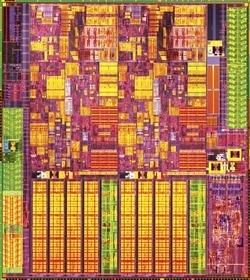
Ivy Bridge in the raw (via Intel)


Intel has recently released their new batch of Ivy Bridge processors using their new 22nm process for ultrabooks, mobile devices and desktops. These include the core i5 and i7 CPU line with the i3, Pentium and Celeron lines coming later this year (2012). All of the chips feature lower power-usage, which translates to longer battery life for the ultrabook/mobile device platforms which include the i5-3317U (clocked at 1.7GHz @ 17w), i5-3427U (clocked at 1.8GHz @ 17w), i7-3717U (clocked at 1.9GHz @17w) and i7-3667U (clocked at 2GHz @17w) for ultrabook OEM makers. Intel released four more processors that consume slightly more wattage with a greater frequency for the mobile market with the i5-3210M (clocked at 2.5GHz @ 35w), i5-3320M (clocked at 2.6GHz @ 35w), i5-3360M (clocked at 2.8GHz @ 35w) and i7-3520M (clocked at 2.9GHz @ 35w) respectively. Finally, rounding out the newly released processors are Intel’s new ‘affordable’ Ivy Bridge QC/DC CPU’s (featuring 5 quad-cores and 1 dual-core) for low-end desktops, which include i5-3470T dual-core (2.9GHz @ 35w), quad-core i5-3470S (clocked at 2.9GHz @ 65w), quad-core i5-3470 (clocked at 3.2GHz @ 77w), quad-core i5-3475S (clocked at 2.9GHz @ 65w), quad-core i5-3570S (clocked at 3.1GHz @ 65w) and the quad-core i5-3570 (clocked at 3.4GHz @ 77w). All of the newly released processors feature Intel’s new 22nm die process that use ‘Tri-Gate’ 3D transistors for processing power over the current standard planar 2D implementation.
 

image

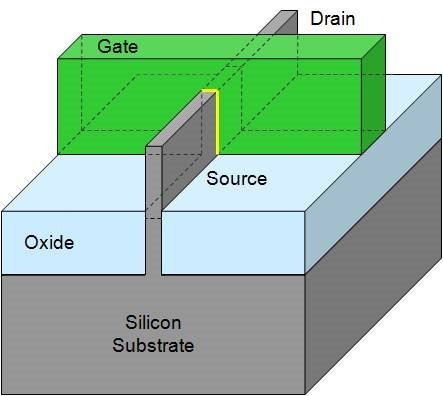
Ivy Bridge transistor concept (via Intel)


So, what exactly are Intel’s Tri-Gate 3D transistors? Simply put; they differ from traditional planar 2D transistors by housing a single horizontal gate that’s stacked onto two vertical gates (three or more silicon fins) which allow for a greater surface area for electrons to travel. According to Intel the 3D transistor allows for better control of the gate which when in the ‘off’ state is as close to zero as possible with wider current flow (more power) in the ‘on’ state. The 3D design allows for faster switching between the two states (over 100 billion times a second). This enables the new Ivy Bridge processors to be 37% faster with a reduction of up to 50% power usage over last generation Sandy Bridge processors. To demonstrate exactly how fast these new process can go, overclocker HiCookie took his Ivy Bridge Core i7-3770K processor and overclocked it to an astounding 7.03GHz using liquid nitrogen for cooling on a Gigabyte Z77X-UD3H motherboard. This was recorded as a world's record for Ivy Bridge processors but was later defeated by Andre Yang who used the same CPU but on an ASUS MAXIMUS V Gene motherboard to achieve a top speed of 7.07GHz!


See more about the Ivy Bridge processor after this link.


Cabe

http://twitter.com/Cabe_e14

  • Sign in to reply
  • DAB
    DAB over 13 years ago

    I'm impressed.  My first computer ran at about 1 MHz using old magnetic core memory.

    With 7 GHz, I see some very interesting developments coming to a product near you.


    You got to love the pace of technology.


    DAB

    • Cancel
    • Vote Up 0 Vote Down
    • Sign in to reply
    • More
    • Cancel
element14 Community

element14 is the first online community specifically for engineers. Connect with your peers and get expert answers to your questions.

  • Members
  • Learn
  • Technologies
  • Challenges & Projects
  • Products
  • Store
  • About Us
  • Feedback & Support
  • FAQs
  • Terms of Use
  • Privacy Policy
  • Legal and Copyright Notices
  • Sitemap
  • Cookies

An Avnet Company © 2025 Premier Farnell Limited. All Rights Reserved.

Premier Farnell Ltd, registered in England and Wales (no 00876412), registered office: Farnell House, Forge Lane, Leeds LS12 2NE.

ICP 备案号 10220084.

Follow element14

  • X
  • Facebook
  • linkedin
  • YouTube