


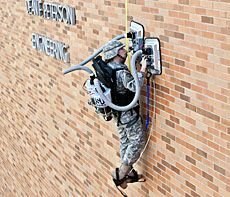
Students from various Universities’ around the nation (US) are invited by the US Air Force to design a way for soldiers to climb tall obstacles without the use of grappling hooks. The teams designed some pretty compelling contraptions, some of which involved the use of robots to secure a rope at the top of a 90ft wall for soldiers to ascend. However, one team in particular chose a different route all together by equipping vacuum technology to the soldiers themselves to secure a line at the top of the obstacle.
Students from Utah State University, called the ‘Ascending Aggies’, designed what they call the Personal Vacuum Assisted Climber (PVAC) for their entry in the Air Force Research Laboratory’s Design Challenge. Looking like a G.I. Joe action figure accessory, the device enables the wearer to use vacuum assisted suction cups that can adhere to Stucco, glass and rock to help them climb obstacles. The system consists of three principal components which include the vacuum-ascender, a rope-ascender or winch and an adhesive anchor. The PVAC uses two high-powered vacuum motors (make and model unknown) that generate 4.5lbs of force which is able to accommodate loads from 500 to 700lbs.
The vacuum’s hoses connect to two large suction pads that connect with rubberized gaskets, which are able to conform to just about any surface in most conditions. The pads are fitted with cables that connect to a pair of foot braces that help the wearer climb more easily almost like climbing a ladder. After the user reaches the top of the obstacle, they then use a super-adhesive to secure an anchor and rope that’s capable of holding 300lbs securely. Both vacuums are powered by batteries (unknown as to what type) housed in ice-cream buckets situated on top of each vacuum respectively.
The design took first place in the Air Force’s competition taking a $100,000 US award to streamline the PVAC system for future testing. After watching the video, it’s apparent that the PVAC system is not entirely tactical as it generates an enormous amount of sound which would tip-off people quite some distance away, so they will have to incorporate some kind of silencing system or muffler. Even with the sound problem the system still works and I would love to try it out.
Cabe
Update: It appears that the Aggies were not the first to create this device, but took the award anyway:
From earlier this year:
From a year ago:


