element14 Community
element14 Community
    Register Log In
  • Site
  • Search
  • Log In Register
  • Community Hub
    Community Hub
    • What's New on element14
    • Feedback and Support
    • Benefits of Membership
    • Personal Blogs
    • Members Area
    • Achievement Levels
  • Learn
    Learn
    • Ask an Expert
    • eBooks
    • element14 presents
    • Learning Center
    • Tech Spotlight
    • STEM Academy
    • Webinars, Training and Events
    • Learning Groups
  • Technologies
    Technologies
    • 3D Printing
    • FPGA
    • Industrial Automation
    • Internet of Things
    • Power & Energy
    • Sensors
    • Technology Groups
  • Challenges & Projects
    Challenges & Projects
    • Design Challenges
    • element14 presents Projects
    • Project14
    • Arduino Projects
    • Raspberry Pi Projects
    • Project Groups
  • Products and Partners
    Products and Partners
    • Arduino
    • Avnet & Tria Boards Community
    • Dev Tools
    • Manufacturers
    • Multicomp Pro
    • Product Groups
    • Raspberry Pi
    • RoadTests & Reviews
  • About Us
    About the element14 Community
  • Store
    Store
    • Visit Your Store
    • Choose another store...
      • Europe
      •  Austria (German)
      •  Belgium (Dutch, French)
      •  Bulgaria (Bulgarian)
      •  Czech Republic (Czech)
      •  Denmark (Danish)
      •  Estonia (Estonian)
      •  Finland (Finnish)
      •  France (French)
      •  Germany (German)
      •  Hungary (Hungarian)
      •  Ireland
      •  Israel
      •  Italy (Italian)
      •  Latvia (Latvian)
      •  
      •  Lithuania (Lithuanian)
      •  Netherlands (Dutch)
      •  Norway (Norwegian)
      •  Poland (Polish)
      •  Portugal (Portuguese)
      •  Romania (Romanian)
      •  Russia (Russian)
      •  Slovakia (Slovak)
      •  Slovenia (Slovenian)
      •  Spain (Spanish)
      •  Sweden (Swedish)
      •  Switzerland(German, French)
      •  Turkey (Turkish)
      •  United Kingdom
      • Asia Pacific
      •  Australia
      •  China
      •  Hong Kong
      •  India
      •  Japan
      •  Korea (Korean)
      •  Malaysia
      •  New Zealand
      •  Philippines
      •  Singapore
      •  Taiwan
      •  Thailand (Thai)
      •  Vietnam
      • Americas
      •  Brazil (Portuguese)
      •  Canada
      •  Mexico (Spanish)
      •  United States
      Can't find the country/region you're looking for? Visit our export site or find a local distributor.
  • Translate
  • Profile
  • Settings
Community Hub
Community Hub
Member's Forum How do you manage "on stock" component on your personal lab?
  • Blog
  • Forum
  • Documents
  • Quiz
  • Events
  • Leaderboard
  • Polls
  • Files
  • Members
  • Mentions
  • Sub-Groups
  • Tags
  • More
  • Cancel
  • New
Join Community Hub to participate - click to join for free!
Actions
  • Share
  • More
  • Cancel
Forum Thread Details
  • Replies 26 replies
  • Subscribers 630 subscribers
  • Views 5251 views
  • Users 0 members are here
Related

How do you manage "on stock" component on your personal lab?

strb
strb over 3 years ago

I was just wondering, how do you keep track of components on a personal lab?

I started by simply not doing it but pretty quickly found myself searching among an increasing amount of small component bags in search of the most close resistor value or the best op. amp. I have on hand for the job. For general passive components (resistor and capacitor) I've bought a couple of cheap kits but I suppose they were too cheap because values are scattered without an apparent logic (some E12 component, some E24 value, missing E12 values etc...).

I then started tracking available components in a simple Excel table and that for me was a big step forward: I could search any available component at "design stage" without needing to bring out the component box. A couple hours of inventory once saves me from needing to search among bags of component each time I'm designing something or drawing a scheme.

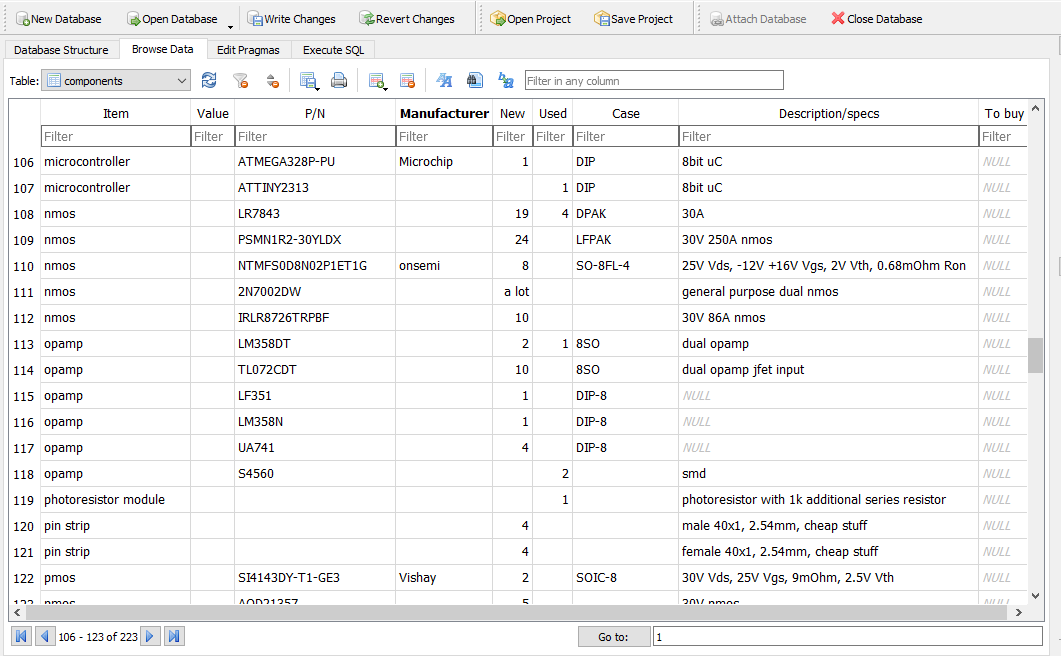
Less than a month ago I switched from Excel to "DB Browser for SQLite". I'm still learning it and using at most basic level but I'm quite pleased with the result even at this early stage.
image

This is my experience so far and I'm not regretting doing it. What's your experience on this matter? Do you have any hints?

  • Sign in to reply
  • Cancel
  • baldengineer
    baldengineer over 3 years ago in reply to strb

    FYI. Most distributors will save your cart if you are logged in. So anytime I realize I am low on parts, I either highlight the row in my spreadsheet or add them to a cart right away. (I really like when they let you name the carts!)

    When I remember, I also use the disty's "custom part number" feature to remind myself it is a "STOCK" part. That way, when it shows up randomly on my next order, I have a reminder of why I bought it.

    • Cancel
    • Vote Up +1 Vote Down
    • Sign in to reply
    • Cancel
  • dougw
    dougw over 3 years ago in reply to shabaz

    Your (a) method is basically a type of kanban system (from JIT manufacturing). Kanban maintains adequate stock with minimal administrative overhead. I use a modified version of kanban for generic parts - mainly overlaying a more complex decision matrix of when to restock. I don't automatically restock when a low stock level is detected, I decide if I will order immediately or wait until I have a need, based on cost, price breaks and probabilities. 

    Your (b) method (database) devolves into a bunch of expedient techniques where some documentation is utilized with built-in search methods, some physical hierarchical organization of bins allows visual physical searches and some pure physical search methods of physical bins. I guess I use all of that for various aspects of my stock to try to minimize the administrative overhead.

    • Cancel
    • Vote Up +2 Vote Down
    • Sign in to reply
    • Cancel
  • strb
    strb over 3 years ago in reply to shabaz
    shabaz said:
    For a home lab, resistor kit books, capacitor kits and so on are great

    I don't have any of those, but I think I will buy some in the near future because as you said they are great. Key point is to be sure to always have enough components and to "refill" when runnning low.

    • Cancel
    • Vote Up 0 Vote Down
    • Sign in to reply
    • Cancel
  • baldengineer
    baldengineer over 3 years ago in reply to strb

    I had to think back to when I created this spreadsheet. Originally, I started the spreadsheet as a way to organize what I had. I intended to then create a SQLlite database and import the data.

    One of the issues I was concerned about is how different part types have different key characteristics. So, I decided to do separate tabs to understand how I would build the database's schema.

    After doing that initial inventory step, I realized the spreadsheet was all I actually wanted. Plus, I didn't have to build any UI since all of the data sorting/analysis tools were already there.

    Like many projects, I had all kinda of crazy ideas for how to extend the functionality. And I suppose in the future, I could still move to a small database.

    But after committing to this idea for a year, I'd rather solder stuff instead.

    • Cancel
    • Vote Up +1 Vote Down
    • Sign in to reply
    • Cancel
  • Andrew J
    Andrew J over 3 years ago in reply to dougw

    It’s not a massive commitment recording mechanism is simple and their location is also recorded.  When I have a project, I do check what I have in-stock and everything else is ordered.  Stuff goes in a project box and once the project is deemed completed, whatever left is then recorded.  I don’t bother recording stuff that gets consumed immediately; I do record, for example, how much heat shrink I used, or wire, connectors etc because these tend to get bought in bulk.  It isn’t a big overhead to keep it up to date, the tedious bit was actually recording my on-hand stuff in the first place.  I suspect it’s that first setup that puts most people off.

    There is an online application called PartsBox that looks pretty useful.

    • Cancel
    • Vote Up +2 Vote Down
    • Sign in to reply
    • Cancel
  • shabaz
    shabaz over 3 years ago in reply to shabaz

    Oh, and I treat some generic discrete semiconductors in category (a) too. I've got plastic trays (conductive ones) with little pots, each one can fit quite a lot of (say) SOT-23 parts, which are my favorite size for them. 

    • Cancel
    • Vote Up 0 Vote Down
    • Sign in to reply
    • Cancel
  • strb
    strb over 3 years ago in reply to baldengineer

    I think that in the end I'm doing something similar to your spreadsheet: I find myself mainly using filters too and nothing more. I actually like the additional column with the location of the component and the "sort and label" functionality with numeric value and "human readable" value.

    • Cancel
    • Vote Up 0 Vote Down
    • Sign in to reply
    • Cancel
  • Andrew J
    Andrew J over 3 years ago in reply to dougw

    I have them in labelled containers and identified shelves which is recorded against the inventory.

    • Cancel
    • Vote Up +1 Vote Down
    • Sign in to reply
    • Cancel
  • shabaz
    shabaz over 3 years ago

    Hi!
    In a design lab where I worked, there were about four main ways to get parts into your hands to build projects! And two important ways were:

    (a) Generic parts like connectors, resistors, capacitors, etc., were not tracked, there were just boxes of them, so you could take as many as you like. For a home lab, resistor kit books, capacitor kits and so on are great. I get through loads of pin headers and sockets, so I don't track those either, and have a little plastic container full of pin headers, and a little component drawer full of those too, so I always have them available one way or another. I think I've got every E24 value of resistor, in 0805, and a smaller range in 0603 and wire-ended, and they are not tracked, I just make sure I have many of those since they are low-cost. I've got a few resistor books and capacitor kits, and quite a lot of Coilcraft kits (I like those for RF projects), one or two Wurth kits, and don't track the parts in those.

    (b) Semiconductors and all non-generic parts in a warehouse/store, and there was a database to use to check out parts. I've got an Excel spreadsheet that is now inaccurate, but since I usually order from Farnell, I just use e-mail search to see if I have ever ordered the part, to know if I have it or have had it in the past. I have about four boxes (about the size of shoe-boxes) for semiconductors, one containing analog and data conversion parts(in their original Farnell bags), one containing discrete parts, one containing digital parts, and one containing microcontrollers. I don't organize them any deeper than that, and just tip the relevant box out to search for what I want. Some semiconductors come in trays or long plastic tubes that won't fit in the boxes, so they are in effectively a small wastepaper bin type container with no organization, I'll just search through that.

    • Cancel
    • Vote Up +1 Vote Down
    • Sign in to reply
    • Cancel
  • strb
    strb over 3 years ago in reply to dougw
    dougw said:
    Knowing where they are located is the harder part. Good labels are important

    That's a good point. I don't have this problem at the moment due to limited number of components, but it's definitely something I will keep in mind

    • Cancel
    • Vote Up +1 Vote Down
    • Sign in to reply
    • Cancel
<>
element14 Community

element14 is the first online community specifically for engineers. Connect with your peers and get expert answers to your questions.

  • Members
  • Learn
  • Technologies
  • Challenges & Projects
  • Products
  • Store
  • About Us
  • Feedback & Support
  • FAQs
  • Terms of Use
  • Privacy Policy
  • Legal and Copyright Notices
  • Sitemap
  • Cookies

An Avnet Company © 2026 Premier Farnell Limited. All Rights Reserved.

Premier Farnell Ltd, registered in England and Wales (no 00876412), registered office: Farnell House, Forge Lane, Leeds LS12 2NE.

Follow element14

  • X
  • Facebook
  • linkedin
  • YouTube