element14 Community
element14 Community
    Register Log In
  • Site
  • Search
  • Log In Register
  • Community Hub
    Community Hub
    • What's New on element14
    • Feedback and Support
    • Benefits of Membership
    • Personal Blogs
    • Members Area
    • Achievement Levels
  • Learn
    Learn
    • Ask an Expert
    • eBooks
    • element14 presents
    • Learning Center
    • Tech Spotlight
    • STEM Academy
    • Webinars, Training and Events
    • Learning Groups
  • Technologies
    Technologies
    • 3D Printing
    • FPGA
    • Industrial Automation
    • Internet of Things
    • Power & Energy
    • Sensors
    • Technology Groups
  • Challenges & Projects
    Challenges & Projects
    • Design Challenges
    • element14 presents Projects
    • Project14
    • Arduino Projects
    • Raspberry Pi Projects
    • Project Groups
  • Products
    Products
    • Arduino
    • Avnet & Tria Boards Community
    • Dev Tools
    • Manufacturers
    • Multicomp Pro
    • Product Groups
    • Raspberry Pi
    • RoadTests & Reviews
  • About Us
    About the element14 Community
  • Store
    Store
    • Visit Your Store
    • Choose another store...
      • Europe
      •  Austria (German)
      •  Belgium (Dutch, French)
      •  Bulgaria (Bulgarian)
      •  Czech Republic (Czech)
      •  Denmark (Danish)
      •  Estonia (Estonian)
      •  Finland (Finnish)
      •  France (French)
      •  Germany (German)
      •  Hungary (Hungarian)
      •  Ireland
      •  Israel
      •  Italy (Italian)
      •  Latvia (Latvian)
      •  
      •  Lithuania (Lithuanian)
      •  Netherlands (Dutch)
      •  Norway (Norwegian)
      •  Poland (Polish)
      •  Portugal (Portuguese)
      •  Romania (Romanian)
      •  Russia (Russian)
      •  Slovakia (Slovak)
      •  Slovenia (Slovenian)
      •  Spain (Spanish)
      •  Sweden (Swedish)
      •  Switzerland(German, French)
      •  Turkey (Turkish)
      •  United Kingdom
      • Asia Pacific
      •  Australia
      •  China
      •  Hong Kong
      •  India
      •  Japan
      •  Korea (Korean)
      •  Malaysia
      •  New Zealand
      •  Philippines
      •  Singapore
      •  Taiwan
      •  Thailand (Thai)
      •  Vietnam
      • Americas
      •  Brazil (Portuguese)
      •  Canada
      •  Mexico (Spanish)
      •  United States
      Can't find the country/region you're looking for? Visit our export site or find a local distributor.
  • Translate
  • Profile
  • Settings
Community Hub
Community Hub
Member's Forum Wat is the oldest chip in your parts bin?
  • Blog
  • Forum
  • Documents
  • Quiz
  • Events
  • Leaderboard
  • Polls
  • Files
  • Members
  • Mentions
  • Sub-Groups
  • Tags
  • More
  • Cancel
  • New
Join Community Hub to participate - click to join for free!
Actions
  • Share
  • More
  • Cancel
Forum Thread Details
  • Replies 45 replies
  • Subscribers 627 subscribers
  • Views 6269 views
  • Users 0 members are here
  • MC6800
  • 2708
  • z80
  • old ICs
  • old chips
Related

Wat is the oldest chip in your parts bin?

dougw
dougw over 3 years ago

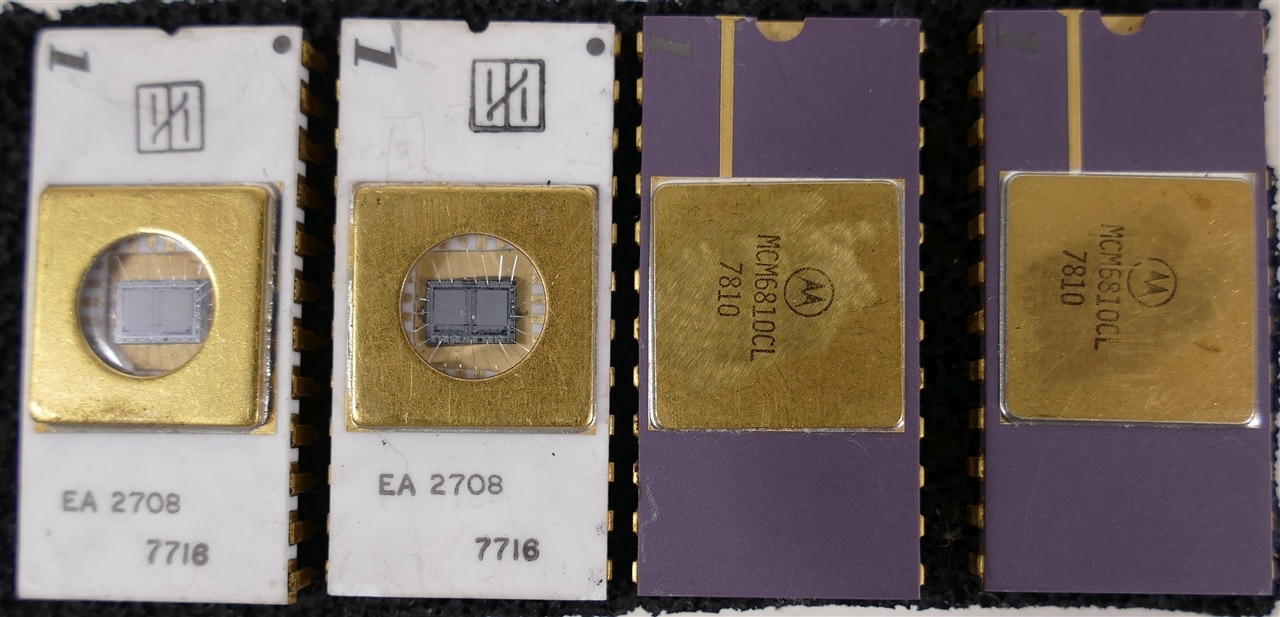
I came across some old and famous chips in one of my parts cabinets. Does anybody else keep old chips? and why?

Note that these were pretty expensive when they were purchased, especially the gold plated ceramic chips.

I expect most of these are part numbers that everyone has heard of.

Have you designed with any of these famous chips?

Brownie points if you can figure out the date codes.
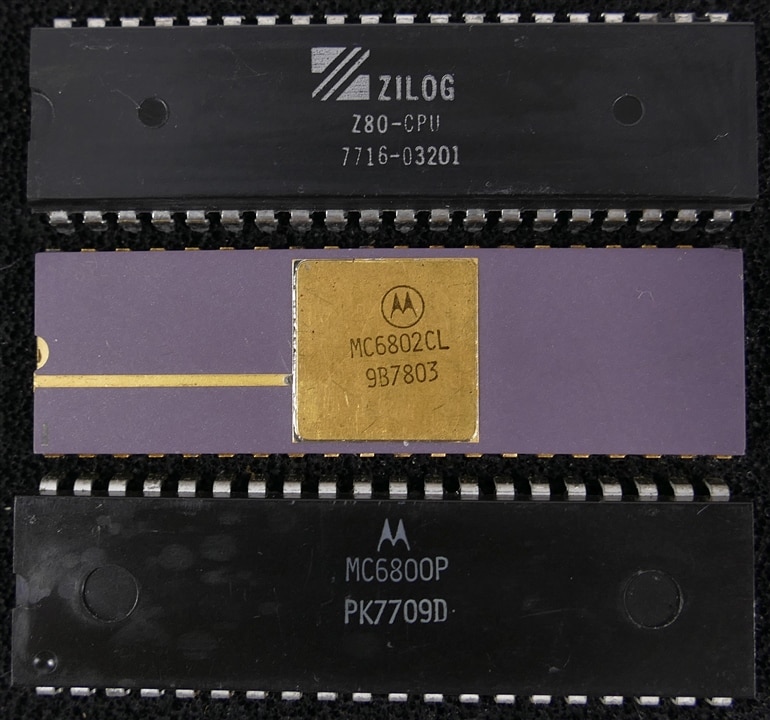
image

image

What chips are buried in your archives?

  • Sign in to reply
  • Cancel
  • dang74
    dang74 over 3 years ago in reply to dougw

    That is just as fine a place as any for it.  Slight smile 

    • Cancel
    • Vote Up +1 Vote Down
    • Sign in to reply
    • Cancel
  • beacon_dave
    beacon_dave over 3 years ago in reply to anniel747

    If you can import the data. I don't think it supports HD6303 assembly ?

    I've had a bit of a look at Ghidra and IDA Pro in the past but I've not found much training material surrounding the older platforms.

    • Cancel
    • Vote Up +1 Vote Down
    • Sign in to reply
    • Cancel
  • dang74
    dang74 over 3 years ago in reply to beacon_dave
    beacon_dave said:
    Also by having lots of near jumps you can reduce the overall code size to fit in the limited memory by reusing code blocks, however once again it makes it a lot harder to follow.

    This has been my observation as well.  Thirty to forty years ago memory size was limited so reuse was the key.  Now us poor suckers that are trying to reverse engineer code from that era are paying the price.

    • Cancel
    • Vote Up +2 Vote Down
    • Sign in to reply
    • Cancel
  • dougw
    dougw over 3 years ago in reply to dang74

    My MC68000 is in my Amiga.....Relaxed

    • Cancel
    • Vote Up +4 Vote Down
    • Sign in to reply
    • Cancel
  • anniel747
    anniel747 over 3 years ago in reply to beacon_dave

    Something like Ghidra would have been useful.

    • Cancel
    • Vote Up +1 Vote Down
    • Sign in to reply
    • Cancel
  • ralphjy
    ralphjy over 3 years ago

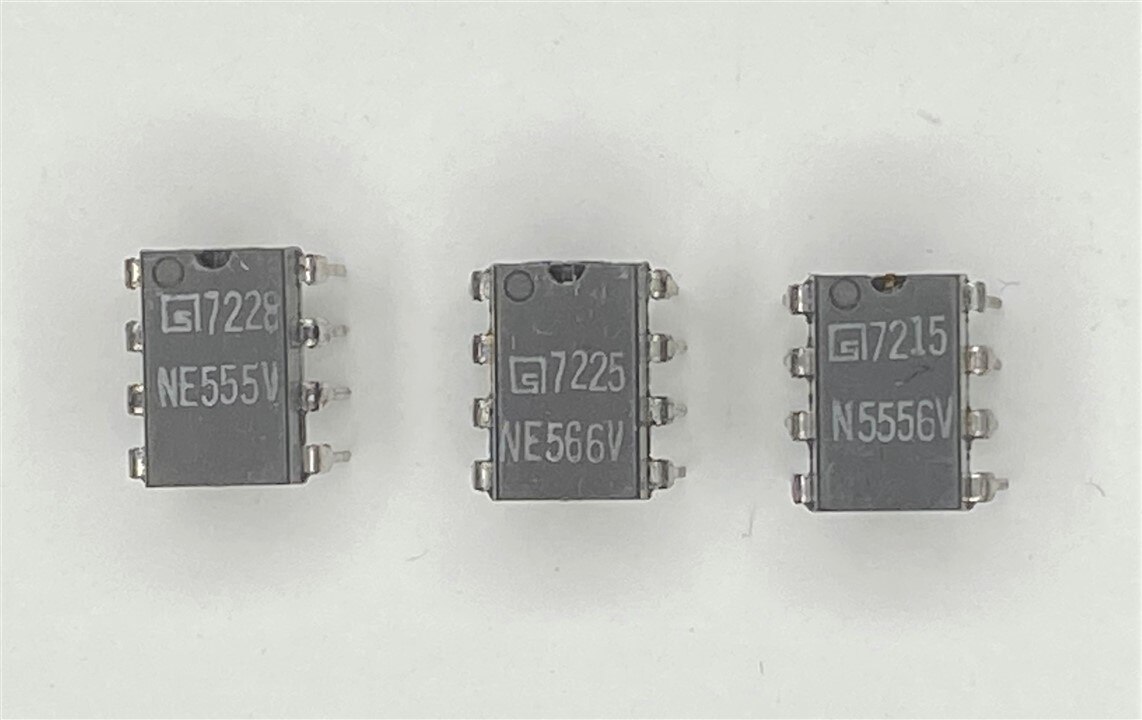
    I used to design with a lot of Signetics parts in the 70's.  I've got one of the early 555 parts.  Shown here with a 566 VCO and 5556 opamp.

    image

    I probably have some of the 56x series PLLs around somewhere.  The 566 is the VCO from one of those parts.

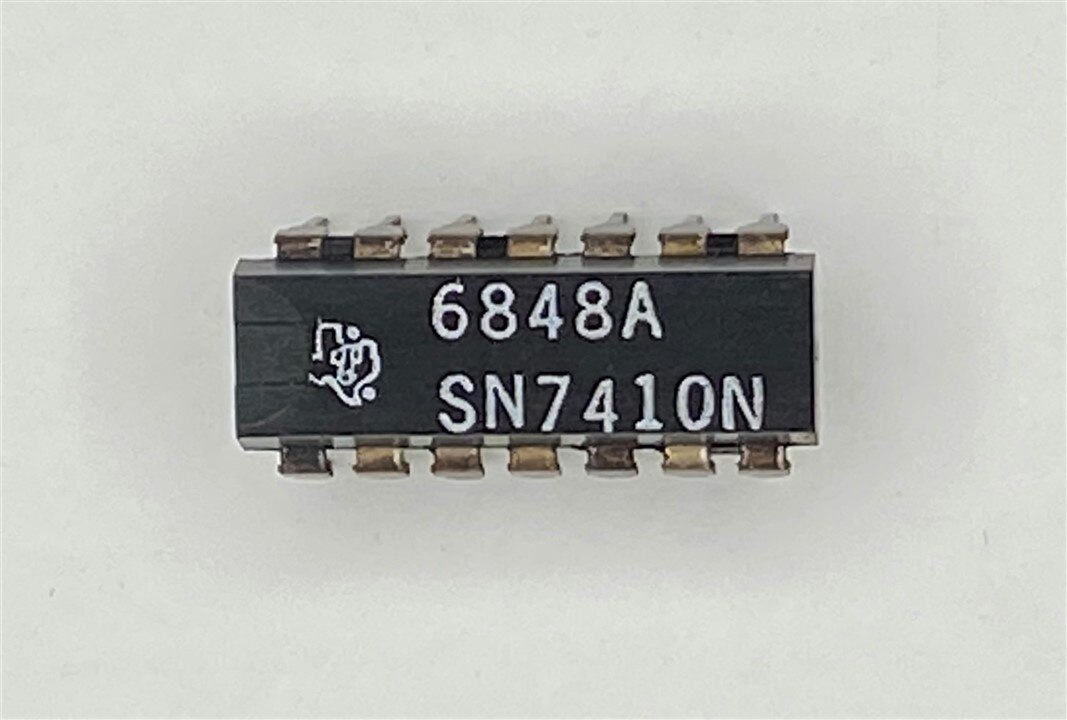
    The earliest part that was easy to find was a 7400 series part from TI.

    image

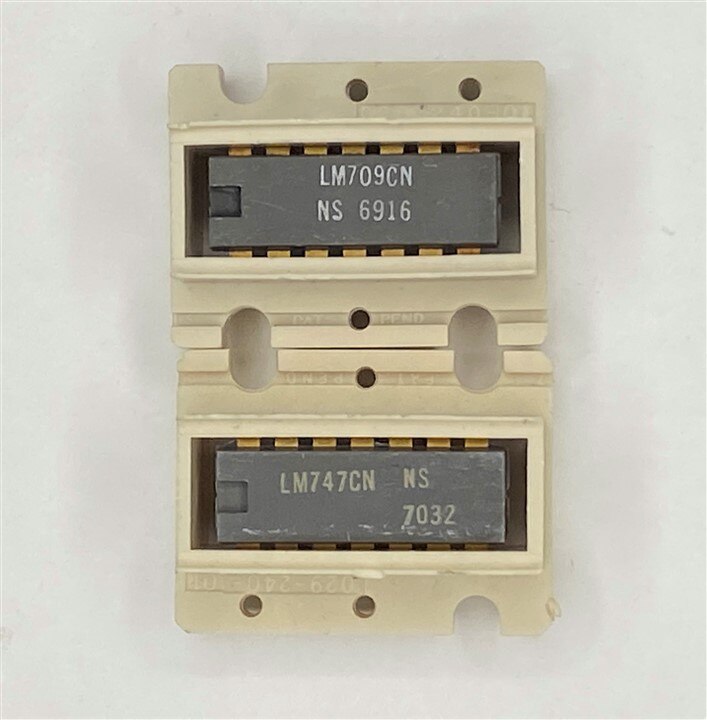
    And, of course I used a lot of opamps.  Here are a couple of National Semi parts (never used spares) - an uncompensated 709 and a dual 747.

    image

    I'm sure I have lots of other old stuff somewhere.  Back in those days I used a lot of MECL from Motorola and analog parts from Fairchild and TI.

    • Cancel
    • Vote Up +8 Vote Down
    • Sign in to reply
    • Cancel
  • dougw
    dougw over 3 years ago in reply to jc2048

    Yes - the ACIA. I also have a bunch of chips in crumbling black anti static foam like what your chip is on.

    • Cancel
    • Vote Up +3 Vote Down
    • Sign in to reply
    • Cancel
  • beacon_dave
    beacon_dave over 3 years ago in reply to dang74

    Actually, I found that was one of the easier parts as Hitachi had a datasheet on the HD6303 so I had the opcode map and the number of operands each opcode expected. I knew where the processor looked for the interrupt vector table in memory so the value stored there at told me the address where the executable code started. From there it is just a case of looking up the opcode and then finding how many operands it expects and away you go. It was a bit tedious as the data sheet was scanned so no quick cut and paste into the program. Add in a few extra routines to calculate addressing offsets to make it more readable. In-line data can be an issue. Also keeping an eye on the interrupt vector table can identify start addresses of other code blocks.  

    If you want effort, then that was months of looking at data captures from a scope trying to figure out patterns in the data. It turned out that the comms was asymmetrically encoded so the few ASCII characters in the config section were initially obfuscated. Then finally once I had identified the encoding method there was a 'Twin Peaks moment' 

    https://www.youtube.com/watch?v=mbi7rq-TSk8&t=78s

    as the hex sequence for the Program ID and data ID strings finally matched one of the data captures and confirmed I was really on the right track.

    If the code was originally generated from an optimising compiler, then it often can often be hard to follow as the optimisation can save program cycles by doing certain procedures in rather non-intuitive ways. Also by having lots of near jumps you can reduce the overall code size to fit in the limited memory by reusing code blocks, however once again it makes it a lot harder to follow.

    It would make life easier I think if I had a way of turning the listing into a graphical diagram with the blocks of code linked by the jumps such that you could slide things around so that the related sections were next to each other. Also a way of labelling and commenting what you had identified so far. I think that's what the call 'data graph' structures in programming lingo ?  I once saw this done manually with string and post-it notes !

    If I was a bit further along the line, then I might have given the LabVIEW challenge a go using it to connect to the ECU (or rather the ECU protocol simulator that I have also written as part of this project). However  I'm not sure what is involved in getting LabVIEW to talk to the ECU protocol and parse the data.

    • Cancel
    • Vote Up +3 Vote Down
    • Sign in to reply
    • Cancel
  • DAB
    DAB over 3 years ago in reply to scottiebabe

    I will search my stash, we might get lucky.

    • Cancel
    • Vote Up +4 Vote Down
    • Sign in to reply
    • Cancel
  • DAB
    DAB over 3 years ago

    I have a lot of IC's from the early 1970's.

    Many have gold coatings, so I hold on to them because they are probably quite valuable by now.

    • Cancel
    • Vote Up +3 Vote Down
    • Sign in to reply
    • Cancel
<>
element14 Community

element14 is the first online community specifically for engineers. Connect with your peers and get expert answers to your questions.

  • Members
  • Learn
  • Technologies
  • Challenges & Projects
  • Products
  • Store
  • About Us
  • Feedback & Support
  • FAQs
  • Terms of Use
  • Privacy Policy
  • Legal and Copyright Notices
  • Sitemap
  • Cookies

An Avnet Company © 2026 Premier Farnell Limited. All Rights Reserved.

Premier Farnell Ltd, registered in England and Wales (no 00876412), registered office: Farnell House, Forge Lane, Leeds LS12 2NE.

Follow element14

  • X
  • Facebook
  • linkedin
  • YouTube