element14 Community
element14 Community
    Register Log In
  • Site
  • Search
  • Log In Register
  • Community Hub
    Community Hub
    • What's New on element14
    • Feedback and Support
    • Benefits of Membership
    • Personal Blogs
    • Members Area
    • Achievement Levels
  • Learn
    Learn
    • Ask an Expert
    • eBooks
    • element14 presents
    • Learning Center
    • Tech Spotlight
    • STEM Academy
    • Webinars, Training and Events
    • Learning Groups
  • Technologies
    Technologies
    • 3D Printing
    • FPGA
    • Industrial Automation
    • Internet of Things
    • Power & Energy
    • Sensors
    • Technology Groups
  • Challenges & Projects
    Challenges & Projects
    • Design Challenges
    • element14 presents Projects
    • Project14
    • Arduino Projects
    • Raspberry Pi Projects
    • Project Groups
  • Products
    Products
    • Arduino
    • Avnet & Tria Boards Community
    • Dev Tools
    • Manufacturers
    • Multicomp Pro
    • Product Groups
    • Raspberry Pi
    • RoadTests & Reviews
  • About Us
  • Store
    Store
    • Visit Your Store
    • Choose another store...
      • Europe
      •  Austria (German)
      •  Belgium (Dutch, French)
      •  Bulgaria (Bulgarian)
      •  Czech Republic (Czech)
      •  Denmark (Danish)
      •  Estonia (Estonian)
      •  Finland (Finnish)
      •  France (French)
      •  Germany (German)
      •  Hungary (Hungarian)
      •  Ireland
      •  Israel
      •  Italy (Italian)
      •  Latvia (Latvian)
      •  
      •  Lithuania (Lithuanian)
      •  Netherlands (Dutch)
      •  Norway (Norwegian)
      •  Poland (Polish)
      •  Portugal (Portuguese)
      •  Romania (Romanian)
      •  Russia (Russian)
      •  Slovakia (Slovak)
      •  Slovenia (Slovenian)
      •  Spain (Spanish)
      •  Sweden (Swedish)
      •  Switzerland(German, French)
      •  Turkey (Turkish)
      •  United Kingdom
      • Asia Pacific
      •  Australia
      •  China
      •  Hong Kong
      •  India
      • Japan
      •  Korea (Korean)
      •  Malaysia
      •  New Zealand
      •  Philippines
      •  Singapore
      •  Taiwan
      •  Thailand (Thai)
      • Vietnam
      • Americas
      •  Brazil (Portuguese)
      •  Canada
      •  Mexico (Spanish)
      •  United States
      Can't find the country/region you're looking for? Visit our export site or find a local distributor.
  • Translate
  • Profile
  • Settings
Personal Blogs
  • Community Hub
  • More
Personal Blogs
NexGen Flight Simuator NexGen: The Lab: Compaq IEEE 1284 Test Box:
  • Blog
  • Documents
  • Mentions
  • Sub-Groups
  • Tags
  • More
  • Cancel
  • New
  • Share
  • More
  • Cancel
Group Actions
  • Group RSS
  • More
  • Cancel
Engagement
  • Author Author: phoenixcomm
  • Date Created: 29 Oct 2023 8:26 PM Date Created
  • Views 1170 views
  • Likes 7 likes
  • Comments 10 comments
  • nexgen
  • debuging
  • the lab
  • IEEE 1248 test box
  • Compaq
  • hacking
Related
Recommended

NexGen: The Lab: Compaq IEEE 1284 Test Box:

phoenixcomm
phoenixcomm
29 Oct 2023

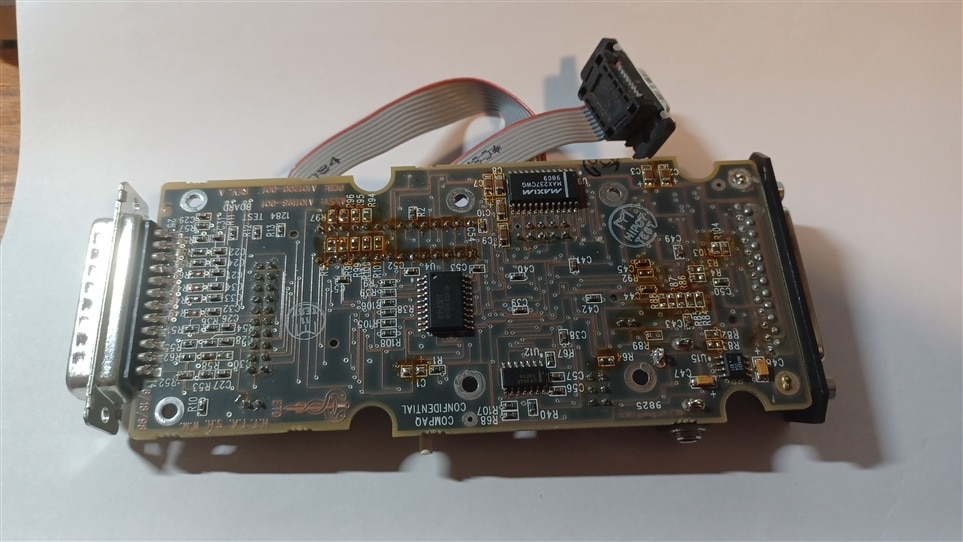
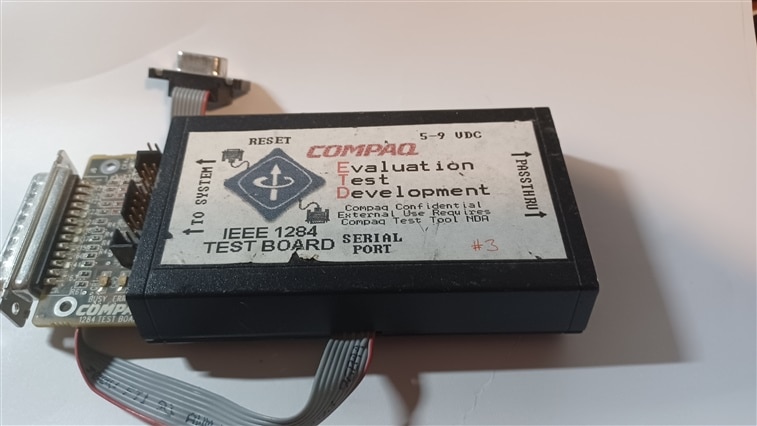
imageOk, So what is this gem, I just uncovered in my junk box, well what the heck is IEEE 1284 well not sure so I looked it up  "IEEE 1284 is a standard that defines bi-directional parallel communications between computers and other devices. It was originally developed in the 1970s by Centronics and was widely known as the Centronics port, both before and after its IEEE standardization. Wikipedia". So as it turns out it's the standard bi-directional printer port. Hmmm, I might be able to use it, so as I could not find much info on the box I decided to just unbox it. What I found was the following.

  • XC68HC912B32 -- 16Bit CPU, memory, lots of I/O
  • AM7205-15RC   -- FIFO, 8KX9
  • M4-128/64          -- CPLD MACH 4 Family 5K Gates 128 Macro Cells
  • MAX237CWG    -- RS-232 Interface
  • SG615PTJC      -- CRYSTAL OSCILLATOR (29.4912Mhz)
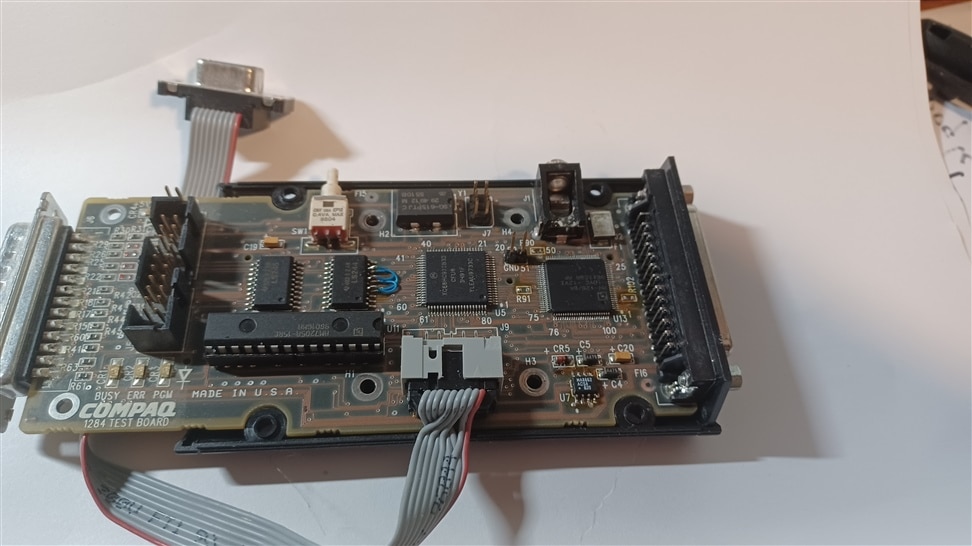
image image

Well as you can see this is straightforward, except for the CPLD. If we assume (this may not be good), that the male header on the top of the device is not there, or to say, since I don't know what it does, hence it does nothing at this point. 

here are the next steps:

  • to find some sort of wall wart about 5-9 or pick in the middle 7vdc 
  • connect a serial monitor on the DB-9F and see if it talks. (alive or dead)

More to come ~~ CAH

  • Sign in to reply
  • shabaz
    shabaz over 2 years ago in reply to phoenixcomm

    Hi Cris,

    I've taken a look and made some changes, and it compiles. I don't know if it does what you wish it to do, but the code structure across all the files is now fine.

    image

    The main changes were to use the #ifndef XYZ_HEADER_FILE in the header files, because that is needed for being able to freely using functions from more than one source file.

    Another key point is that Arduino uses C++ for the .ino file, and if the remainder files have .c suffix then it confuses things (because it's not possible to link C and C++ unless the .C code is labeled with extern "C". So, your options are either to rename all the files as .cpp, or to use that extern in the code. I didn't know which was preferred, so I've placed the extern "C" in your files.

    Now the code successfully builds in the Arduino IDE, and it should build using Eclipse, but I don't have that installed and cannot test that.

    Also, I placed a empty loop() function because then the code can still compile in Arduino (in case others need to troubleshoot it and they don't have Eclipse installed), and should still work with Eclipse, because the empty loop() is benign.

    I've sent you a PM with access to the zip file containing the modifications, but it would be good to share your code with the community if there are more issues, because I don't know Arduino very well, and others will be able to help better.

    • Cancel
    • Vote Up 0 Vote Down
    • Sign in to reply
    • More
    • Cancel
  • phoenixcomm
    phoenixcomm over 2 years ago in reply to shabaz

    no i hung in on my server. 

    I will send you a pm. 

    • Cancel
    • Vote Up 0 Vote Down
    • Sign in to reply
    • More
    • Cancel
  • shabaz
    shabaz over 2 years ago in reply to phoenixcomm

    68000 was awesome too! I tried to make my own PDA-type device with a 68k core, but everything was a struggle back then. Now it's much easier to add functionality like high-res displays and WiFi with Arduino etc. Back then I was having to learn how to interface to a PCMCIA Wi-Fi card, and creating a TFT driver with a CPLD.

    I don't think I ever received your code (or a link to it), was it sent to my e-mail address? (supplied in a PM).

    • Cancel
    • Vote Up 0 Vote Down
    • Sign in to reply
    • More
    • Cancel
  • phoenixcomm
    phoenixcomm over 2 years ago in reply to shabaz

     shabaz Cool beans,  When I was working at Garrett AiReasearch I worked in a small department called "special test" we had standardized on STD-Bus 56 pins and it was all 8-bit, mostly Z-80s. They asked for a proposal for a Next Generation to replace the STD bus. I was at that time in love with the 68000 and that's what i recommended as the migration from 16 bits to full 32 bits was a piece of cake. They went with It and I got a bonus of about a grand. whoopie, unfortunately, the only buss around at that time was the god awful versa bus. and that is what they went with. thankfully VME was around the corner and I believe they upgraded it. but that was after the layoff. BTW VME still lives!!! Sun Microsystems converted to VME but it had the normal P1 and P2 on the rear plus one more that was my first server, I picked up    Sun-1 it had both vme and versa my god what an abortion. ~~ Cris

    Oh btw did you ever look at that code???,

    • Cancel
    • Vote Up 0 Vote Down
    • Sign in to reply
    • More
    • Cancel
  • shabaz
    shabaz over 2 years ago

    Nice! The Motorola microcontrollers always felt leading edge. They had EEPROM program storage before the idea of it was whispered in the corridors of PIC chip manufacturer. And decent instruction sets and decent user manuals. And all the nice cars had them inside.

    I made a living as a student helping a manufacturer with their legacy 68HCxx products.. mostly 68HC05 series and 68HC11 though.

    One product they had lost the source code, but still had a fan-fold paper printout of assembler, for an unknown revision. But it was enough to reverse-engineer a bit of the program in the chip, and patch off to some fresh code to implement a new feature.

    • Cancel
    • Vote Up 0 Vote Down
    • Sign in to reply
    • More
    • Cancel
<
element14 Community

element14 is the first online community specifically for engineers. Connect with your peers and get expert answers to your questions.

  • Members
  • Learn
  • Technologies
  • Challenges & Projects
  • Products
  • Store
  • About Us
  • Feedback & Support
  • FAQs
  • Terms of Use
  • Privacy Policy
  • Legal and Copyright Notices
  • Sitemap
  • Cookies

An Avnet Company © 2026 Premier Farnell Limited. All Rights Reserved.

Premier Farnell Ltd, registered in England and Wales (no 00876412), registered office: Farnell House, Forge Lane, Leeds LS12 2NE.

ICP 备案号 10220084.

Follow element14

  • X
  • Facebook
  • linkedin
  • YouTube