element14 Community
element14 Community
    Register Log In
  • Site
  • Search
  • Log In Register
  • Community Hub
    Community Hub
    • What's New on element14
    • Feedback and Support
    • Benefits of Membership
    • Personal Blogs
    • Members Area
    • Achievement Levels
  • Learn
    Learn
    • Ask an Expert
    • eBooks
    • element14 presents
    • Learning Center
    • Tech Spotlight
    • STEM Academy
    • Webinars, Training and Events
    • Learning Groups
  • Technologies
    Technologies
    • 3D Printing
    • FPGA
    • Industrial Automation
    • Internet of Things
    • Power & Energy
    • Sensors
    • Technology Groups
  • Challenges & Projects
    Challenges & Projects
    • Design Challenges
    • element14 presents Projects
    • Project14
    • Arduino Projects
    • Raspberry Pi Projects
    • Project Groups
  • Products
    Products
    • Arduino
    • Avnet & Tria Boards Community
    • Dev Tools
    • Manufacturers
    • Multicomp Pro
    • Product Groups
    • Raspberry Pi
    • RoadTests & Reviews
  • About Us
    About the element14 Community
  • Store
    Store
    • Visit Your Store
    • Choose another store...
      • Europe
      •  Austria (German)
      •  Belgium (Dutch, French)
      •  Bulgaria (Bulgarian)
      •  Czech Republic (Czech)
      •  Denmark (Danish)
      •  Estonia (Estonian)
      •  Finland (Finnish)
      •  France (French)
      •  Germany (German)
      •  Hungary (Hungarian)
      •  Ireland
      •  Israel
      •  Italy (Italian)
      •  Latvia (Latvian)
      •  
      •  Lithuania (Lithuanian)
      •  Netherlands (Dutch)
      •  Norway (Norwegian)
      •  Poland (Polish)
      •  Portugal (Portuguese)
      •  Romania (Romanian)
      •  Russia (Russian)
      •  Slovakia (Slovak)
      •  Slovenia (Slovenian)
      •  Spain (Spanish)
      •  Sweden (Swedish)
      •  Switzerland(German, French)
      •  Turkey (Turkish)
      •  United Kingdom
      • Asia Pacific
      •  Australia
      •  China
      •  Hong Kong
      •  India
      •  Japan
      •  Korea (Korean)
      •  Malaysia
      •  New Zealand
      •  Philippines
      •  Singapore
      •  Taiwan
      •  Thailand (Thai)
      •  Vietnam
      • Americas
      •  Brazil (Portuguese)
      •  Canada
      •  Mexico (Spanish)
      •  United States
      Can't find the country/region you're looking for? Visit our export site or find a local distributor.
  • Translate
  • Profile
  • Settings
Personal Blogs
  • Community Hub
  • More
Personal Blogs
NexGen Flight Simuator YouTube video blogger that well got it wrong!!
  • Blog
  • Documents
  • Mentions
  • Sub-Groups
  • Tags
  • More
  • Cancel
  • New
  • Share
  • More
  • Cancel
Group Actions
  • Group RSS
  • More
  • Cancel
Engagement
  • Author Author: phoenixcomm
  • Date Created: 12 Apr 2016 12:00 AM Date Created
  • Views 1734 views
  • Likes 3 likes
  • Comments 8 comments
  • usb
  • youtube
  • electronics_taredown
  • basic_electronics
  • horrific usb power supply fault. electrocution risk
Related
Recommended

YouTube video blogger that well got it wrong!!

phoenixcomm
phoenixcomm
12 Apr 2016
You don't have permission to edit metadata of this video.
Edit media
x
image
Upload Preview
image

You should know by know that I have a pension for things that well blow up or end badly. You can alway go to the German Safty Test video for your giggles.  He now (1:52 - 2:39) draws and explains a schematic of the power supply of this silly thing. For some strange reason, he puts a transformer after a bridge rectifier. Now when I went to grade school (a long, long time ago, when we did "duck and cover")  and you found out that DC will not make a magnet. You just don't create the magnetic lines of force.  Also, NEVER put a cap between transformer windings. Below here is what he should have drawn:

He gets a big FAIL.image
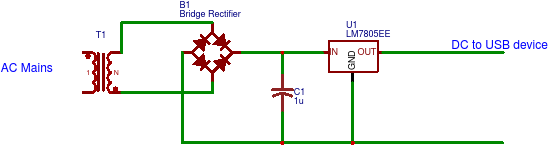
image

See you soon

image  Cris H.

  • Sign in to reply

Top Comments

  • phoenixcomm
    phoenixcomm over 10 years ago in reply to mcb1 +1
    Just maybe he was thinking of a flux capacitor ??
  • mcb1
    mcb1 over 10 years ago in reply to michaelwylie +1
    Are that makes sense. Yes it is a good design practice to get rid of any harmonics that might be on the line, or are sent back towards the line. I'm not so sure about having a cap across the primary to…
  • mcb1
    mcb1 over 10 years ago in reply to shabaz

    Yep.

    He didn't do it very well but it certainly is the standard rectify the mains, then chop the resultant DC to get your voltage.


    He gets several fails from me.

    1. He knew it was giving an AC voltage but never actually measured it. (It looks like half wave mains by the lamp shown later)

    2. He decided to use some enamalled wire on a mains voltage lamp and relied on that as the primary isolation to stop him getting a shock.

         Yes says he has a RCD (why he didn't want to measure between metalwork and earth) but still it isn't the point when he knows its faulty.

    3. He tried to prove it by removing the transformer rather than cutting the track to prove it. In removing the transformer he has cleared the initial fault.

    4. Using a sharp knife and cutting towards is a NO NO . In my day that was the first thing your father taught you about knives.

    5. The comments about two sets of 'secondary' windings using three parallel wires is incorrect ... these would be the primary winding.


    His final conclusion is that the feedback winding was in contact with the primary winding.

    I presume that the 'earth' side of this winding is the output ground, which was then elevated to a mains voltage via diode, which gives the half wave effect observed with the lamp.


    If I'm not mistaken this has a non polarised mains plug.

    image

    A quick check would have been to reverse the mains connection to see if it stayed live.


    This is typical of these cheaply made devices where they are relying on basic insulation of a key component.

    The exact cause was single insulation failure (the coating only) and may well have survived if the mains was only 115v.


    People wonder why we promote safety around Mains Voltages and this is another very good example.


    Cheers

    Mark

    • Cancel
    • Vote Up 0 Vote Down
    • Sign in to reply
    • More
    • Cancel
  • michaelwylie
    michaelwylie over 10 years ago

    Aren't Y capacitors exactly for this application? Filtering between primary and secondary.

    • Cancel
    • Vote Up 0 Vote Down
    • Sign in to reply
    • More
    • Cancel
  • shabaz
    shabaz over 10 years ago

    Ouch - that multimeter burning video is scary.

    Ordinarily I'd agree, a lot of vloggers are pretty bad, Big Clive is usually very good though. He rushed through the description a bit, but basically he was describing an AC-DC converter (i.e. something like this block diagram), not a linear supply. It was easy to miss though, it was just very quickly sketched just as a box so it was a bit unclear.

    I've not seen the entire video but looking forward to it - curious what the end fault was.

    • Cancel
    • Vote Up 0 Vote Down
    • Sign in to reply
    • More
    • Cancel
<
element14 Community

element14 is the first online community specifically for engineers. Connect with your peers and get expert answers to your questions.

  • Members
  • Learn
  • Technologies
  • Challenges & Projects
  • Products
  • Store
  • About Us
  • Feedback & Support
  • FAQs
  • Terms of Use
  • Privacy Policy
  • Legal and Copyright Notices
  • Sitemap
  • Cookies

An Avnet Company © 2026 Premier Farnell Limited. All Rights Reserved.

Premier Farnell Ltd, registered in England and Wales (no 00876412), registered office: Farnell House, Forge Lane, Leeds LS12 2NE.

Follow element14

  • X
  • Facebook
  • linkedin
  • YouTube