Enrollment closes in
Days 0 Hours 0 Mins 0 Secs 0


Attend the PYNQ Webinar on May 8th: Unlock the Power of FPGAs through Python: Building Reconfigurable Embedded Systems with PYNQ
| {tabbedtable} Tab Label | Tab Content |
|---|---|
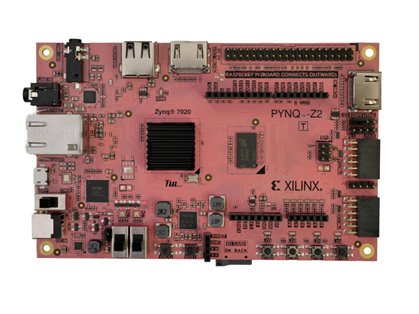
| About | The TUL PYNQ™-Z2 board, based on Xilinx Zynq SoC and originally designed for the Xilinx University Program, supports the Python Productivity for Zynq® framework and embedded systems development. PYNQ is an open-source project from Xilinx® that makes it easy to design embedded systems with Xilinx Zynq® Systems on Chips (SoCs). Using the Python language and libraries, designers can exploit the benefits of programmable logic and microprocessors in Zynq to build more capable and exciting embedded systems. PYNQ is intended to be used by a wide range of designers and developers including:
Key Features
Video: Learn More About the PYNQ-Z2 from element14 presents
Additional Information |
| Important Dates | Enrollment Begin: May 6 2019 Enrollment Ends: June 6 2019 RoadTesters Selected: Jun 12 2019 Product Shipped: June 14 2019 RoadTesting Begins: June 21 2019 Reminder/Update Email: July 21 2019* Submit Reviews By: August 21 2019* *The element14 RoadTest Staff will send this reminder/update email. **If a RoadTester is unable to meet the deadline, please notify the RoadTest Program Lead, rscasny, as soon as possible before the deadline. |
| RoadTesters | |
| Terms and Conditions | RoadTest PYNQ-Z2 Dev Board: Python Productivity for Zynq® Terms and Conditions These are the terms and conditions which govern the PYNQ-Z2 Dev Board: Python Productivity for Zynq® contest. This Contest requires participants to submit an application indicating their previous experience with this type of equipment/component, information on what they would do to test the equipment/component, and the applicant’s desire to post a thorough review of their experience with images, photos, or other supplemental materials. Participants will be required to meet the Conditions for Participation. The winners of this RoadTest will receive the item(s) listed below. RoadTest Reviews are due no later than 60 days after the receipt of the item(s). No other prizes are offered. The Principal terms of the Competition: The following words and phrases are used in these terms and conditions and have the meanings given to them below. (RoadTest or Contest) Key dates: Applications Close: midnight (GMT) on Jun 6 2019 Announcement of Winner (estimated): June 11 2019 Prize: PYNQ-Z2 Dev Board: Python Productivity for Zynq®
Competition Site: https://www.element14.com/community/groups/roadtest?ICID=menubar_resources_roadtest Site or element14 Community: www.element14.com/community Judges: members of the element14 community team chosen at the Organiser’s discretion. Judging Criteria, All of the following which will have equal weighting: · Demonstrated competence with the technologies including links or descriptions of past projects · Qualifications as indicated by current job role and/or schooling/vocational training; · A thorough description of how the prize would be tested; · Likelihood that the Applicant will blog about the prize and provide a review on element14.com; · Originality; · Innovation. Organiser: Premier Farnell plc (registered in England and Wales under company number 876412) whose registered office is at Farnell House, Forge Lane, Leeds, UK Conditions for Qualification: in addition to meeting the requirements of these terms, all persons applying to take part in the Contest (each one an Applicant) must: · Provide a RoadTest application describing what he/she would do if awarded the Prize including similar previous projects, product experience and qualifications Terms: these terms and conditions which govern the Competition and to which the Organiser reserves the right to make changes from time to time and the latest version of these Terms from time to time will be posted to the Site.
1.1 Save as set out in these Terms, the Contest is open to any natural or legal person, firm or company or group of natural persons or unincorporated body. 1.2 All Applicants must be aged at least 18 at the time of their application. 1.3 Applicants must not enter the RoadTest if doing so or taking part may: 1.3.1 cause the Organiser and/or themselves to be in breach of any agreement (including but not limited to any contract of employment) to which they are a party or in breach of any law, regulation or rule having the force of law to which the Organiser or the Applicant may be subject or any policy of the Organiser or the Sponsor; 1.3.2 Require the Organiser to obtain any licence, authorisation or permission to deal with the Applicant; or 1.3.3 Be in breach of any policy or practice of their employer. Some employers prohibit or restrict their employees from taking part in competitions such as these or receiving prizes under them and the Organiser respects those policies and practices. The Organiser reserves the right to disqualify any Application made in breach of these Terms and to reject any Application which it reasonably believes may be or become in breach. The Organiser reserves the right to require evidence in such form as the Organiser may reasonably require of any Applicant’s compliance with any of these Terms and to disqualify any Applicant or Participant who cannot provide such evidence reasonably promptly. 1.4 Multiple applications are not permitted. 1.5 Applications may not be submitted by an agent whether acting on behalf of an undisclosed principal or otherwise. 1.6 The Contest is NOT open to: 1.6.1 Any person or entity who is a resident or national of any country which is subject to sanctions, embargoes or national trade restrictions of the United States of America, the European Union or the United Kingdom; 1.6.2 Any employee, director, member, shareholder (as appropriate) or any of their direct families (parents, siblings, spouse, partner, children) (“Direct Families”) of the Organiser and Sponsors; or 2.1 Each Applicant must fully complete and submit a RoadTest Application by the Application Close. 2.2 By submitting a Registration Form, each Applicant: 2.2.1 Authorises the Organiser to use his or her personal data (as defined in the Data Protection Act 1998) for the purposes of running and promoting the RoadTest; 2.2.2 Authorises the Organizer to copy, reproduce and publish their application should they be accepted as a Participant; 2.2.3 Will be deemed to have read, accepted and agree to be bound by these Terms. Applicants are advised to print and keep safe these Terms; 2.2.4 Authorises the Organiser to copy, reproduce and use the Application and/or Review for the purposes of the RoadTest and as otherwise contemplated by these Terms. The Organiser will not be responsible for any inaccuracy, error or omission contained in any reproduction or use of the Project Blogs. 2.2.5 Licenses the Organiser to use the intellectual property in the Project (IP) for the purposes of this Contest. As between the Applicant and the Organiser the IP remains owned by the Applicant. 2.2.6 Grants the Organiser the right to use his or her likeness, photographs, logos, trademarks, audio or video recordings without restriction for the purposes of Contest or the promotion of it or the Site; 2.2.7 Agrees to participate positively in all publicity surrounding the Contest; 2.2.8 Agrees to be responsible for all expenses and costs incurred by him or her in preparing for, entering and participating in the Contest (save for any expenses expressly agreed by the Organiser to be borne by it in these Terms); 2.2.9 Confirms that he or she owns all IP used in his or her application or Project or Blogs and indemnifies the Organiser from any claim by a third party that use of any material provided by an Applicant to the Organiser infringes the intellectual property rights of any third party; 2.2.10 Agrees not to act in any way or fail to act in any way or be associated with any cause or group which would have a negative impact on the reputation of the Organiser and/or the RoadTest. 2.3 All applications submitted to this RoadTest must meet the following criteria: 2.3.1 Applicants must be the author, creator and owner of the proposed review idea. Applicants must not submit someone else’s idea; 2.3.2 The proposed application must be reasonably achievable by the within the time constraints of the Contest; 2.3.3 Applications must not include or propose any of the following, the inclusion of which shall render any proposed application ineligible: (a) Applications which relate to socially taboo topics, such as illicit drug use or sexual gratification; (b) Applications that are or could reasonably be considered to be illegal, immoral, discriminatory or offensive as determined by the Organiser; (c) Applications in relation to them which if accepted would infringe or breach any of the policies or terms of access or use of the Site. 2.4 No Application may contain any of the hazardous substances identified by Article 4 of Directive 2002/95/EC of the European Parliament on the Restrictions on the Use of Substances in Electronic and Electrical Equipment ("the Directive") or the use of such hazardous substances in the in any such Project must not exceed the maximum concentration values set out in the Directive. 3.1 Winners will be selected by the Organiser on the basis of the quality of his or her application and its adherence to these Terms. 3.2 The total number of Winners selected will be at least the minimum number set out above but the actual number is at the sole discretion of the Organizer and/or the Sponsor, if applicable. 3.3 The Organiser will use all reasonable efforts to announce the Winners via an update to the RoadTest page by the date listed above. 3.4 Winners agree to take part in all publicity which the Organiser or the Sponsor wishes to use to promote the RoadTest, the Products featured or other Contests with which the Organiser may be connected from time to time. 3.5 Details of the Winners may also be published in the media. 3.6 Winners are responsible for all applicable taxes, duties or other charges payable in relation to any prize. 3.7 4.1 The Organiser hereby excludes all and any Liability arising out of the Contest or the acceptance, use, quality, condition, suitability or performance of any Prize, even where that Liability may arise from the Organiser’s negligence. 4.2 Nothing in these Terms will affect any Liability of the Organiser for death or personal injury arising from its negligence, for breach of Part II of the Consumer Protection Act 1987 (in the event that any entrant is entitled to claim rights under the Consumer Protection Act 1987) or for any matter in relation to which it would be illegal for the Organiser to exclude or to attempt to exclude its Liability. 4.3 Subject to 4.2, neither the Organiser, any parent company nor any subsidiary of the Organiser or such parent company or any of their directors, officers and employees (together referred to in these terms and the ‘Associates’) makes any guarantee, warranty or representation of any kind, express or implied, with respect to this Competition or the Prizes potentially available under it. Neither the Organiser nor any of its Associates shall be responsible for any Liability that may arise out of or in connection with person’s participation in this Competition, the claiming, redemption or value of any prizes under it, the use or enjoyment of such prizes or any events or circumstances arising out of or in connection with any of them. Any implied warranties of condition, merchantability or suitability or fitness for purpose of any of them are hereby expressly excluded. Wherever used in these Terms, ‘Liability’ shall mean any and all costs, expenses, claims, damages, actions, proceedings, demands, losses and other liabilities (including legal fees and costs on a full indemnity basis) arising directly or indirectly out of or in connection with the matter concerned. 5.1 The RoadTest is organised and sponsored by the Organiser. The Organiser reserves the right to delegate all or any of its powers, rights and obligations arising in relation to the RoadTest to any Associate and certain such rights and powers are assumed by the Organiser on behalf of itself and each Associate. Reference to “Organiser” shall be deemed to include reference to each Associate. 5.2 The RoadTest may be terminated at any time if there are, in the sole opinion of the Organiser, an insufficient number of entries, or if the Applications are not of an appropriate standard for a competition of this nature. The Organiser has the right to cancel or suspend the RoadTest at any time due to circumstances outside its reasonable control. 5.3 The Organiser shall have the sole discretion to disqualify (without correspondence or right of appeal) any Applicant it considers to be adversely affecting the process or the operation of the RoadTest or to be in breach of these Terms or to be acting in a disruptive manner or with intent to annoy, abuse, threaten or harass any other Applicant or Participant. 5.4 The Organiser has the right to amend or add to these Terms from time to time. Revised Terms and Conditions will be posted on the Contest Site and it is a condition of entry to the RoadTest that Applicants agree to comply with these Terms and, if appropriate, such Terms as amended from time to time. 5.5 Headings are for convenience only and do not affect the interpretation or construction of these Terms and Conditions. 5.6 These Terms and the operation of the Contest shall be governed by and construed in accordance with English Law and any claim or matter arising under these Terms shall be subject to the exclusive jurisdiction of the English courts. |