element14 Community
element14 Community
    Register Log In
  • Site
  • Search
  • Log In Register
  • Community Hub
    Community Hub
    • What's New on element14
    • Feedback and Support
    • Benefits of Membership
    • Personal Blogs
    • Members Area
    • Achievement Levels
  • Learn
    Learn
    • Ask an Expert
    • eBooks
    • element14 presents
    • Learning Center
    • Tech Spotlight
    • STEM Academy
    • Webinars, Training and Events
    • Learning Groups
  • Technologies
    Technologies
    • 3D Printing
    • FPGA
    • Industrial Automation
    • Internet of Things
    • Power & Energy
    • Sensors
    • Technology Groups
  • Challenges & Projects
    Challenges & Projects
    • Design Challenges
    • element14 presents Projects
    • Project14
    • Arduino Projects
    • Raspberry Pi Projects
    • Project Groups
  • Products
    Products
    • Arduino
    • Avnet & Tria Boards Community
    • Dev Tools
    • Manufacturers
    • Multicomp Pro
    • Product Groups
    • Raspberry Pi
    • RoadTests & Reviews
  • About Us
    About the element14 Community
  • Store
    Store
    • Visit Your Store
    • Choose another store...
      • Europe
      •  Austria (German)
      •  Belgium (Dutch, French)
      •  Bulgaria (Bulgarian)
      •  Czech Republic (Czech)
      •  Denmark (Danish)
      •  Estonia (Estonian)
      •  Finland (Finnish)
      •  France (French)
      •  Germany (German)
      •  Hungary (Hungarian)
      •  Ireland
      •  Israel
      •  Italy (Italian)
      •  Latvia (Latvian)
      •  
      •  Lithuania (Lithuanian)
      •  Netherlands (Dutch)
      •  Norway (Norwegian)
      •  Poland (Polish)
      •  Portugal (Portuguese)
      •  Romania (Romanian)
      •  Russia (Russian)
      •  Slovakia (Slovak)
      •  Slovenia (Slovenian)
      •  Spain (Spanish)
      •  Sweden (Swedish)
      •  Switzerland(German, French)
      •  Turkey (Turkish)
      •  United Kingdom
      • Asia Pacific
      •  Australia
      •  China
      •  Hong Kong
      •  India
      •  Japan
      •  Korea (Korean)
      •  Malaysia
      •  New Zealand
      •  Philippines
      •  Singapore
      •  Taiwan
      •  Thailand (Thai)
      •  Vietnam
      • Americas
      •  Brazil (Portuguese)
      •  Canada
      •  Mexico (Spanish)
      •  United States
      Can't find the country/region you're looking for? Visit our export site or find a local distributor.
  • Translate
  • Profile
  • Settings
Experts, Learning and Guidance
  • Technologies
  • More
Experts, Learning and Guidance
Ask an Expert Forum How do i convert 220v to 12v without a transformer
  • Blog
  • Forum
  • Documents
  • Leaderboard
  • Files
  • Members
  • Mentions
  • Sub-Groups
  • Tags
  • More
  • Cancel
  • New
Join Experts, Learning and Guidance to participate - click to join for free!
Actions
  • Share
  • More
  • Cancel
Forum Thread Details
  • Replies 20 replies
  • Subscribers 335 subscribers
  • Views 3950 views
  • Users 0 members are here
Related
See a helpful answer?

Be sure to click 'more' and select 'suggest as answer'!

If you're the thread creator, be sure to click 'more' then 'Verify as Answer'!

How do i convert 220v to 12v without a transformer

nelson64
nelson64 over 3 years ago

I am trying to build a circuit with a transformer to put in 220v to get 12v and if possible get 5v out to

  • Sign in to reply
  • Cancel

Top Replies

  • scottiebabe
    scottiebabe over 3 years ago in reply to michaelkellett +3
    Yes.. Perhaps E14 produce a learning module on clairvoyance so we can all do better
  • michaelkellett
    michaelkellett over 3 years ago in reply to Jan Cumps +2
    It's a Schrödinger Transformer. MK
  • Jan Cumps
    Jan Cumps over 3 years ago +2
    The most used method is to use a capacitive dropper. It can reduce the mains to a manageable voltage with little loss, You need to know the impedance of your load to calculate the capacitive dropper's…
  • scottiebabe
    scottiebabe over 3 years ago in reply to Jan Cumps

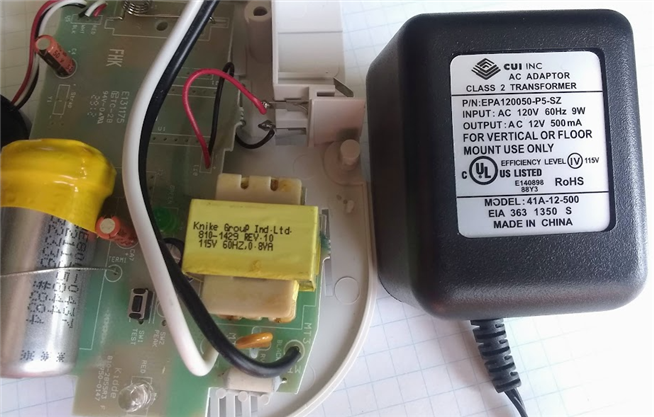
    I have bought a few over the years and saved a few and you can find them almost anywhere heres one in an expired carbon monoxide detector...

    image

    But it sounds like the OP just wants a 12V power supply....

    • Cancel
    • Vote Up +1 Vote Down
    • Sign in to reply
    • Cancel
  • michaelkellett
    michaelkellett over 3 years ago in reply to scottiebabe

    This is the trouble with OPs - they so often don't quite tell us what they really want Confused

    MK

    • Cancel
    • Vote Up 0 Vote Down
    • Sign in to reply
    • Cancel
  • scottiebabe
    scottiebabe over 3 years ago in reply to michaelkellett

    Yes.. Perhaps E14 produce a learning module on clairvoyance so we can all do better Slight smile

    image

    • Cancel
    • Vote Up +3 Vote Down
    • Sign in to reply
    • Cancel
  • michaelkellett
    michaelkellett over 3 years ago in reply to nelson64

    Definitely best to use a ready made 12V supply. Your water pump may draw a much higher current when it starts up than its steady state power rating might lead you to expect.

    Low frequency based transformer based power supplies are often quite good at this but switchers may have trouble. Kind of hard to tell without just trying it because pumps and power supplies at the low end of the market are not usually specified in detail  in this regard.

    If the water pump is small just get  a power supply that can deliver 4x the nominal pump power.

    You can make the 5V with a regulator from the 12V supply, you can buy one from Amazon or Ebay if looking for cheapness. For simplicity just use a second DC supply.

    MK

    • Cancel
    • Vote Up +1 Vote Down
    • Sign in to reply
    • Cancel
  • Jan Cumps
    Jan Cumps over 3 years ago in reply to nelson64

    Water and a power supply without transformer are enemies. Go for a solution with a transformer.

    • Cancel
    • Vote Up +1 Vote Down
    • Sign in to reply
    • Cancel
  • kmikemoo
    kmikemoo over 3 years ago in reply to Jan Cumps

    I was leaning to the same point but for the motor inrush.  Use a buck autotransformer and maintain your neutral bond.  Helps to trip the breaker if something goes wrong.

    • Cancel
    • Vote Up +1 Vote Down
    • Sign in to reply
    • Cancel
  • nelson64
    nelson64 over 3 years ago in reply to Jan Cumps

    thanks

    • Cancel
    • Vote Up 0 Vote Down
    • Sign in to reply
    • Cancel
  • phoenixcomm
    phoenixcomm over 3 years ago in reply to scottiebabe

    DITO!!

    • Cancel
    • Vote Up +1 Vote Down
    • Sign in to reply
    • Cancel
  • phoenixcomm
    phoenixcomm over 3 years ago

    Are you trying to kill yourself and others??  If your circuit FAILS, and WHEN, the motor will likely take the full voltage which means you have 220v on the pump motor, hence you may electrify your little system. And then don't touch it or you might DIE,  with 110 your muscles react with an open hand, on the other hand, 220 will make your muscles grab on, well you get the picture. I used to work as an electrician, and whenever when I was messing about with 220 (live) I always had an extra person holding me with a rope to my belt. or standing on a rubber mat, with rubber gloves and an apron. SO JUST Buy a wall wart.  Because I knew what I was doing I and two other guys changed out everything from the  3 Federal Pacific boxes that always ran hot (they lost their certification), to Square D and everything  was powered by 2 pole pigs (transformers) which were tied together where the boxes were. 

    • Cancel
    • Vote Up +1 Vote Down
    • Sign in to reply
    • Cancel
  • colporteur
    colporteur over 3 years ago in reply to phoenixcomm

    Your concern has merit. Being able to do it doesn't necessarily mean you should do it. I thought a 12V wall wart would solve the problem. That is the solution I opted for when the door bell PS went south. Still ringing to this day....sorry got to go someone at the door.

    • Cancel
    • Vote Up 0 Vote Down
    • Sign in to reply
    • Cancel
<
element14 Community

element14 is the first online community specifically for engineers. Connect with your peers and get expert answers to your questions.

  • Members
  • Learn
  • Technologies
  • Challenges & Projects
  • Products
  • Store
  • About Us
  • Feedback & Support
  • FAQs
  • Terms of Use
  • Privacy Policy
  • Legal and Copyright Notices
  • Sitemap
  • Cookies

An Avnet Company © 2026 Premier Farnell Limited. All Rights Reserved.

Premier Farnell Ltd, registered in England and Wales (no 00876412), registered office: Farnell House, Forge Lane, Leeds LS12 2NE.

Follow element14

  • X
  • Facebook
  • linkedin
  • YouTube