


INSTALLATION OF LIGHTS
Before moving on to the final stages – Schematic Design of the Complete System and Schematic Design of Controls – I installed LED lighting and configured the Operational Controls, with an additional indication feature:

MVF LIGHTS OFF, jpg

MVF LIGHTS ON .jpg
I have made a small video clip that also makes the lighting more apparent, with the addition of a flashing warning light, signalling the telescopic drive is in operation.
MVF LIGHTS ON .mov
Next, the ‘interesting-going-automated’ stuff’, focusing on the layout of the system and the relationship between the main elements and associated controls:
MVF SYSTEM A SCHEMATIC .jpg
Plus, setting out the controls and power aspects:
MVF CONTROLS SCHEMATIC. jpg
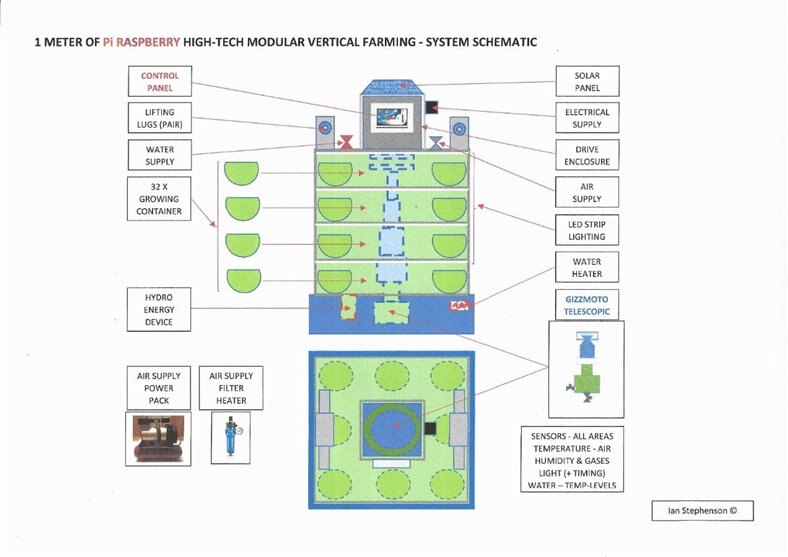
SYSTEM SCHEMATIC
Some aspects of the System configuration are worth highlighting:
FEATURES
A) On the top of the structure, a pair of Lifting Lugs are fitted. These will facilitate the initial loading of the MVF System construction by a RASPBERRY Pi controlled ‘cherry-picker’ and assist in the subsequent positioning at the operating/plant growing location.
B) By the same token, this feature will enable movement/lifting of the MVF package for harvesting or maintenance functions, in RASPBERRY Pi controlled semi-automatic mode.
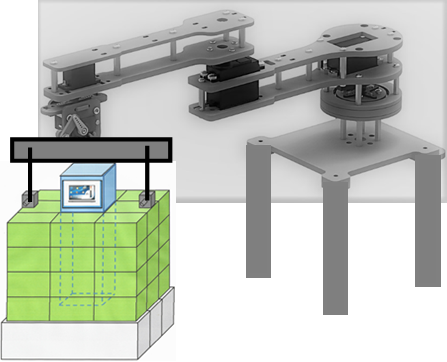
NOTE: Two designs are in hand, one that enables movement of the complete MVF, as seen in the schematic; a second that keeps the central Control Panel, Drive Enclosure, GIZZMOTO TELESCOPIC HEAD and Base/Tank in situ, whilst the surrounding structure is lifted clear.
PLUS
C) The Electrical, Compressed Air and Water Supplies are fitted with self-sealing quick-release couplings to enable smooth disconnection, under ‘live’ conditions, when necessary.
D) Compressed Air is stored in the Tank/Air Receiver of the Air Supply Power Pack at a Pressure up to 10 Bar, controlled by a local Unloader-Type Pressure Switch. The Air Supply to the GIZZMOTO TELESCOPIC HEAD (GTH) can be adjusted and set to a maximum of 1 Bar.
E) Air can be supplied at Ambient Temperature or Warmed up to 40 degrees Celsius by passing through a Filter/Heater Combination Unit. The amount of Air used depends on the cycle rate of the GTH determined by the RASPBERRY Pi programme.
F) Alternatively, Water for moisture/aerosol spraying can be heated to similar temperature by a heater installed in the Water Tank. Tank levels are controlled by the onboard level sensor connected through the Control Panel to operate a Piezo Air Assisted Solenoid Shut-Off Valve.
NEXT: SCHEMATIC B CONTROLS

CONTROLS SCHEMATIC
POWER & UTILITIES
The MVF System requires a minimum of electrical power as operational functions are supplemented by Compressed Air. This is used to assist the triggering of control valves that open and close Water Supply and Air Supply valves. Electrical power is drawn down intermittently for Air and Water Heating.
SENSORS & INPUTS
In addition to signals from environment sensors, the Control Panel and Enclosure accepts inputs from the Drive Enclosure, all processed by a RASPBERRY Pi. All outputs are routed through a bank of relays, providing the necessary (low) power operation for Drive, LED Lighting, GTH, Water and Air functions.
A SIMULATOR block is included, comprising a set of manual switches, that can be used for setting-up and testing, forcing outputs either singularly or to initiate functions in a planned sequence. All monitored by a CONTROL PANEL with INDICATION & DISPLAYS.
NEXT CONCEPTUAL DESIGN: MVF HIGH-TECH SYSTEM .jpg

SUMMARY & CONCLUSIONS
To maximise the full potential of the MVF concept, there are areas requiring further investigation, in addition to Solar and Hydro-Energy. The latter would benefit from carefully designed individual container tray/bases to capture residual water and return to the holding tank via the Hydro-Energy Device. Also, the style, design and material used for the containers is probably worth exploring, according to preliminary research.
Using the small-scale model for reference, a full-size High-Tech Modular Vertical Farm System, powered and controlled by RASPBERRY Pi can now be built and installed for food growing and sustainable production. As the fundamental design is based on modular cells - basic linkable structures - they can form different shapes and sizes of self-contained MVF’s, with adjusted individual heights and space to accommodate selected crops, from a minimum of two levels upwards (the existing schematics show four levels). Note that this a cross between aeroponic and hydroponic horticulture and no soil is required.
(An additional step will be to use calculations to design modular kits for educational purposes and these will hook-up to RASPBERRY Pi controls,)
Going forward, the scope of the concept can cover a single, self-contained MVF package or be expanded to construct a fully automated production facility comprising multiples of MVF’s incorporating harvesting and replenishment.
It would be feasible to build a separate, larger scale, fully automatic Vertical Farming food production facility by multiplying the number of MVF Systems. A bank of MVF Systems could be positioned alongside each other, in a row, with minimal clearance sufficient to allow an overhead ‘pick-and-place’ unit to traverse down the length, to remove a pre-selected System for harvesting, refreshing and return. Again, powered and controlled by a RASPBERRY Pi.

REMINDER - As a significant feature, the importance of the GIZZMOTO TELESCOPIC HEAD (GTH) sub-system can be underlined by its ability to produce a wide range of environment conditions, from temperate to tropical, substituting mechanical pumps and fans.
FURTHER NOTE: There is scope to produce a combined RASPBERRY Pi CONTROLLED GIZZMOTO TELESCOPIC PUMP PACKAGE – out of this world, watch this space!
1meterofpi raspberry_pi, design challenge, raspberry pi 4 2gb, 1 meter of pi, 1_meter_of_pi, 1 meter of pi - design challenge
