


The Space Vegetables project consists in cultivating vegetables for consumption in a almost automated hydroponics setup.
The objective is the minimum maintenance by an Astronaut, because they have other work to do.
Here I'm going to try to describe, very basically and short, what is hydroponics - bare in mind that this all new to me.
What is Hydroponics
Hydroponics is the science of cultivating plants in a solution of water and nutrients where the plant roots are supported by a inert medium that is not soil.This technique can be used from a small domestic setup to intensive culture.
There are several advantages from traditional agriculture :
- More yield by area
- less water is used
- less pesticides
- less prone to infestations and diseases
There are also some disadvantages:
- A bigger initial investment in materials
- A need of a greater technical know-how
Hydroponic systems
The main hydroponics systems are:
- Nutrient Film Technique - NFT (what Space Vegetables is going to use)
- Deep Water Culture (DWC)
- Wick System
- Ebb And Flow
- Drip system
- Aeroponics

NFT
This is the more well known hydroponic system and usually, when someone mentions hydroponics, is referring to NFT.
When proper designed, it can be used to grow small and medium plants.
In a common NFT system:
- There's a constant flow of nutrients
- The nutrient solution is pumped from a deposit into a canal where it flows constantly. It returns to the deposit after running through the all system.
- some part of the vegetable roots is submersed in the solution film, the other part is above the humid air, absorbing oxygen.
- Normally, there's no culture medium or substrate. The plant roots are supported by the mesh vase. You can also use some substrate, like lava rocks, expanded clay pebbles or coconut coir.
- It's an active system.
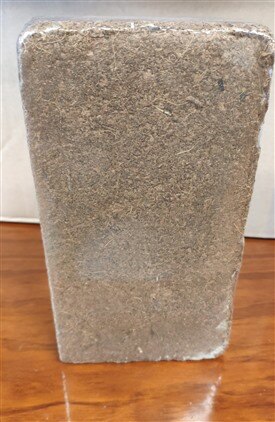
The image above is a brick of Coconut Coir
Nutrient solution
The success and development of your vegetables in hydroponics depends essentially of the nutrient solution. It's from the nutrient solution that the plant gets all the nutrients it needs do develop and grow.
The following image is an example of a nutrient solution to add to the water.

Temperature
The ideal temperature of the solution (nutrient) is between 18ºC and 24ºC in summer and 10ºC to 14ºC in the winter. Temperatures above or below will cause harm to the plants, because they have difficulty absorbing the nutrients in extreme temperatures.
Oxygen
In hydroponics is essential to keep the solution well oxygenated to maintain the nutrient absorption. This can be accomplished during the circulation of the solution when returning to the reservoir, using compressed air or with an air pump.
Electric Conductivity (EC)
The control of the EC is of utmost importance, because it can tell how much quantity there is of nutrients - quantity of ions - in the solution. The more ions there is, the greater is the electric conductivity. The ideal measurement of the solution is between 0.5 to 2.0 miliSiemens/cm, which corresponds to 250 to 1.000 ppm (parts per million) of ions concentration.
Still, every plant has it's own requirements. Tomatoes can go high has 2.4, while basil should never go above 1.4 .
The EC must be measured regularly.
- If the EC stays the same: The plant is using as much water and nutrients, and is balanced.
- if the EC goes down: It indicates the plant is using more nutrients than water. The nutrient solution should be added to make it stronger and keep measuring the EC
- if the EC goes up: The plant is using more water than nutrients and it isn't absorbing what it should. More water is need to dilute the solution down. Burned leafs and slowed growth can be signs of over-feeding and the nutrient solution may be to strong. Temperature also affects the EC and in hotter days the plants can "drink" more water.
PH
The nutrient solution PH it is very important because plants can't survive in PH values below 3.5. In hydroponics, plants have their development in PH values between 5.2 and 6.5. Within this values the absorption of micro and macro nutrients is best by the plants roots.
The image below is a PH meter - manual. Space Vegetables will use a electronic one.

This is a very basic explanation of hydroponics and what cares should be taken with the system.
References:
https://loja.ecocenter.pt/post/solucao-nutritiva
https://www.hydroponics.co.uk/news/why-ec-is-important-in-hydroponics/
Top Comments