



Designing the System concept
The Space Vegetables project will have some electronics to control and some sensors to monitor.
The 1 Meter of Pi challenge will offer:
- 1 Raspberry PI 4 2GB
- 1 Automation HAT mini
- 1 Enviro HAT
- 1 PICO HAT Hacker
Because the Automation HAT and the Enviro HAT are not stackable, another Raspberry PI will have to be used. Since I have a Raspberry PI 3B+ available, that will be used and a Raspberry PI Zero W for the Twitter updates.
Raspberry PI 4 2GB
This is the more powerful Raspberry PI, so it will be used has the main Raspberry PI , the database server and the Web Services server.
The Enviro HAT will be connected to this Raspberry PI, plus the sensors - PH, TDS (EC) and a status light .
Database Server
To monitor the system status in time and check the values and progress, a SQLITE3 database will be used to store the values.
Values monitored:
- Temperature
- Humidity
- Luminosity (turn on or off the grow lights)
- Gas sensor
- Carbon monoxide (CO)
- Nitrogen monoxide (NO2)
- Hydrogen (H2)
- PH
- TDS (or EC)
- Pump Active
- Lights ON
Web Services
Because we're going to use several Raspberry PIs for the project, there has to be communication between them . The Raspberry PI 4 is the main server and will be the provider of the Web Services. The other Raspberry PIs will query it for values, and eventually will use it to change values.
The Web Services will be implemented using Flask and REST . I will be explaining what is REST and Python Web Services when the time comes for the code.

Raspberry PI 3B+
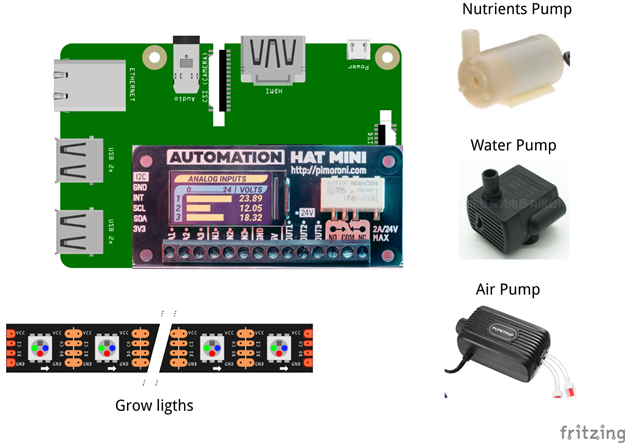
The Automation HAT mini will be connected to this Raspberry PI. It will control:
- Water Pump
- Air Pump
- Nutrients PUMP
- Grow Lights
The pumps will be controlled using the web services or the timers defined in the code.
Raspberry PI Zero
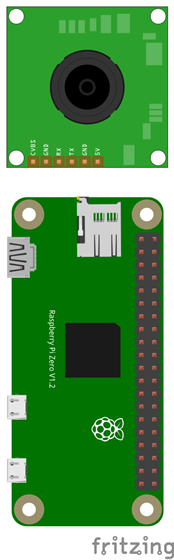
The raspberry PI zero will send daily updates to the Space Vegetables Twitter account.
With a camera it will take pictures of the vegetables grow status, along with same environmental status and post it to Twitter. The code to post to Twitter has already been shared here, if someone wants to know how to do it.
The environmental parameters will be requested using the Web Services provided by the Raspberry PI 4. In time, all the code will be shared.
This a general design of the system. When I start putting it together, wiring schematics will posted, along with pictures .