element14 Community
element14 Community
    Register Log In
  • Site
  • Search
  • Log In Register
  • Community Hub
    Community Hub
    • What's New on element14
    • Feedback and Support
    • Benefits of Membership
    • Personal Blogs
    • Members Area
    • Achievement Levels
  • Learn
    Learn
    • Ask an Expert
    • eBooks
    • element14 presents
    • Learning Center
    • Tech Spotlight
    • STEM Academy
    • Webinars, Training and Events
    • Learning Groups
  • Technologies
    Technologies
    • 3D Printing
    • FPGA
    • Industrial Automation
    • Internet of Things
    • Power & Energy
    • Sensors
    • Technology Groups
  • Challenges & Projects
    Challenges & Projects
    • Design Challenges
    • element14 presents Projects
    • Project14
    • Arduino Projects
    • Raspberry Pi Projects
    • Project Groups
  • Products
    Products
    • Arduino
    • Avnet & Tria Boards Community
    • Dev Tools
    • Manufacturers
    • Multicomp Pro
    • Product Groups
    • Raspberry Pi
    • RoadTests & Reviews
  • About Us
  • Store
    Store
    • Visit Your Store
    • Choose another store...
      • Europe
      •  Austria (German)
      •  Belgium (Dutch, French)
      •  Bulgaria (Bulgarian)
      •  Czech Republic (Czech)
      •  Denmark (Danish)
      •  Estonia (Estonian)
      •  Finland (Finnish)
      •  France (French)
      •  Germany (German)
      •  Hungary (Hungarian)
      •  Ireland
      •  Israel
      •  Italy (Italian)
      •  Latvia (Latvian)
      •  
      •  Lithuania (Lithuanian)
      •  Netherlands (Dutch)
      •  Norway (Norwegian)
      •  Poland (Polish)
      •  Portugal (Portuguese)
      •  Romania (Romanian)
      •  Russia (Russian)
      •  Slovakia (Slovak)
      •  Slovenia (Slovenian)
      •  Spain (Spanish)
      •  Sweden (Swedish)
      •  Switzerland(German, French)
      •  Turkey (Turkish)
      •  United Kingdom
      • Asia Pacific
      •  Australia
      •  China
      •  Hong Kong
      •  India
      • Japan
      •  Korea (Korean)
      •  Malaysia
      •  New Zealand
      •  Philippines
      •  Singapore
      •  Taiwan
      •  Thailand (Thai)
      • Vietnam
      • Americas
      •  Brazil (Portuguese)
      •  Canada
      •  Mexico (Spanish)
      •  United States
      Can't find the country/region you're looking for? Visit our export site or find a local distributor.
  • Translate
  • Profile
  • Settings
Bluetooth Unleashed Design Challenge
  • Challenges & Projects
  • Design Challenges
  • Bluetooth Unleashed Design Challenge
  • More
  • Cancel
Bluetooth Unleashed Design Challenge
Blog Neonatal Jaundice Phototherapy - Part 1.a: Introduction
  • Blog
  • Forum
  • Documents
  • Polls
  • Files
  • Events
  • Mentions
  • Sub-Groups
  • Tags
  • More
  • Cancel
  • New
  • Share
  • More
  • Cancel
Group Actions
  • Group RSS
  • More
  • Cancel
Engagement
  • Author Author: sunnyiut
  • Date Created: 8 May 2018 8:17 PM Date Created
  • Views 1706 views
  • Likes 8 likes
  • Comments 5 comments
  • phototherapy
  • neonatal jaundice
  • bluetooth unleashed
  • bluetooth® le cc2640r2f launchpad
  • bluetooth unleashed design challenge
Related
Recommended

Neonatal Jaundice Phototherapy - Part 1.a: Introduction

sunnyiut
sunnyiut
8 May 2018

Title: Neonatal Jaundice Phototherapy

By: sunnyiut


Design Challenge: Bluetooth Unleashed

Blog number: 01


In my very first blog post in the Bluetooth Unleashed Design Challenge, I'll give an introduction of my project .

This is basically a slightly modified version of my project proposal/application.


Introduction:image


In this design challenge my goal is to design a low cost Phototherapy device that can be used to treat neonatal jaundice. It will be an interactive device that will monitor basic health parameters of the baby during treatment period and notify in case of abnormalities. Bluetooth communication will be used to collect health parameters and to send notifications.


This project includes three modules -

     1. Phototherapy unit [Blue LED light source with driver circuitry]

     2. Interfacing and control unit to control the LED light intensity

     3. Wearable health monitor which will collect and send health parameters to the control unit


the 'wearable health monitor' will be mounted on the baby's body and the communication with the control unit will be BLUETOOTH.


Hero board:


Texas Instruments - CC2640R2 LaunchPad
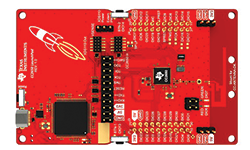
image

Close


Neonatal Jaundice -
"Jaundice is a common, temporary. and usually harmless condition in newborn infants. It affects both full-term and premature babies, usually appearing during the first week of the baby's life.

Jaundice occurs when there is a build-up of a naturally occurring substance in the blood called bilirubin . Bilirubin is an orange/red pigment in the blood. Bilirubin is produced by the normal breakdown of red blood cells. It is normal for everyone to have low levels of bilirubin in their blood. As bilirubin begins to build up, it deposits on the fatty tissue under the skin causing the baby's skin and whites of the baby's eyes to appear yellow. "

ref--> Your Baby, Jaundice, and Phototherapy


Phototherapy by LEDs-

Some “normal” jaundice will disappear within a week or two without treatment. Other babies will require treatment because of the severity of the jaundice, the cause of the jaundice, or how old the baby is when jaundice appears.

Phototherapy (light treatment - blue light) is the process of using light to eliminate bilirubin in the blood. Your baby's skin and blood absorb these light waves. These light waves are absorbed by your baby's skin and blood and change bilirubin into products, which can pass through their system.

Phototherapy treatments decrease the bilirubin levels in the blood by changing the trans-bilirubin into cis-bilirubin isomer, which is water-soluble.

Super bright LEDs with ~460nm blue color of the light spectrum wavelength have an abrupt attenuation of the irradiance from the infra-red and ultra-violet wavelength ranges, reducing undesired effects to the infant's skin.
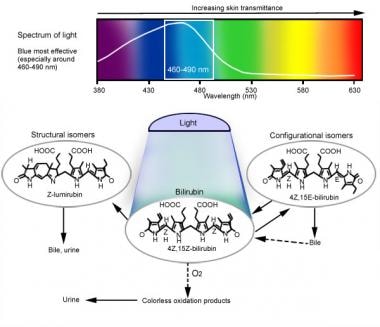
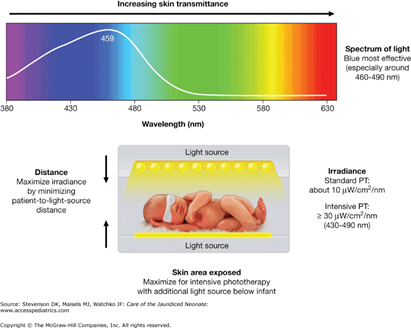
Closeimage


Side effects -

Generally it's safe and considered to have short term side effects like -

  •      interference with maternal-infant interaction,
  •      imbalance of thermal environment,
  •      sudden water loss,
  •      electrolyte disturbance etc


My experience -

I have a baby girl of four months old. After one week of her birth, she developed jaundice and it became severe. So, she had to go under phototherapy treatment.

She was responding actively during the treatment sessions [15 mins feeding break after every 45 mins of treatment]. like crying and moving repeatedly with unrest to show her discomfort, which was a normal behavior. But after several intensive sessions her body temperature gradually dropped at night and she stopped responding. This in-activeness was due to dehydration.

Unfortunately we could not noticed it in time, as the cradle was covered with thick cloth so that the light does not come out of the treatment area. As soon as they found her losing response, they paused it and advised for excessive breastfeeding until she regain her natural responses.

My observation regarding this issue is that -

during the 45 minutes of treatment session, a continuous monitoring system of the baby's physical condition can reduce this kind of inconvenience. Monitoring basic health parameters like temperature, heart rate, hydration etc. will be good enough to predict the physical condition of the baby. And based on that, intensity of the treatment can be optimized automatically to keep the baby out of undesired side effects.

This experience led me to design a device with these features.


Objectives -


  • monitor the basic health parameters of the baby
    • Heart rate
    • Body temperature
    • Hydration from skin impedance measurement [optional - if I get enough time for that]
  • monitor the ambient environment of the treatment area
    • ambient temperature
    • humidity
    • light intensity
  • flexible control of the intensity of the treatment [controlling the brightness of the LEDs]
  • display live updates of different parameters and notify if needed


Design Challenge Participation -

I was working on choosing the LED and designing the driver circuit when this design challenge took place in the community.

In this project, the basic health parameter monitoring module has to be small wearable, portable and should have communication capability to send the data to the control unit.

As the baby moves a lot, it's not a safe idea to go for wired communication. Therefore, I choose Bluetooth communication for interfacing. This gave me an opportunity to participate in this design challenge.


In my next blog post, I'll be describing my Project Plan in detail.

  • Sign in to reply

Top Comments

  • BigG
    BigG over 7 years ago +3
    I recall the time I spent at my daughters side in hospital when she was born and thought much along the same lines that things could be significantly improved on the monitoring side. I never quite got…
  • aspork42
    aspork42 over 7 years ago +3
    Looking forward to seeing you project. My first child had a few days in the special care nursery tethered with all those darn wires. My second kid was born in December right before the Pi Chef Challenge…
  • genebren
    genebren over 7 years ago +2
    Great project idea. This is a real area of concern and I think that is great that you are looking to improve upon the treatment and monitoring for this condition. I look forwarding to following your progress…
  • aspork42
    aspork42 over 7 years ago

    Looking forward to seeing you project. My first child had a few days in the special care nursery tethered with all those darn wires. My second kid was born in December right before the Pi Chef Challenge started and needed the “Billy Blanket“ due to jaundice. Again with all the wires!


    image

    • Cancel
    • Vote Up +3 Vote Down
    • Sign in to reply
    • More
    • Cancel
  • sunnyiut
    sunnyiut over 7 years ago in reply to genebren

    Thank you Gene. image

    however, the treatment is almost the same as it is.

    My focus will be on implementing the monitoring system. BLE gives us the flexibility in this case.

    • Cancel
    • Vote Up +1 Vote Down
    • Sign in to reply
    • More
    • Cancel
  • sunnyiut
    sunnyiut over 7 years ago in reply to BigG

    Yep, Colin

    it's better to replace the alarm system with Peer 2 Peer notification using bluetooth, specially for minor abnormality detection.

    i'll try my best to incorporate this feature in this project.

    thank you image

    • Cancel
    • Vote Up +2 Vote Down
    • Sign in to reply
    • More
    • Cancel
  • BigG
    BigG over 7 years ago

    I recall the time I spent at my daughters side in hospital when she was born and thought much along the same lines that things could be significantly improved on the monitoring side. I never quite got round to making something, so I'm really pleased to see your project description as Bluetooth is a great enabler.


    One aspect I did not like at all with current monitoring equipment, as it affects all parties involved (nurses, patients and visitors) is the method of alarm. A loud alarm buzzer should really not be on the equipment / monitoring device beside the bed of a patient as this needs to be set at a high enough dB so that staff can hear and respond. This affects everyone in the ward, especially the patient if they are there long term. With Bluetooth you can now make alarms peer to peer, as in, for example, minor alarms could be sent directly to the assigned nurse while all the alarms can be distributed to different location points depending on severity. It would be nice to see this aspect incorporated somehow into the design.


    Anyhow, I look forward to reading your the rest of your blogs.


    Good luck.


    Colin

    • Cancel
    • Vote Up +3 Vote Down
    • Sign in to reply
    • More
    • Cancel
  • genebren
    genebren over 7 years ago

    Great project idea.  This is a real area of concern and I think that is great that you are looking to improve upon the treatment and monitoring for this condition.  I look forwarding to following your progress through this project.

    Good Luck!

    Gene

    • Cancel
    • Vote Up +2 Vote Down
    • Sign in to reply
    • More
    • Cancel
element14 Community

element14 is the first online community specifically for engineers. Connect with your peers and get expert answers to your questions.

  • Members
  • Learn
  • Technologies
  • Challenges & Projects
  • Products
  • Store
  • About Us
  • Feedback & Support
  • FAQs
  • Terms of Use
  • Privacy Policy
  • Legal and Copyright Notices
  • Sitemap
  • Cookies

An Avnet Company © 2025 Premier Farnell Limited. All Rights Reserved.

Premier Farnell Ltd, registered in England and Wales (no 00876412), registered office: Farnell House, Forge Lane, Leeds LS12 2NE.

ICP 备案号 10220084.

Follow element14

  • X
  • Facebook
  • linkedin
  • YouTube