element14 Community
element14 Community
    Register Log In
  • Site
  • Search
  • Log In Register
  • Community Hub
    Community Hub
    • What's New on element14
    • Feedback and Support
    • Benefits of Membership
    • Personal Blogs
    • Members Area
    • Achievement Levels
  • Learn
    Learn
    • Ask an Expert
    • eBooks
    • element14 presents
    • Learning Center
    • Tech Spotlight
    • STEM Academy
    • Webinars, Training and Events
    • Learning Groups
  • Technologies
    Technologies
    • 3D Printing
    • FPGA
    • Industrial Automation
    • Internet of Things
    • Power & Energy
    • Sensors
    • Technology Groups
  • Challenges & Projects
    Challenges & Projects
    • Design Challenges
    • element14 presents Projects
    • Project14
    • Arduino Projects
    • Raspberry Pi Projects
    • Project Groups
  • Products
    Products
    • Arduino
    • Avnet & Tria Boards Community
    • Dev Tools
    • Manufacturers
    • Multicomp Pro
    • Product Groups
    • Raspberry Pi
    • RoadTests & Reviews
  • About Us
  • Store
    Store
    • Visit Your Store
    • Choose another store...
      • Europe
      •  Austria (German)
      •  Belgium (Dutch, French)
      •  Bulgaria (Bulgarian)
      •  Czech Republic (Czech)
      •  Denmark (Danish)
      •  Estonia (Estonian)
      •  Finland (Finnish)
      •  France (French)
      •  Germany (German)
      •  Hungary (Hungarian)
      •  Ireland
      •  Israel
      •  Italy (Italian)
      •  Latvia (Latvian)
      •  
      •  Lithuania (Lithuanian)
      •  Netherlands (Dutch)
      •  Norway (Norwegian)
      •  Poland (Polish)
      •  Portugal (Portuguese)
      •  Romania (Romanian)
      •  Russia (Russian)
      •  Slovakia (Slovak)
      •  Slovenia (Slovenian)
      •  Spain (Spanish)
      •  Sweden (Swedish)
      •  Switzerland(German, French)
      •  Turkey (Turkish)
      •  United Kingdom
      • Asia Pacific
      •  Australia
      •  China
      •  Hong Kong
      •  India
      • Japan
      •  Korea (Korean)
      •  Malaysia
      •  New Zealand
      •  Philippines
      •  Singapore
      •  Taiwan
      •  Thailand (Thai)
      • Vietnam
      • Americas
      •  Brazil (Portuguese)
      •  Canada
      •  Mexico (Spanish)
      •  United States
      Can't find the country/region you're looking for? Visit our export site or find a local distributor.
  • Translate
  • Profile
  • Settings
Energy Harvesting Design Challenge
  • Challenges & Projects
  • Design Challenges
  • Energy Harvesting Design Challenge
  • More
  • Cancel
Energy Harvesting Design Challenge
Blog A side step to other technologies for harvesting
  • Blog
  • Forum
  • Documents
  • Files
  • Mentions
  • Sub-Groups
  • Tags
  • More
  • Cancel
  • New
  • Share
  • More
  • Cancel
Group Actions
  • Group RSS
  • More
  • Cancel
Engagement
  • Author Author: vsluiter
  • Date Created: 24 Apr 2013 5:55 PM Date Created
  • Views 810 views
  • Likes 1 like
  • Comments 2 comments
  • energy_harvesting
  • human_energy
  • energy_harvesting_challenge
  • energy_harvesting_source
Related
Recommended

A side step to other technologies for harvesting

vsluiter
vsluiter
24 Apr 2013

When looking around for energy harvesting solutions I found quite a bunch of intersting techniques to get motion into energy. A lot of these are highly experimental, but look promising for the future. I'll highlight the things I found most interesting:


Electro-active Polymers (EAP)

Please, please, pleeeeaaassse, can I have these? They are a new way transform between mechanical and electrical energy, in both ways. EAPs can be used as 'muscles' / actuators and as generators


http://www.polypower.com/NR/rdonlyres/A129F5B2-B810-4213-AD2D-337A871612E5/0/Filmvoltage_off_on200x179.jpghttp://www.polypower.com/NR/rdonlyres/79AD46EC-8EFE-4B68-B44D-D7E168FB9DB3/0/energy_graph400x238.jpghttp://www.polypower.com/NR/rdonlyres/8383ECFC-EA5F-4873-856F-9F271353C24A/0/Functionalityenergy_harvestingconcept228x228jpg.jpg

EAP as actuator and as generator. Images from http://www.polypower.com


I can highly recommend browsing polypowers website, a lot of info can be found there.


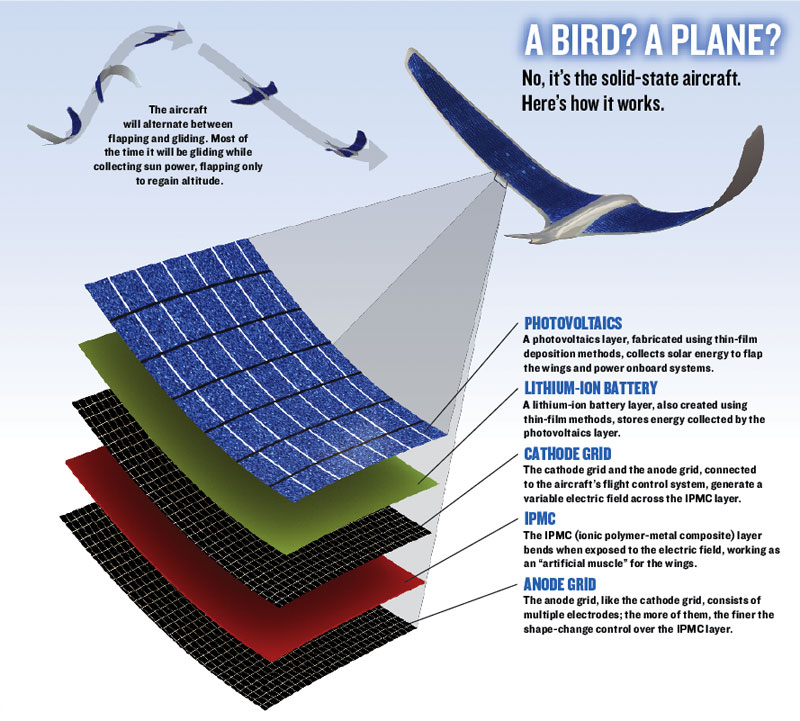
Another website with info on EAP's, with a very interesting take on the actuators is http://www.hizook.com:, they even have a future vision of an EAP / photocell plane! Now wouldn't that be nice to build with the energy harvesting kit image

http://www.hizook.com/files/users/3/EAP_Wings.jpg


Maybe it's a bi far-fetched yet, but it looks feasible in the future to me.


Current state of biomechatronic energy harvesting

I'll be short here, as I can't do a good abstract of an article as exhaustive as this, by Riemer and Shapiro:

Biomechanical energy harvesting from human motion: theory, state of the art, design guidelines, and future directions

What I found most interesting is that they researched all joints and their respective energy potential. Interesting, interesting.....


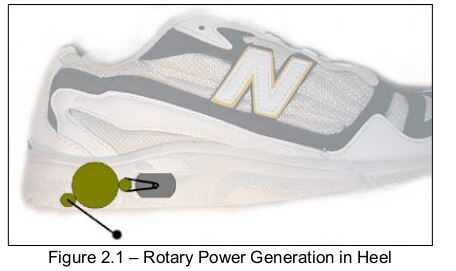
Talking about research and energy harvesting from humans, this is what MIT came up with: an "Unobtrusive integration of magnetic generator systems into common footwear[pdf], Hayashida". They integrated two small DC motors and a gearbox into the sole of a sneaker to get energy from the heel strike while walking. The idea and research is very nice, but I would like to hear whether all those gears wouldn't make too much noise...
image

Concept of generating power by walking; heelstrike generates motion of DC-motor


What about bike lighting?

Ouch, painful subject.... Today I saw on hackaday.com that someone made a bicycle light with help of a relay. He uses something rattling against the spokes to generate energy. It works, but it's not a very charming solution acousticly (unless you're still putting playing cards on your wheel..).

http://hackadaycom.files.wordpress.com/2013/04/rattle-generator-bicycle-spokes.jpg?w=580&h=394


In the comments, however I someone mentioning the magnic light kickstarter. Now this is doing everything I wanted to do with my project, but then better; contactless energy out of the motion of the wheels, no problems with snow, rain, no maintenance, no batteries. The circuit is based on eddy currents gnerated in the rim of the wheel, and I have to find out how they've done it, as I wouldn't know how they're transforming the electromagnetic  field of those eddy currents back to usable energy. I mean, to me it looks like you'd get an opposing magnet field back, which contains no fluctuation, so you can't use a transformer... Anyways, I have to see what this means for my design, as this is a legion higher in elegance than I could ever make using saddle motion.....


For now: a picture

https://lh6.googleusercontent.com/-6sp8eIxkz9M/Tzdj6Vy2fJI/AAAAAAAANK8/tw_R1JP2oxY/s576/FrontLight.jpg

  • Sign in to reply
Parents
  • DAB
    DAB over 12 years ago

    Hi Victor,


    Very interesting find.

    I think I understand how this magnetic generator works and I have to admit, it's a cool way to generator power.

    Aluminum is a conductor, so inducing an electric current using the magnets make sense.

    As the wheel turns, you will get a varying magnetic field from the aluminum, which you can then pickup with a simple coil.

    You then just run the alternating current into a step up transformer, rectify it and you have usable DC if you need it, thought a simple diode would probably get you a good enough pulsed AC voltage to run the LED.


    Really a brilliant discovery.


    Just my opinion,

    DAB

    • Cancel
    • Vote Up 0 Vote Down
    • Sign in to reply
    • More
    • Cancel
Comment
  • DAB
    DAB over 12 years ago

    Hi Victor,


    Very interesting find.

    I think I understand how this magnetic generator works and I have to admit, it's a cool way to generator power.

    Aluminum is a conductor, so inducing an electric current using the magnets make sense.

    As the wheel turns, you will get a varying magnetic field from the aluminum, which you can then pickup with a simple coil.

    You then just run the alternating current into a step up transformer, rectify it and you have usable DC if you need it, thought a simple diode would probably get you a good enough pulsed AC voltage to run the LED.


    Really a brilliant discovery.


    Just my opinion,

    DAB

    • Cancel
    • Vote Up 0 Vote Down
    • Sign in to reply
    • More
    • Cancel
Children
  • vsluiter
    vsluiter over 12 years ago in reply to DAB

    Hello DAB,

    As I understand it, the eddy currents generated in the rim will not be an alternating magnetic field. As the wheel spins, it tries to generate an opposing field to the permanent magnet in the 'lamp'. This opposing field will be of constant 'direction' (opposing the magnetic field of the permanent magnet), only changing in magnitude in relation to the wheel velocity.

    I've contacted the designer of this lamp to ask for an explanation image


    By the way, please do not excuse yourself for your opinions!


    EDIIT:

    The patent is here: http://patentscope.wipo.int/search/en/WO2013004320

    The light uses (a) rotating magnet(s), thereby alternating the magnet poles facing the rim, thereby alternating the magnet field.... Man.... This guy made a very smart invention!

    • Cancel
    • Vote Up 0 Vote Down
    • Sign in to reply
    • More
    • Cancel
element14 Community

element14 is the first online community specifically for engineers. Connect with your peers and get expert answers to your questions.

  • Members
  • Learn
  • Technologies
  • Challenges & Projects
  • Products
  • Store
  • About Us
  • Feedback & Support
  • FAQs
  • Terms of Use
  • Privacy Policy
  • Legal and Copyright Notices
  • Sitemap
  • Cookies

An Avnet Company © 2025 Premier Farnell Limited. All Rights Reserved.

Premier Farnell Ltd, registered in England and Wales (no 00876412), registered office: Farnell House, Forge Lane, Leeds LS12 2NE.

ICP 备案号 10220084.

Follow element14

  • X
  • Facebook
  • linkedin
  • YouTube