


Hello All,
As you might have noticed, I haven't posted for a while; the reasons are many, I'll elaborate a small bit;
- Holland got a new king and queen, which was a great happening. I've been spending some time in preparations for a concert.
- In my job, some great changes are taking place, or are prepared to take place. My brain capacity was mostly spent there, not on this project...
- The magnic light I wrote about in my last post was so overwhelmingly well thought-of (great concept, good product, very smart) that I just lost enthousiasm to create my own project. I just couldn't get the energy together to either finish either the bike-light project or a new project.
Luckily, all the king-and-queen festivities are over, I got some clarity on changes in my job and I think I'll get started with the 'Energy Harvesting Gadget', e.g. the EHG: an energy-harvesting-powered egg timer.
What I've done in between
I abandoned the bike light project; The last thin I had done on that was using the LTC3105, and was pleasantly surprised about the MPPC feature (original on http://video.linear.com/LTC3105):
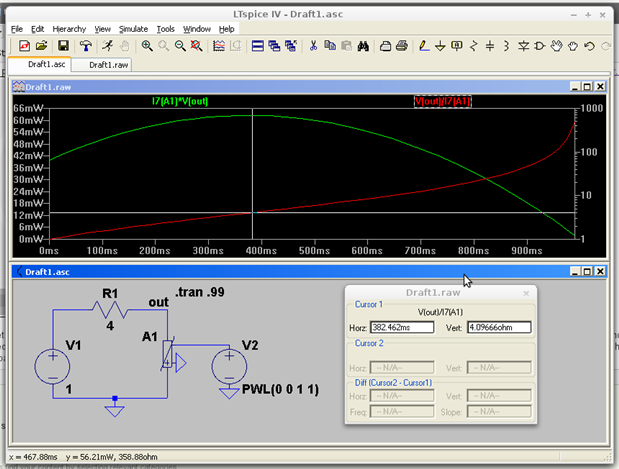
As I've seen in trying to get energy from motors and / or speakers, it is very important to match the input impedance of the harvester with the output of the energy source. I'll show this with an example of a source with 4 Ohm impedance, and 1V open clamp output voltage (for example, a motor that is used as a generator). The circuit below is 'loaded' with a variable resistor. In the plot you'll see the output power and load resistance plotted versus the varistor control voltage.
The 'maximum power point', where maximum power from the source is used is found at the place where the source impedance matches the input impedance of the harvester. Of course, in a practical harvesting application you'll want to hit this 'sweet spot', which is what the LTC3105 enables you to do.
I'll show more about this in a following post!
