


See the title; I'll be going off-topic. A bit.
Why bother (or: how does this relate to the Energy Harvesting Solution)?
The reason I'll be looking into the physics of boiling an egg is that for this energy harvesting solution I wanted to make something that would use the computational power of the EFM32. I've had the idea of making something that would monitor the temperature of water for making a good tea. To make a good tea, you need to first boil water, and then let it cool down until the temperature reaches the right temperature zone, which is different for specific tea leaves (black-> hottest, then, green, then fruit / herbal->'coolest'). I wanted to make that, but I thought it could simply be done with an analog circuit. No computational power needed.
Boiling an egg, on the other hand, is computational stuff. There are several ways of boiling an egg, and each uses another temperature profile to get the yolk at the right temperature. But it's impossible to directly measure the temperature of the yolk, so you'll have to make a model of your egg, and use that model to predict when the yolk is firm enough. To your personal taste, of course.
The bigger picture
I think that energy harvesting is a great technology, but is now mostly limited to sensor applications, of which a lot can be interfaced with analog electronics. However, if you want to log data, or send data wirelessly a microcontroller is making life much easier. The Cortex M3's EnergyMicro is using in their chips is powerful enough to do a lot of calculating; to be honest, I think the examples for the board don't do justice to the power it has. Although I'm just cooking an egg, I'd like to use that as a showcase for doing some low-power 'harvested energy' calculations. In the real world, energy-harvesting applications could get smarter by calculating their own needed values. FFT on a self-powered vibration sensor, anyone?
Egg theory
When looking into this, I found a very interesting website: Khymos.org: towards the perfect soft boiled egg. This site is based on this page from the university of Exeter, which gives a PDF with very detailed derivation of the cooking time of an egg. After some 'easy physics' (ahem), they're deriving this formula:
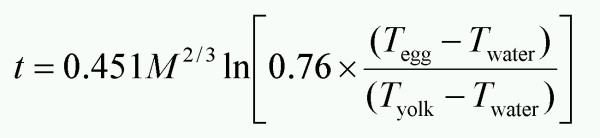
This is based on cooking an egg (with temperature Tegg, and mass M by dropping it in water of temperature Twater). The yolk temperature is used for the hardness of the egg. According to this chart (PDF) , a soft egg is made at Tyolk = 65°C, a medium egg at Tyolk = 77°C and a hard boiled egg at Tyolk = 90°C. Good. Or not? There are several issues with this calculation:
- The first issue I have with this calculation is that it presumes you keep the water boiling all the time. I'm using a method at home where I warm up the water with the eggs, and then boil two minutes, and then turn off the fire and let the eggs rest in the water for another 15 minutes. I get a firm egg yolk, without a green ring. Hmmm.... But not covered by this formula
- The formula is based on a fixed value for the heat resistance and heat capacity for both egg white and egg yolk. I'd guess that this is incorrect. I think that the heat properties of both white and yolk change when they solidify; they become less watery and more dense, so probably the heat resistance increases. Won't be a big issue, but just to put some counterweight on the impressive looking formula
Egg oddity
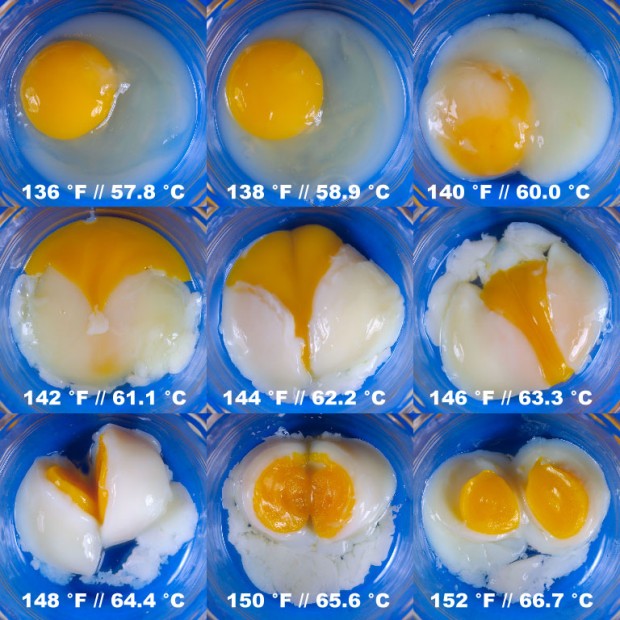
The funny thing about eggs is that the white solidifies partly (12% of proteins) at 62-65°C, while the majority of the egg white solidifies at 80°C. This way, you can create an 'opposite egg', see the pictures below; firm egg yolk and runny white when slow-cooking at 65°C (source: khymos.org, Douglas Baldwin)! Weird ey?
From the kitchen to the lab
To get a good calculation of egg hardness, I'll have to integrate the heat flow into the egg. Due to shortness of development time I'll make my life simpler by just taking room temperature eggs into account (yes, I could measure egg temperature in advance, maybeI'll add that if time permits). To model the heat flow I should calculate the heat flow using the specific heat resistance and capacity of egg white and yolk. I will however do a guestimate of what is going on temperature-wise in the egg, and verify that with known cooking times...
As usual, I use LTSpice for simulations. Below, an initial guess at the variables.... In the graph you see temperature in degrees Celsius expressed in Volts, and time on the horizontal axis.

