element14 Community
element14 Community
    Register Log In
  • Site
  • Search
  • Log In Register
  • Community Hub
    Community Hub
    • What's New on element14
    • Feedback and Support
    • Benefits of Membership
    • Personal Blogs
    • Members Area
    • Achievement Levels
  • Learn
    Learn
    • Ask an Expert
    • eBooks
    • element14 presents
    • Learning Center
    • Tech Spotlight
    • STEM Academy
    • Webinars, Training and Events
    • Learning Groups
  • Technologies
    Technologies
    • 3D Printing
    • FPGA
    • Industrial Automation
    • Internet of Things
    • Power & Energy
    • Sensors
    • Technology Groups
  • Challenges & Projects
    Challenges & Projects
    • Design Challenges
    • element14 presents Projects
    • Project14
    • Arduino Projects
    • Raspberry Pi Projects
    • Project Groups
  • Products
    Products
    • Arduino
    • Avnet & Tria Boards Community
    • Dev Tools
    • Manufacturers
    • Multicomp Pro
    • Product Groups
    • Raspberry Pi
    • RoadTests & Reviews
  • About Us
    About the element14 Community
  • Store
    Store
    • Visit Your Store
    • Choose another store...
      • Europe
      •  Austria (German)
      •  Belgium (Dutch, French)
      •  Bulgaria (Bulgarian)
      •  Czech Republic (Czech)
      •  Denmark (Danish)
      •  Estonia (Estonian)
      •  Finland (Finnish)
      •  France (French)
      •  Germany (German)
      •  Hungary (Hungarian)
      •  Ireland
      •  Israel
      •  Italy (Italian)
      •  Latvia (Latvian)
      •  
      •  Lithuania (Lithuanian)
      •  Netherlands (Dutch)
      •  Norway (Norwegian)
      •  Poland (Polish)
      •  Portugal (Portuguese)
      •  Romania (Romanian)
      •  Russia (Russian)
      •  Slovakia (Slovak)
      •  Slovenia (Slovenian)
      •  Spain (Spanish)
      •  Sweden (Swedish)
      •  Switzerland(German, French)
      •  Turkey (Turkish)
      •  United Kingdom
      • Asia Pacific
      •  Australia
      •  China
      •  Hong Kong
      •  India
      •  Japan
      •  Korea (Korean)
      •  Malaysia
      •  New Zealand
      •  Philippines
      •  Singapore
      •  Taiwan
      •  Thailand (Thai)
      •  Vietnam
      • Americas
      •  Brazil (Portuguese)
      •  Canada
      •  Mexico (Spanish)
      •  United States
      Can't find the country/region you're looking for? Visit our export site or find a local distributor.
  • Translate
  • Profile
  • Settings
Energy Harvesting Design Challenge
  • Challenges & Projects
  • Design Challenges
  • Energy Harvesting Design Challenge
  • More
  • Cancel
Energy Harvesting Design Challenge
Blog Hot water harvesting
  • Blog
  • Forum
  • Documents
  • Files
  • Mentions
  • Sub-Groups
  • Tags
  • More
  • Cancel
  • New
  • Share
  • More
  • Cancel
Group Actions
  • Group RSS
  • More
  • Cancel
Engagement
  • Author Author: gelmi
  • Date Created: 17 May 2013 7:57 PM Date Created
  • Views 612 views
  • Likes 1 like
  • Comments 1 comment
  • low_power
  • heat
  • wuerth
  • low_energy
  • thermal_energy
  • linear
  • würth
  • temperature
  • enery_efficiency
  • energy_harvesting
  • thermal
  • efm32
  • peltier
  • energy_micro
  • self_powered
  • kit
  • energy_saving
  • energy_harvesting_challenge
  • energy_harvesting_source
Related
Recommended

Hot water harvesting

gelmi
gelmi
17 May 2013

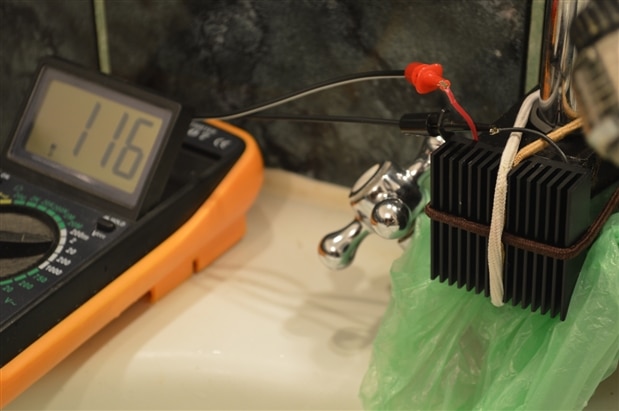
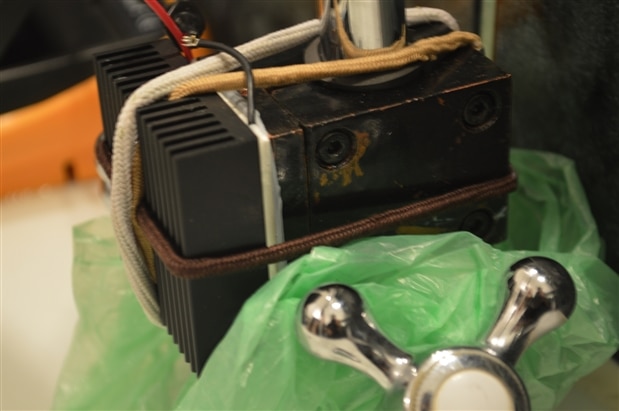
I have finally created a prototype of energy harvester for my project. Let's start from the beginning. I managed to get a solid copper brick with a hole drilled through. Unfortunately, the diameter of this hole was too large to tightly fit the battery pipe, inside which hot water runs. The difference between diameters was approximately 4 mm. An idea came to mind to use thermopad. It is the flexible and squeezable small piece of mat which conducts the heat pretty well. So, I used it to feel the void between the brick and the pipe. You can check how it looks in the photos.
imageimage

The brick has some screws and one can disassemble it. I unsoldered the TEG with radiator from the kit and put in against the brick. At first, I could not get better values on my meter than with heat from a hand, so I have decided to use some silver thermo paste in order to create better contact. Just the same I use for my PC's CPU. That did the trick! When water started to flow, I had over 110 mV with open circuit. With load I got approximately half of that.

image

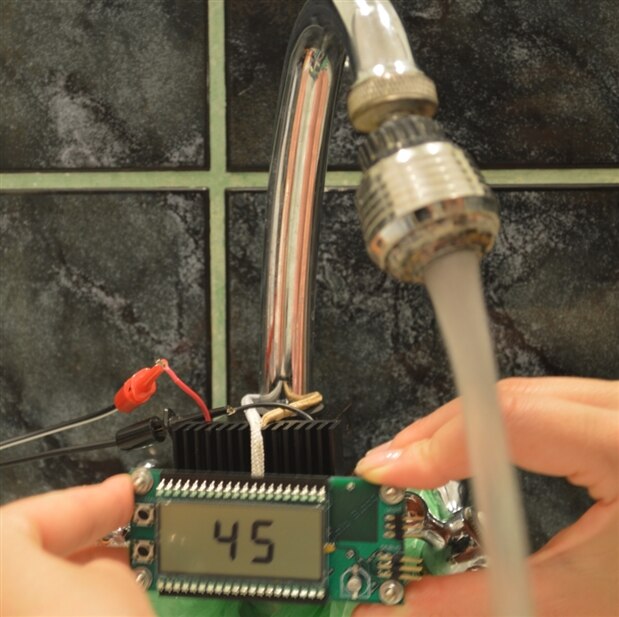
I did check the temperatures. After a while – steady state – the radiator temperature was approximately 45 deg C and water coming from the tap was almost 55 deg C. I assume that the temperature of the Peltier module's hot side was little over 50 deg C, because of the heat loss across the thermopad, brick and paste. Ambient temperature was 26 deg C.
imageimage

I believe this method of harvesting is a win for me. Now, I have to create a device based on EFM32 for my project, which would run for 24h straight after storing the energy in supercaps for some time: a shower or two and doing the dishes image

And now the funny part. The steady state and steady temperatures occur after only a minute of two. But when you turn off the tap, the heat in the pipe (water) still allows to get going and to store some of this heat energy in the supercaps, thanks to LTC's chip. Water had been running for some time while the STK temperature demo had been connected to the harvester board, then I turned off the hot water tap and the voltage started to drop. But it took 17 minutes, to get only 26 mV from the TEG and after this time the LCD started to faint.

But guys, the truth is that after you turn off the tap, you still have to pay for the hot water that is between the meter and the battery. Because, next time when you turn it on, this water will be cold (and you pay for it as it was hot). This is the method to partially use this heat, which otherwise would be wasted.

As always stay tuned for my next posts. I will try to create my project demo based on STK and give you some details soon.

  • Sign in to reply
  • DAB
    DAB over 12 years ago

    Good post.


    With a simple set up you have shown how to collect heat from a faucet and do a rough thermal load test.


    I will be very interested to see if you can create a collection system to build up enough energy storage to make it useful.


    Thanks

    DAB

    • Cancel
    • Vote Up 0 Vote Down
    • Sign in to reply
    • More
    • Cancel
element14 Community

element14 is the first online community specifically for engineers. Connect with your peers and get expert answers to your questions.

  • Members
  • Learn
  • Technologies
  • Challenges & Projects
  • Products
  • Store
  • About Us
  • Feedback & Support
  • FAQs
  • Terms of Use
  • Privacy Policy
  • Legal and Copyright Notices
  • Sitemap
  • Cookies

An Avnet Company © 2026 Premier Farnell Limited. All Rights Reserved.

Premier Farnell Ltd, registered in England and Wales (no 00876412), registered office: Farnell House, Forge Lane, Leeds LS12 2NE.

ICP 备案号 10220084.

Follow element14

  • X
  • Facebook
  • linkedin
  • YouTube