element14 Community
element14 Community
    Register Log In
  • Site
  • Search
  • Log In Register
  • Community Hub
    Community Hub
    • What's New on element14
    • Feedback and Support
    • Benefits of Membership
    • Personal Blogs
    • Members Area
    • Achievement Levels
  • Learn
    Learn
    • Ask an Expert
    • eBooks
    • element14 presents
    • Learning Center
    • Tech Spotlight
    • STEM Academy
    • Webinars, Training and Events
    • Learning Groups
  • Technologies
    Technologies
    • 3D Printing
    • FPGA
    • Industrial Automation
    • Internet of Things
    • Power & Energy
    • Sensors
    • Technology Groups
  • Challenges & Projects
    Challenges & Projects
    • Design Challenges
    • element14 presents Projects
    • Project14
    • Arduino Projects
    • Raspberry Pi Projects
    • Project Groups
  • Products
    Products
    • Arduino
    • Avnet & Tria Boards Community
    • Dev Tools
    • Manufacturers
    • Multicomp Pro
    • Product Groups
    • Raspberry Pi
    • RoadTests & Reviews
  • About Us
    About the element14 Community
  • Store
    Store
    • Visit Your Store
    • Choose another store...
      • Europe
      •  Austria (German)
      •  Belgium (Dutch, French)
      •  Bulgaria (Bulgarian)
      •  Czech Republic (Czech)
      •  Denmark (Danish)
      •  Estonia (Estonian)
      •  Finland (Finnish)
      •  France (French)
      •  Germany (German)
      •  Hungary (Hungarian)
      •  Ireland
      •  Israel
      •  Italy (Italian)
      •  Latvia (Latvian)
      •  
      •  Lithuania (Lithuanian)
      •  Netherlands (Dutch)
      •  Norway (Norwegian)
      •  Poland (Polish)
      •  Portugal (Portuguese)
      •  Romania (Romanian)
      •  Russia (Russian)
      •  Slovakia (Slovak)
      •  Slovenia (Slovenian)
      •  Spain (Spanish)
      •  Sweden (Swedish)
      •  Switzerland(German, French)
      •  Turkey (Turkish)
      •  United Kingdom
      • Asia Pacific
      •  Australia
      •  China
      •  Hong Kong
      •  India
      •  Japan
      •  Korea (Korean)
      •  Malaysia
      •  New Zealand
      •  Philippines
      •  Singapore
      •  Taiwan
      •  Thailand (Thai)
      •  Vietnam
      • Americas
      •  Brazil (Portuguese)
      •  Canada
      •  Mexico (Spanish)
      •  United States
      Can't find the country/region you're looking for? Visit our export site or find a local distributor.
  • Translate
  • Profile
  • Settings
Energy Harvesting Design Challenge
  • Challenges & Projects
  • Design Challenges
  • Energy Harvesting Design Challenge
  • More
  • Cancel
Energy Harvesting Design Challenge
Blog Measuring, egg temperature, programming
  • Blog
  • Forum
  • Documents
  • Files
  • Mentions
  • Sub-Groups
  • Tags
  • More
  • Cancel
  • New
  • Share
  • More
  • Cancel
Group Actions
  • Group RSS
  • More
  • Cancel
Engagement
  • Author Author: vsluiter
  • Date Created: 4 Jun 2013 7:56 PM Date Created
  • Views 636 views
  • Likes 1 like
  • Comments 0 comments
  • wuerth
  • low_energy
  • thermal_energy
  • würth
  • temperature
  • enery_efficiency
  • thermal
  • efm32
  • peltier
  • energy_harvesting_challenge
  • energy_harvesting_source
Related
Recommended

Measuring, egg temperature, programming

vsluiter
vsluiter
4 Jun 2013

Calibration - resistance

270 Ohm - 253 = -6%

1k2 Ohm - 1188 = -1%

15kOhm -   15000 =  0%

120kOhm - 114503 = -5%


With 5% resistors, I think this is pretty good; probably the error is distributed between my measurement and the resistor error


Programming the temperature gradient

As stated in my previous post, I was modelling the temperature gradient in the egg as a linear model, represented by thermal resistance and thermal capacity. I 'guestimated'  the time constants in a simulation in LTSpice:
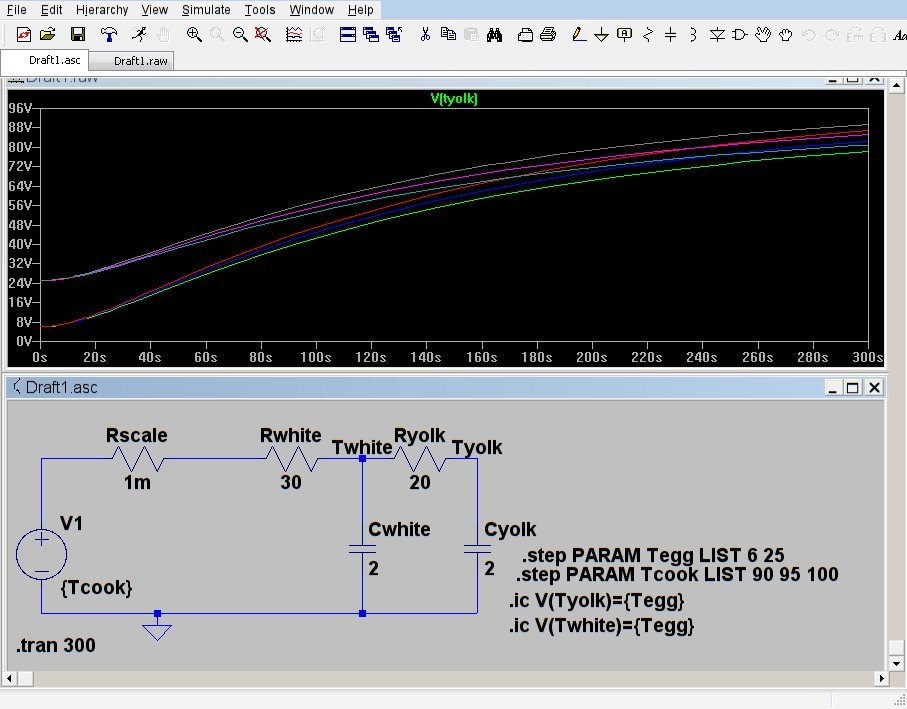
image


Good results, now I have to program this circuit in the microcontroller. I didn't want to dive into theory of differential equation solving by hand, so I calculated a 'crude' solution; every two seconds I calculate the current through the resistors based on the calculated 'temperature/voltages' of the previous sample. I then use these currents to calculate the new voltages on the capacitors.

This is a bit inaccurate, especially for fast changing temperatures, but I guess that won't be a problem in this case. To proof whether my method made sense I first programmed it in a spreadsheet (see formula in box: calculate currents, integrate this over capacitor):
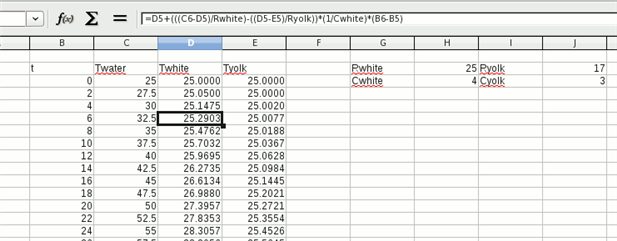
image


I checked these values (also after 300 seconds) and they corresponded nicely with the values from the simulation. This is what it became in code:


#define RTH_WHITE 25.0

#define CTH_WHITE 4.0

#define RTH_YOLK  17.0

#define CTH_YOLK  3.0

#define TSTART_EGG 20.0


struct egg_s

{

    float tyolk;

    float twhite;

};


void CalculateTyolk(struct egg_s *egg, float twater)

{

    float tyolk_new, twhite_new;

    twhite_new = egg->twhite + ((((twater - egg->twhite)/RTH_WHITE)-((egg->twhite - egg->tyolk)/RTH_YOLK))*(1/CTH_WHITE)*2);

    tyolk_new  = egg->tyolk  + (((egg->twhite- egg->tyolk)/RTH_YOLK) * (1/CTH_YOLK) * 2);

    egg->tyolk = tyolk_new;

    egg->twhite = twhite_new;


}


Preliminary results

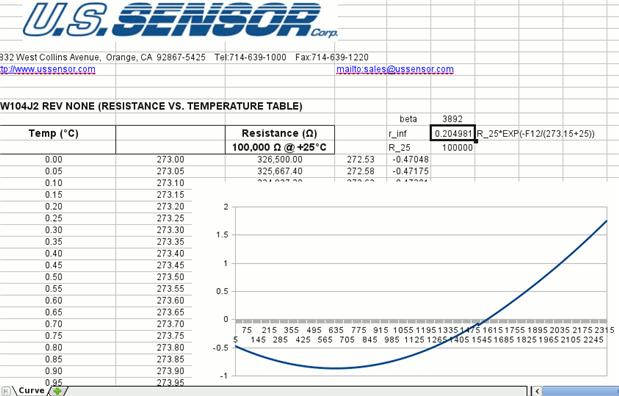
I tested this code last weekend, and it worked reasonably well for the amount of estimation I used. The problem I found was that the cooking point was at 108 degrees Celsius... The Netherlands are below sea level, but pressure is not that high.... One of the reasons is the 'simple' beta value calculation I used: here a plot of the values, again from a spreadsheet; the plot shows the error. The simplified formula is good around 25 degrees, but not at the extremes. I can change the formula to 'shift' the error to another point, and I'm going to check what the temperature sensors' resistance is at those extremes.
image


Energy usage

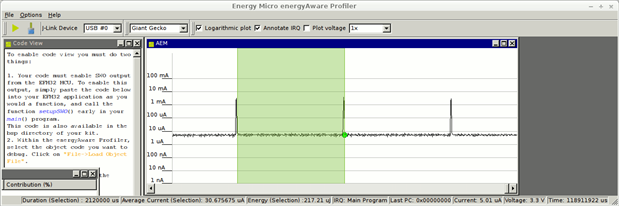
image

Click on the image to see in real size; in the status bar you can see that one sample costs 217microjoule, with an average usage of  31uA.

  • Sign in to reply
element14 Community

element14 is the first online community specifically for engineers. Connect with your peers and get expert answers to your questions.

  • Members
  • Learn
  • Technologies
  • Challenges & Projects
  • Products
  • Store
  • About Us
  • Feedback & Support
  • FAQs
  • Terms of Use
  • Privacy Policy
  • Legal and Copyright Notices
  • Sitemap
  • Cookies

An Avnet Company © 2026 Premier Farnell Limited. All Rights Reserved.

Premier Farnell Ltd, registered in England and Wales (no 00876412), registered office: Farnell House, Forge Lane, Leeds LS12 2NE.

ICP 备案号 10220084.

Follow element14

  • X
  • Facebook
  • linkedin
  • YouTube