element14 Community
element14 Community
    Register Log In
  • Site
  • Search
  • Log In Register
  • Community Hub
    Community Hub
    • What's New on element14
    • Feedback and Support
    • Benefits of Membership
    • Personal Blogs
    • Members Area
    • Achievement Levels
  • Learn
    Learn
    • Ask an Expert
    • eBooks
    • element14 presents
    • Learning Center
    • Tech Spotlight
    • STEM Academy
    • Webinars, Training and Events
    • Learning Groups
  • Technologies
    Technologies
    • 3D Printing
    • FPGA
    • Industrial Automation
    • Internet of Things
    • Power & Energy
    • Sensors
    • Technology Groups
  • Challenges & Projects
    Challenges & Projects
    • Design Challenges
    • element14 presents Projects
    • Project14
    • Arduino Projects
    • Raspberry Pi Projects
    • Project Groups
  • Products
    Products
    • Arduino
    • Avnet & Tria Boards Community
    • Dev Tools
    • Manufacturers
    • Multicomp Pro
    • Product Groups
    • Raspberry Pi
    • RoadTests & Reviews
  • About Us
    About the element14 Community
  • Store
    Store
    • Visit Your Store
    • Choose another store...
      • Europe
      •  Austria (German)
      •  Belgium (Dutch, French)
      •  Bulgaria (Bulgarian)
      •  Czech Republic (Czech)
      •  Denmark (Danish)
      •  Estonia (Estonian)
      •  Finland (Finnish)
      •  France (French)
      •  Germany (German)
      •  Hungary (Hungarian)
      •  Ireland
      •  Israel
      •  Italy (Italian)
      •  Latvia (Latvian)
      •  
      •  Lithuania (Lithuanian)
      •  Netherlands (Dutch)
      •  Norway (Norwegian)
      •  Poland (Polish)
      •  Portugal (Portuguese)
      •  Romania (Romanian)
      •  Russia (Russian)
      •  Slovakia (Slovak)
      •  Slovenia (Slovenian)
      •  Spain (Spanish)
      •  Sweden (Swedish)
      •  Switzerland(German, French)
      •  Turkey (Turkish)
      •  United Kingdom
      • Asia Pacific
      •  Australia
      •  China
      •  Hong Kong
      •  India
      •  Japan
      •  Korea (Korean)
      •  Malaysia
      •  New Zealand
      •  Philippines
      •  Singapore
      •  Taiwan
      •  Thailand (Thai)
      •  Vietnam
      • Americas
      •  Brazil (Portuguese)
      •  Canada
      •  Mexico (Spanish)
      •  United States
      Can't find the country/region you're looking for? Visit our export site or find a local distributor.
  • Translate
  • Profile
  • Settings
Experimenting with Thermistors
  • Challenges & Projects
  • Design Challenges
  • Experimenting with Thermistors
  • More
  • Cancel
Experimenting with Thermistors
Challenge Blog Thermistor Multiplexing – Introduction
  • Blog
  • Forum
  • Documents
  • Files
  • Mentions
  • Sub-Groups
  • Tags
  • More
  • Cancel
  • New
  • Share
  • More
  • Cancel
Group Actions
  • Group RSS
  • More
  • Cancel
Engagement
  • Author Author: scottiebabe
  • Date Created: 2 Aug 2022 7:43 PM Date Created
  • Views 16691 views
  • Likes 12 likes
  • Comments 9 comments
  • experimenting with thermistors
Related
Recommended

Thermistor Multiplexing – Introduction

scottiebabe
scottiebabe
2 Aug 2022

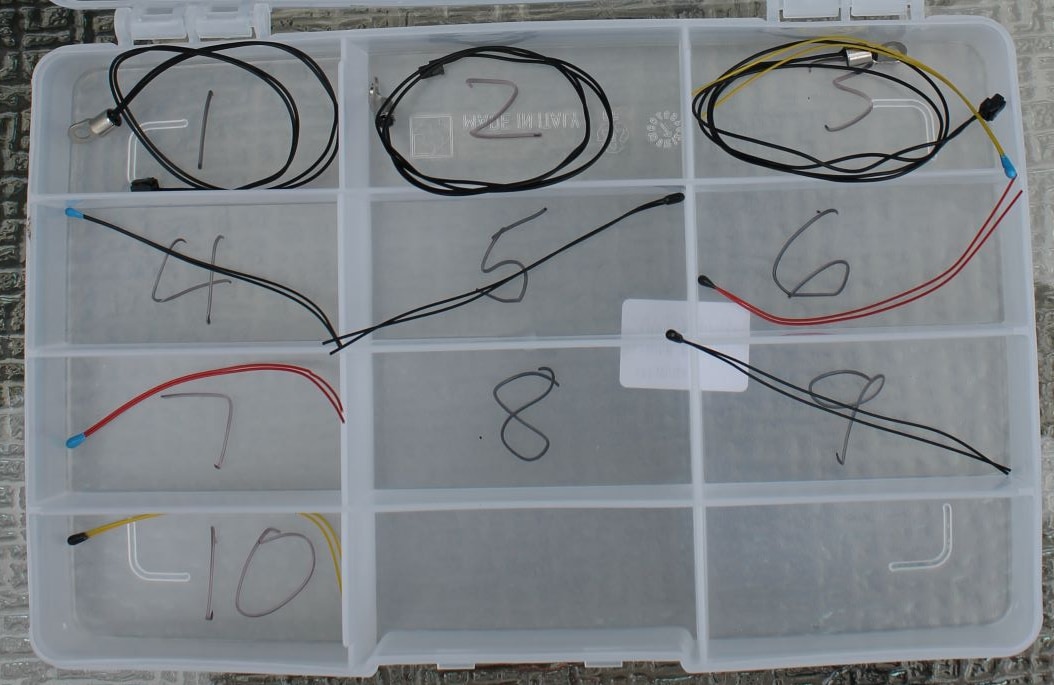
As soon as I saw the announcement for the ‘Experimenting with Thermistors’ challenge, I knew I would be thrilled to have my name on challenger list. Thank you to Element14 and Molex for selecting as one of 10 experimenters to receive an assortment of Molex thermistors to experiment with. The kit arrived safe and sound and neatly organized on July 15, thanks to great staff at element14!
image

The 7 bead style Molex thermistors I received as part of the experimenters kit are as follows:

R25 Beta Wire Color Epoxy Color Datasheet
3k 3892K black black https://www.molex.com/molex/products/part-detail/cable_assemblies/2152723307
4k7 3892K black blue https://www.molex.com/molex/products/part-detail/cable_assemblies/2152723407
5k 3892K red black https://www.molex.com/molex/products/part-detail/cable_assemblies/2152723507
10k 3892K black black https://www.molex.com/molex/products/part-detail/cable_assemblies/2152723607
12k 3892K red blue https://www.molex.com/molex/products/part-detail/cable_assemblies/2152723707
30k 3892K yellow blue https://www.molex.com/molex/products/part-detail/cable_assemblies/2152723807
47k 3892K yellow black https://www.molex.com/molex/products/part-detail/cable_assemblies/2152723907

The 3 ring-terminal mount Molex thermistors are:

R25 Beta Datasheet
10k 3500k https://www.molex.com/molex/products/part-detail/cable_assemblies/2138601637
10k 3500k https://www.molex.com/molex/products/part-detail/cable_assemblies/2138602637
10k 3800k https://www.molex.com/molex/products/part-detail/cable_assemblies/2138622637

Before you get too excited about the induvial unit prices, it is important to remember that these are not just bare thermistors. Rather, the Molex products are temperature measurement probes/sub-assemblies, with 1% tolerances on R25 and beta. They only have 2 leads and being thermal-resistors they are inherently electrically un-polarized. They aren’t ESD sensitive, within reason I suppose. Even better yet, they are extremely sensitive to temperature changes, the specific value vary per thermistor and over temperature, but typical figures are anywhere from -2%/degC to -5% /degC. The list could go own, suffice it to say they are more than just bare thermistors.

Who is Scottie?

At times she is an electronics designer and at other times she is a professional tinkerbell. She has been an electronics hobbyist the vast majority of her life and collected a number of technical hats along the way (and cute shoes) along the way. My contributions on element14 have been rooted in sharing my love, passion, and knowledge of electronics design with the other 700k+ extraordinary individuals who make up the element14 community.

The Experiment

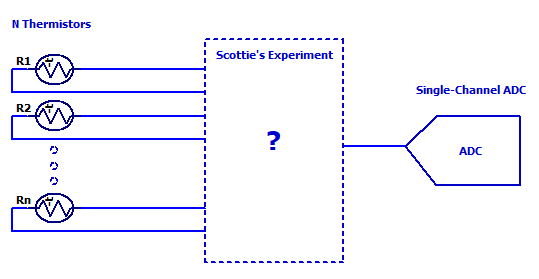
For this “experimenting with” competition I have chosen a well defined thermistor problem that I am interested in experimenting with. Sampling one thermistor is great, but perhaps you would like to sample 2, 3, or even 16 thermistors while only having a single Analog to Digital Converter (ADC).
image

The are few different circuit topologies I can think of, each with their own pros and cons. As a result of my experiments I hope to shed some light on this topic and learn lots about thermistors along the way! (I already am :))

Golden Samples for the Golden Girl

I don’t have the personal means to create any of the cardinal temperature points on the ITS-90 temperature scale. So, if I were to make any experimental temperature measurements they would all referenced against a temperature measurement probe. Given the resources available to me, my measurement uncertainty budget would be at least 1 to 2 orders of magnitude off what a fully funded R&D lab could achieve. So, I don’t intend to focus on experimentally determining the exact relation between the operating temperature and electrical resistance of an NTC thermistor. From the circuit designers perspective, it is the thermistor supplier’s role to describe and document what the temperature-resistance function is. We only need to recognize that the relation is Highly non-linear and that thermistor’s resistance may vary by 2 orders of magnitude over a 100 degC temperature span.

As such, I have constructed 6 golden resistance samples that model the equivalent resistance of a 10 kOhm thermistor at temperatures varying from -25 degC to +100 degC. In the mechanical drawing for 10 kOhm thermistor (215272-3607), there is a temperature-resistance table. From this resistance table, I noted the nominal resistance at 6 temperature as shown my golden sample table below. I tried my best to select/construct an equivalent resistance from the metal film resistors I had on hand.

image

I measured the resistance of the samples in 4-wire mode with my 6-1/2 digit multi-meter (HP 34401A).

I will acknowledge that these samples may be slightly tarnished, in that they won’t model the self-heating effects of a real thermistor that arises from the I2R power due to the measurement excitation current.

Defining Experimental Success

In this element14 event, I only intended to author two formal blogs. The first blog is this introductory blog and the second blog will present and summarize my experiments, achievements, and learnings over the course of the 2 month challenge period. Additionally, I consider my forum posts to be my personal experimental logbook of my measurements and learnings. At the time of authoring this post, I have thus far spent considerable time learning/refreshing my memory on the theory, operation, models, and simulation of thermistors.

As far as I am concerned, If I am able complete the two required blogs for this challenge while spreading good cheer and perhaps a few technical insights into thermistors, I will consider my experiment to be a great success!

Now as the big element14 sharks circle the prize pool, (I’m told technical sharks have an supper sense of smell for coffee), this little starfish will tinker away on her experiments!

Thanks for reading and take care.

  • Sign in to reply

Top Comments

  • shabaz
    shabaz over 3 years ago +1
    Interesting challenge! Looking forward to seeing the results. I've been puzzling with a slightly different thermistor multiplexing issue. Maybe once your investigation is complete, I might find a way…
  • javagoza
    javagoza over 3 years ago +1
    Good luck with your project. I will be attentive to the next blog because I feel angry with myself for not having understood the experiment well. I found the thermistor simulation very interesting and…
  • ntewinkel
    ntewinkel over 3 years ago +1
    OOOh!! This looks like a great experiment, scottiebabe . !! I was just lamenting the lack of analog inputs on my ESP-8266 based dev boards, and thought of multiplexing but soon realized that would be…
  • scottiebabe
    scottiebabe over 3 years ago in reply to javagoza

    Thanks for vote of confidence, you are always there to cheer on my blogs! 

    The golden samples serve as nearly prefect thermistors at 6 temperatures. If I had a thermometer designed for a Molex 10k thermistor, I could attach one of my golden samples to the meter instead of the thermistor and observe the reported temperature. If the displayed temperature did not match the theoretical temperature, I could attribute the error to the meter, because the sample is accurately known.

    Likewise in my experiments, when I make measurements of these golden samples, any measurement errors will be the result of me and or component tolerances of my circuits.

    • Cancel
    • Vote Up 0 Vote Down
    • Sign in to reply
    • More
    • Cancel
  • javagoza
    javagoza over 3 years ago

    Good luck with your project. I will be attentive to the next blog because I feel angry with myself for not having understood the experiment well.

    I found the thermistor simulation very interesting and clever, but I don't understand why you needed to do that simulation. I think I have lost something in understanding the text.

    • Cancel
    • Vote Up +1 Vote Down
    • Sign in to reply
    • More
    • Cancel
  • scottiebabe
    scottiebabe over 3 years ago in reply to shabaz

    Thanks for the kind words, I am excited to start experimenting. If your thermistor project involves a Molex thermistor you could be the great white shark 

    image 

    LOL jokes aside this event will be a lot fun of regardless of the prize outcome Slight smile

    • Cancel
    • Vote Up 0 Vote Down
    • Sign in to reply
    • More
    • Cancel
  • shabaz
    shabaz over 3 years ago

    Interesting challenge! Looking forward to seeing the results.

    I've been puzzling with a slightly different thermistor multiplexing issue. Maybe once your investigation is complete, I might find a way to repurpose your project for my task..

    I'll write up my problem in a separate thread not to hijack your blog, in case you have any ideas.

    • Cancel
    • Vote Up +1 Vote Down
    • Sign in to reply
    • More
    • Cancel
<
element14 Community

element14 is the first online community specifically for engineers. Connect with your peers and get expert answers to your questions.

  • Members
  • Learn
  • Technologies
  • Challenges & Projects
  • Products
  • Store
  • About Us
  • Feedback & Support
  • FAQs
  • Terms of Use
  • Privacy Policy
  • Legal and Copyright Notices
  • Sitemap
  • Cookies

An Avnet Company © 2026 Premier Farnell Limited. All Rights Reserved.

Premier Farnell Ltd, registered in England and Wales (no 00876412), registered office: Farnell House, Forge Lane, Leeds LS12 2NE.

ICP 备案号 10220084.

Follow element14

  • X
  • Facebook
  • linkedin
  • YouTube