


Hi everyone! It’s an honour to be selected as one of the competitors for the “My Project is Trash” design challenge. It’s been a while since I’ve had the time to participate in such programs and despite applying for some activities, being chosen is always down to luck.
Nevertheless, I’d have to say that I’m absolutely amazed to be chosen for this challenge because it feels like a very fun challenge to do – so I’ll try to make my posts a bit of fun, while being educational and detailed. Unlike previous contest entries, I’ll also try to make them a little more interactive than normal … after all, you might call me an upcoming binfluencer.
The Problem
If you live in a country where your waste is stored in a “wheely bin” that you take out to the kerbside, you probably have a host of frustrations to deal with. As a family, I’ve dealt with a number of issues, ranging from:
- Lids accidentally left open or blown open by the wind, allowing rain or animals to get in and make a mess of all the rubbish.
- Not knowing how much free space is in the bin before deciding to embark on a clean-up, resulting in an awkward situation that the bin is already full – especially likely given the recent down-sizing of garbage bins in our area to encourage more recycling uptake.
- Bins falling over, especially after emptying, rolling around and potentially fouling the road and risking traffic accidents.
- Bins not being collected early after being emptying, resulting in unfriendly neighbours using up your bin capacity. Sometimes unfriendly neighbours may also place smelly or disallowed waste into your bins causing a reprimand letter from the council or refusal to empty your bin.
- Family members may be busy, while others may be forgetful with pre-dementia and forget to take out the bin or forget how many bins need to be taken out. Relying on your neighbours is not a guarantee as they can get it wrong too!
- Trash-rummagers may pick through recycling bins looking for containers with return credits attached, leaving the lid open or pouring out its contents everywhere – something to catch them starting before they cause a big issue would be good.
As a result, I’d have to say these are all wheely problems we need to solve!
The Solution
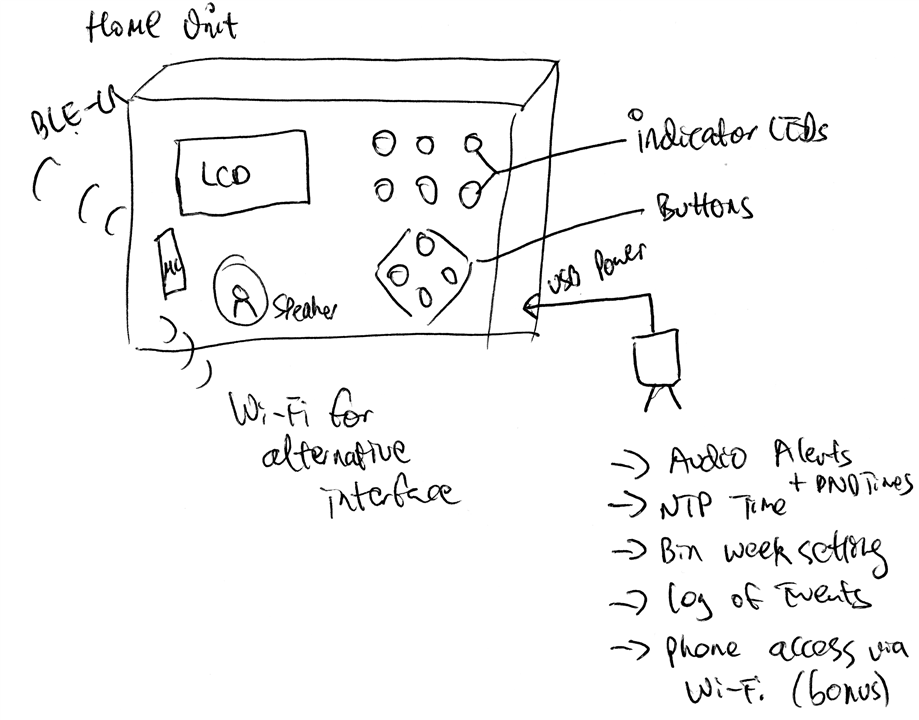
I envisage the solution to be a two-part solution. The first part sits inside the home and is a unit that has a display, a few indicators, a speaker for aural alerts and some buttons. The unit will have a simple LCD interface that displays the current and historical status of up to two bins, with some counters and history logs. The indicators will flash to indicate alerts (e.g. tonight is bin night, bin has been tampered) or to indicate approximate level. Buttons will be used to provide feedback to the system to indicate the bins have been taken out or to navigate menus. Time should be provided through NTP (so no RTC is necessary and hopefully the time will remain accurate). Connection to a home network would be made over Wi-Fi, which should also allow a mobile phone to visit the unit’s webpage to see the same status without being in-front of the unit.
The other part of the solution will be the outside unit that is installed into the bin. The two microswitches will be used to detect the lid status and the bin upright status by detecting the ground – this makes it a little easier in case the bin is placed on an incline where the accelerometer data may be a bit more tricky to interpret. The accelerometer will be used on the lid itself to try and determine the lid angle in case it is opened and to detect if the bin has been “hit” by an object (perhaps useful for afternoon cricket on a Sunday). Inside the bin, an infrared sensor perhaps of the Time-of-Flight variety (I wonder if the provided infrared angle sensors can be used for this) would be used to measure the free space above the trash to the lid to determine free capacity. The unit will be powered by a rechargeable Li-Poly battery and be charged by solar power using a panel on the lid of the bin. Connectors will be used to allow the electronics to be detached from the microswitches mounted on the bin sections, to allow for the module to be exchanged.
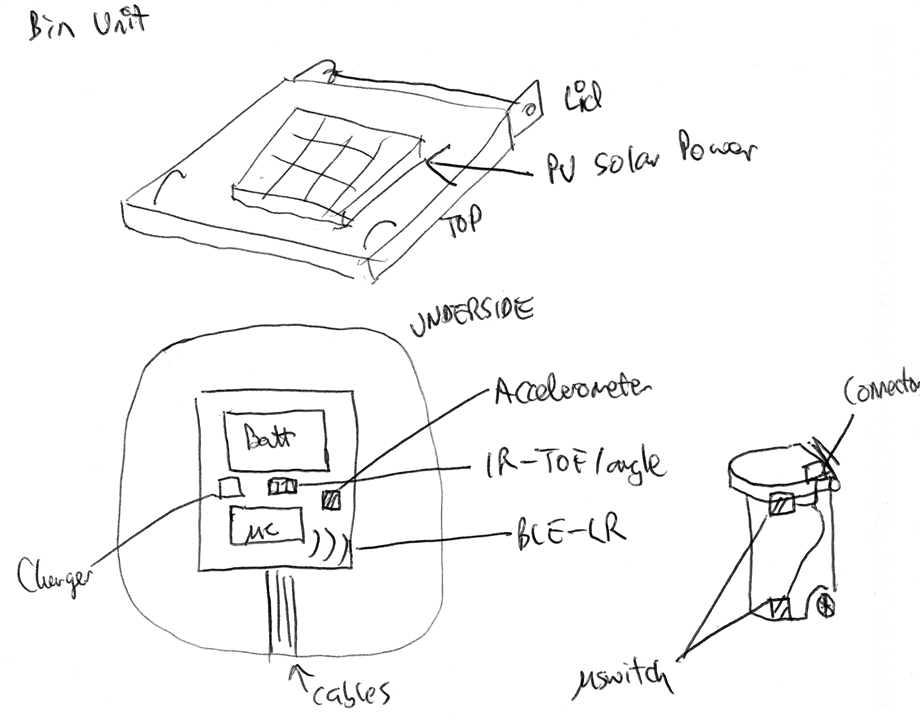
Connectivity from the outside unit to the inside unit will be made using Bluetooth Low-Energy in Coded PHY (long-range) mode. Hopefully this will be reliable and stable enough to keep an eye on my bin even though it’s on the street (experience suggests that it should work), but co-existence with BLE + Wi-Fi might be a bit tricky. For this purpose, I believe the best platform would be an ESP32, preferably the S3/C3 revision or newer.
A second bin (e.g. a recycling bin) would be added by adding another sensor node – but since the supplied kit is limited, I’ll leave that extension as one for exploring after the completion of the challenge.
Challenges to Overcome
The first challenge that is faced is simply the total five-week design challenge period of which I’d estimate just four weeks after the parts are received. This is not a lot of time (especially as I do have a full-time job) and means that I might have to resort to Veroboard construction and using parts from my junk box rather than ordering project-specific parts and PCBs. As a result, the outcome might not be as polished as in a longer design challenge.
The second is simply the issue of having a bin to use. The problem is that my real rubbish bins are property of the council and they probably won’t be happy if I’m modifying their bins or if my contraptions fall off into a garbage truck (especially as they may have batteries which could become fire hazards). As a result, I’ll need to source my own bin or bin-surrogate in a way. Perhaps I can 3D print a bin … but with the small print bed size, it’ll be a bit of a long journey to finish in parts and assembly would be a pain.
The third might well be issues with connectivity and energy – making sure there’s enough energy and optimising the sleep routines. Building up the user interface will also be another challenge to refine. Having the equipment outdoors, potentially exposed to high temperatures and humidity will pose challenges for the electronics, which might need to be hardened to survive. Nevertheless, these will be things I encounter when I get there and I have some ideas of how I might overcome these. But I intend to “learn as I go” on some of these things … putting electronics “inside” the bin might help them weather a storm as long as the lid is closed … but also might expose it to dirt and there’s also the potential issues of vermin and insects.
What’s in a Name? ***YOUR HELP REQUIRED!***
When I applied for this design challenge, I had a long think about what I would call my project. I settled on a name which I preferred, but not before coming up with a flood of names vaguely trash-related. Rather than simply go with my preferred name, I decided that I would post a list of my best attempts at naming my “trashy” project and let the readers decide.
Here are the candidate names:
- Lil’ Raccoon – we know raccoons are cute and love trash. They’re even known colloquially as “trash pandas”. The system will definitely let you know if a raccoon has gotten into your bin – not a problem in Australia but I can’t help but like the cute connotations.
- Osama – perhaps not a name in the greatest taste, but the project will let you know if your “bin [is] laden”. But I’m not sure element14 would like to announce Osama Bin Laden as the winner …
- Bintegrity – a portmanteau of bin and integrity. It’s simple and it explains what it does.
- Monitrash – a portmanteau of monitor and trash. Much the same.
- iBin (or iCan) – it keeps an “eye” on the bin and it’s “intelligent” … but it feels a bit too 2000’s and Apple-y. At least I won’t call it a Mac Pro *shots fired* …
- Binspector – a portmanteau of bin and inspector.
- Bintellect (or Bintelligent) – a portmanteau of bin and intellect/intelligent.
- Binminder – a portmanteau of bin and reminder (or minder).
- Bin Counter – a pun on “bean counter”, since the project can “count” trash.
I sort of know which name I like the most … but rather than simply decide with my own gut, I’ve decided to give the community the honours of naming my project. So let’s put it to a vote and in seven days, I’ll make a decision. After all, this isn’t a bin-ary decision …
Conclusion
While the challenge kit still has not arrived, this challenge will be quite a short one, with only four weeks remaining. This might mean that I won’t have time to make a PCB or order specialised components, so perhaps I should instead make things out of whatever I could find in my junk box. After all, this is a trash challenge. More than that, I’ll resist the temptation to rely on any form of AI – I prefer to be authentic and enjoy the journey. After all, it’s not a slop challenge and the terms do make some stipulations about the intellectual property being either owned by the author or available from code repositories.
I look forward to the imminent arrival of the kit some time this week. Once I have it in-hand, I’ll have a much better idea of just how I might proceed.
That’s all for this first blog post – but you can help me by voting for a name for my project or suggesting a new one. Optionally, I’m also open to some trash-talk, if you want to give that a go. Let me know what’s on your mind! Bonus points for your best puns …
