


Hi. I welcome you to next part of my series about my experiments with industrial sensors. In this part I will look at thermocouple. As part of kit, I’ve got kit of five K-Type thermocouple. Compared to previously described sensor, thermocouple is complete opposite. It do not produce current output, instead it produces voltage output, and instead of getting decent industrial reliable output, it actually generates only few millivolts. While previous sensor was providing absolute value, thermocouples provide relative output to some reference called cold junction. It is temperature on connector where different metal touch each other. Sensor provides temperature difference between probe and this connector. To get absolute measurement, we need to measure one of these temperatures by different sensor. But Let’s begin simply. Let’s start with multimeter again.
As a first experiment I connected multimeter in mili-voltmeter mode directly to sensor:

And when I heated a probe a little I’ve got slightly higher voltage:

Note that measurements are not in V. They are in mV. So, it is 0,00023V actually. Very low voltage!
I tried Fluke online calculator at: www.fluke.com/.../thermocouple-voltage-to-temperature-calculator
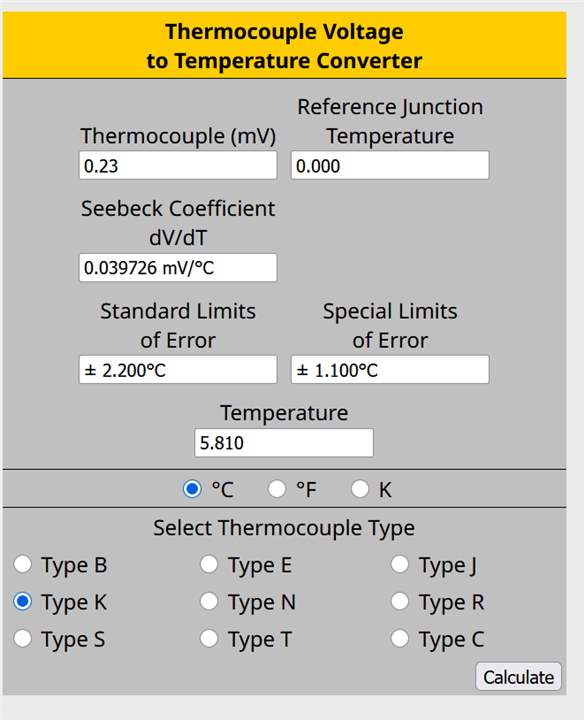
As you can see, such small voltage difference correspond to 5,810 °C temperature difference between cold junction and thermocouple. It corresponds to difference between room temperature about 29°C these days and my finger temperature around 36°C.
Let’s try digitally
For using thermocouples in real, we need to deal with two problems. Very low voltage and need for second sensor. Back in 2022, there were Experimenting with Thermistors competition which I joined. Thermistors are one of the possible solutions for second sensor need. Additionally, as part of Experimenting with Thermistor I created board with 24-bit ADC with PGA which can nicely measure both thermistor and thermocouple. It is built around MAX11410 ADC chip. I reused it for this project. The idea was to reuse current part for thermistor and reference:

Chip has build int constant current generator, which can generate current like 50uA and pass it from port like AIN4 here. This current flow down through thermistor and 22k precise (0,1% tolerance resistor) which generates reference (REF1). This can nicely measure thermistor relatively to known reference without any precise voltage reference (50uA current is also imprecise).
For thermocouple I had plan to use another two channels of my board like Maxim showcase in ADC chip datasheet (however I used AIN7 and 8 since 4, 5, 6 are already occupied):

For this measurement, I actually need precise voltage reference. My idea was to use builtin reference, measure precise resistor using it, estimate it’s error and compensate thermocouple voltage measurement with this knowledge.
I connected everything:

Note that thermistor end (two thin black wires ending on yellow connector) touches cold junction of thermocouple.
Failed
However, my experiment failed. I migrated my MAX11410 library to Arduino Uno Q, adjusted code to do measurements as needed, but if for some reason returned full scale voltage in nearly all cases. As part of troubleshooting, I tried run the same experiment which I run back in Experimenting with Thermistors era, on same board, with same code, with disconnected other new parts and it still produce bad numbers.
I am not sure what happened to my ADC board, but I am, no longer do even basic voltage measurements with it. After few hours of troubleshooting, I gave up.
And since time is running out. This is end of my experimenting here. In next part, I will summarize all my efforts.