element14 Community
element14 Community
    Register Log In
  • Site
  • Search
  • Log In Register
  • Community Hub
    Community Hub
    • What's New on element14
    • Feedback and Support
    • Benefits of Membership
    • Personal Blogs
    • Members Area
    • Achievement Levels
  • Learn
    Learn
    • Ask an Expert
    • eBooks
    • element14 presents
    • Learning Center
    • Tech Spotlight
    • STEM Academy
    • Webinars, Training and Events
    • Learning Groups
  • Technologies
    Technologies
    • 3D Printing
    • FPGA
    • Industrial Automation
    • Internet of Things
    • Power & Energy
    • Sensors
    • Technology Groups
  • Challenges & Projects
    Challenges & Projects
    • Design Challenges
    • element14 presents Projects
    • Project14
    • Arduino Projects
    • Raspberry Pi Projects
    • Project Groups
  • Products
    Products
    • Arduino
    • Avnet & Tria Boards Community
    • Dev Tools
    • Manufacturers
    • Multicomp Pro
    • Product Groups
    • Raspberry Pi
    • RoadTests & Reviews
  • About Us
  • Store
    Store
    • Visit Your Store
    • Choose another store...
      • Europe
      •  Austria (German)
      •  Belgium (Dutch, French)
      •  Bulgaria (Bulgarian)
      •  Czech Republic (Czech)
      •  Denmark (Danish)
      •  Estonia (Estonian)
      •  Finland (Finnish)
      •  France (French)
      •  Germany (German)
      •  Hungary (Hungarian)
      •  Ireland
      •  Israel
      •  Italy (Italian)
      •  Latvia (Latvian)
      •  
      •  Lithuania (Lithuanian)
      •  Netherlands (Dutch)
      •  Norway (Norwegian)
      •  Poland (Polish)
      •  Portugal (Portuguese)
      •  Romania (Romanian)
      •  Russia (Russian)
      •  Slovakia (Slovak)
      •  Slovenia (Slovenian)
      •  Spain (Spanish)
      •  Sweden (Swedish)
      •  Switzerland(German, French)
      •  Turkey (Turkish)
      •  United Kingdom
      • Asia Pacific
      •  Australia
      •  China
      •  Hong Kong
      •  India
      • Japan
      •  Korea (Korean)
      •  Malaysia
      •  New Zealand
      •  Philippines
      •  Singapore
      •  Taiwan
      •  Thailand (Thai)
      • Vietnam
      • Americas
      •  Brazil (Portuguese)
      •  Canada
      •  Mexico (Spanish)
      •  United States
      Can't find the country/region you're looking for? Visit our export site or find a local distributor.
  • Translate
  • Profile
  • Settings
Save The Bees Design Challenge
  • Challenges & Projects
  • Design Challenges
  • Save The Bees Design Challenge
  • More
  • Cancel
Save The Bees Design Challenge
Blog BeeAInspector: a camera trap to help in wild bee conservation and research
  • Blog
  • Forum
  • Documents
  • Leaderboard
  • Polls
  • Files
  • Members
  • Mentions
  • Sub-Groups
  • Tags
  • More
  • Cancel
  • New
Join Save The Bees Design Challenge to participate - click to join for free!
  • Share
  • More
  • Cancel
Group Actions
  • Group RSS
  • More
  • Cancel
Engagement
  • Author Author: FollowTheWizard
  • Date Created: 2 Feb 2023 8:03 PM Date Created
  • Views 1853 views
  • Likes 14 likes
  • Comments 14 comments
  • save the bees
  • savethebeesch
  • nicla vision
  • wild bees
  • arduino pro
Related
Recommended

BeeAInspector: a camera trap to help in wild bee conservation and research

FollowTheWizard
FollowTheWizard
2 Feb 2023

BeeAInspector Bee

  Blog 1

Hi everyone, we are Phil and Ale, and like all of you, we are interested in saving the bees and using some fun tech along the way  Grinning .

About us

image

Phil: I am a semiconductor test engineer and my passion is using information technology to tackle real world problems. I like contributing to progress and making processes easier, safer and more reliable through innovation.   

image

Ale: I am a biologist working at a university in plant-insect networks, such as herbivores and pollination. I am interested in sustainable development and conservation, specially in the way we do agriculture and we feed humanity.

Phil will be building up the technical set up, with Ale as a consultant on the biological aspects of the bees. We hope our interdisciplinary backgrounds help us address better the “Element 14 Save the bees” challenge and help with testing our device in the ground eventually.

For this challenge we would like to build up a camera set up that allows us to record solitary bees and a few aspects of their biology that are still understudied. In this first blog we will introduce you to the bee species we will be working with and the research questions we would like to address and to info about our model bees, that will be useful to understand our set up later. In further blog posts we will go deeper into the technical aspects.


About the solitary and wild bees

There are 22000 species of bees around the world, most of which are solitary. This doesn’t mean that they live alone; just means that they do not form part of a colony, like honeybees or bumblebees, but each of them makes a nest of its own, usually next to each other. Some of the most common types of solitary bees that nest in our region (Germany) are called Mason bees, and some examples of species are Osmia bicornis (common name: red mason bee) and Megachile centuncularis (common name: leafcutter bee).

 image

Osmia bicornis (common name: red mason bee)

 image By S.Falk (Flicker)

Megachile centuncularis (common name: leafcutter bee)


You can see from the images how different these bees look to the european honeybee most people are familiar with. These bees don’t produce honey in their nests, but they still visit flowers for their nectar and pollen.

imageFun fact!

Mason bees collect pollen in their bellies (called the abdominal scopa), instead of carrying it in their legs. Pollen is very important for the larvae of the bee, because it contains the proteins necessary to develop.


In honeybee colonies, there is only one bee that mates and lays eggs – the queen. But for mason bees, all females bees can mate and build a nest of their own, starting in spring. In a reed or hollow branch they lay multiple eggs in a row, each in one compartment that they close off with soil or pieces of leaves. Each reed can have approximately 4-12 cells, from which usually the female (eggs) are lay first (at the bottom) since they take longer to develop than the male (eggs) that go in front (towards the exit of the reed).


 image

Opened reed from a red mason bee: you can see 5 cells, each with a an egg and pollen reserve, separated by a wall made with soil (as are the safety and exit closures)


The mother bee also patiently brings pollen grains into each cell so the larvae can feed while it grows and transforms into a pupae. The exit of the reed is sealed with soil or leaves, depending on the species, to prevent parasites and other bees from entering and disturbing the nest.

A lot of work goes into building a nest! And a mother bee only can do a handful until their time is up and they die, which depending on the species would be around end of summer or autumn.
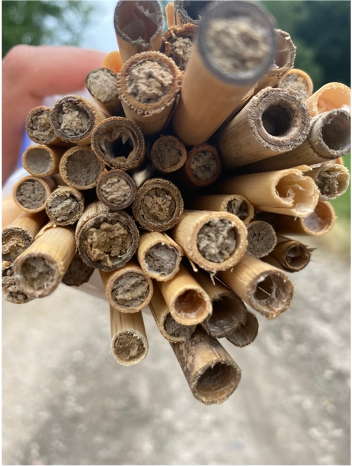
 

 image

Closed and opened reeds from a red mason bee from outside


Our research questions

Most research is being done in honeybees, given their importance for honey production and pollination of crops, whereas less is known of the biology of solitary bees, even if they a crucial part of pollination services for crops and wild plants. Wild bees can in many cases even be more efficient in pollination than honeybees because they sometimes specialize in only one type of plant (a well known case being the alfalfa crop).  

In the context of conservation of solitary bees, it would be important to be able to explore:

  • How long does it take for a wild bee nest to fill up?

  • How many flights does the mother bee makes to bring in pollen to the larvae before closing the nest?

  • How is the temperature, air quality and humidity level affecting the proportion of reeds successfully filled and closed?


The challenge: BeeAInspector

Answering these questions requires that naturalists and scientist spend many hours recording observations during long periods of time, often months. Also many of these nests need to be placed where the wild bees are, which can be anything from easy access balconies and patios in urban spaces to difficult access faraway areas in national parks and agricultural fields. So scientists spend a lot of time, resources and effort traveling to these areas multiple times, and even so they cannot monitor every nest at the same time. 


Camera traps can be a useful tool to better understand life cycles and correlate developmental milestones with environmental factors that affect them. An intelligent camera could provide a daily record of bee movement in without a person being present on site. Furthermore, if it would be paired with sensors that measure different environmental parameters, these could be correlated with the bee movements and percentage of filled nests. Finally, we could develop software to analyze the images over time and inform about the ratio of filled vs. empty reeds.

This is what we want to achieve with BeeAInspector, a project that with a playful name between bees, AI, and inspection will basically be a camera trap to help in wild bee conservation and research.


In further blog posts, we will dig deeper into the technical aspects of this project. We do hope the kits arrives soon! Hope you enjoyed our first blog and feel free to ask questions in the comment section Bee


Phil and Ale


  • Sign in to reply
Parents
  • beacon_dave
    beacon_dave over 2 years ago

    This sounds great.

    If the bees tend to lay eggs in reeds of about 4-12 cells, does this mean that 'bee hotels' like this one:

    image

    should really be deeper to hold longer reeds?

    • Cancel
    • Vote Up 0 Vote Down
    • Sign in to reply
    • More
    • Cancel
  • FollowTheWizard
    FollowTheWizard over 2 years ago in reply to beacon_dave

    Hi there, thanks for the question. Indeed most commercial bee hotels that are being sold have some issues: length of the reed is too short, the walls are too thin, the diameter is too big, and sometimes they have materials that are not suitable. It doesnt mean that no bee will occupy it - some can go around some of these flaws, for example by building up thicker walls with the materials they can carry. 

    The issue with having shorter reeds (less than 10 cm I would say) is that bees may lay only eggs of a certain sex as they dont have space to lay sufficient eggs of both sexes. Some literature says they will lay only males (e.g., https://www.ars.usda.gov/pacific-west-area/logan-ut/pollinating-insect-biology-management-systematics-research/docs/reed-nests/ ). But we have a 7 cm length reed nest in our garden and we have seen mostly females coming out. It would be a nice hypothesis to work on!

    On the positive side, these bee hotels look cute, they are appealing to children and they help raise awareness on wild bees - so they are not useless! But in the next blog we will show how we build our "research nests" of 18-20 cm length, which perhaps are less appealing to humans but provide a more comfy space for the bees.

    Cheers Bee

    • Cancel
    • Vote Up 0 Vote Down
    • Sign in to reply
    • More
    • Cancel
  • ntewinkel
    ntewinkel over 2 years ago in reply to FollowTheWizard

    Really interesting, FollowTheWizard ! What do you use for reeds? I'm wondering if my bamboo prunings would work? Is this one of those "please hold your questions until after the lesson/next blog post" situations? ;)

    • Cancel
    • Vote Up 0 Vote Down
    • Sign in to reply
    • More
    • Cancel
  • FollowTheWizard
    FollowTheWizard over 2 years ago in reply to ntewinkel

    We are happy for questions anytime! Bamboo prunings should work -  we are using bamboo reeds that we buy in a conservation center. This is in Germany, but you can check if they look like yours: https://www.naturschutzcenter.de/schilf . The important thing when cutting them is that you dont leave thick splinters in the edge, as the wings of the bees are fragile and could get damaged as they come in.

    • Cancel
    • Vote Up 0 Vote Down
    • Sign in to reply
    • More
    • Cancel
Comment
  • FollowTheWizard
    FollowTheWizard over 2 years ago in reply to ntewinkel

    We are happy for questions anytime! Bamboo prunings should work -  we are using bamboo reeds that we buy in a conservation center. This is in Germany, but you can check if they look like yours: https://www.naturschutzcenter.de/schilf . The important thing when cutting them is that you dont leave thick splinters in the edge, as the wings of the bees are fragile and could get damaged as they come in.

    • Cancel
    • Vote Up 0 Vote Down
    • Sign in to reply
    • More
    • Cancel
Children
No Data
element14 Community

element14 is the first online community specifically for engineers. Connect with your peers and get expert answers to your questions.

  • Members
  • Learn
  • Technologies
  • Challenges & Projects
  • Products
  • Store
  • About Us
  • Feedback & Support
  • FAQs
  • Terms of Use
  • Privacy Policy
  • Legal and Copyright Notices
  • Sitemap
  • Cookies

An Avnet Company © 2025 Premier Farnell Limited. All Rights Reserved.

Premier Farnell Ltd, registered in England and Wales (no 00876412), registered office: Farnell House, Forge Lane, Leeds LS12 2NE.

ICP 备案号 10220084.

Follow element14

  • X
  • Facebook
  • linkedin
  • YouTube