element14 Community
element14 Community
    Register Log In
  • Site
  • Search
  • Log In Register
  • Community Hub
    Community Hub
    • What's New on element14
    • Feedback and Support
    • Benefits of Membership
    • Personal Blogs
    • Members Area
    • Achievement Levels
  • Learn
    Learn
    • Ask an Expert
    • eBooks
    • element14 presents
    • Learning Center
    • Tech Spotlight
    • STEM Academy
    • Webinars, Training and Events
    • Learning Groups
  • Technologies
    Technologies
    • 3D Printing
    • FPGA
    • Industrial Automation
    • Internet of Things
    • Power & Energy
    • Sensors
    • Technology Groups
  • Challenges & Projects
    Challenges & Projects
    • Design Challenges
    • element14 presents Projects
    • Project14
    • Arduino Projects
    • Raspberry Pi Projects
    • Project Groups
  • Products
    Products
    • Arduino
    • Avnet & Tria Boards Community
    • Dev Tools
    • Manufacturers
    • Multicomp Pro
    • Product Groups
    • Raspberry Pi
    • RoadTests & Reviews
  • About Us
  • Store
    Store
    • Visit Your Store
    • Choose another store...
      • Europe
      •  Austria (German)
      •  Belgium (Dutch, French)
      •  Bulgaria (Bulgarian)
      •  Czech Republic (Czech)
      •  Denmark (Danish)
      •  Estonia (Estonian)
      •  Finland (Finnish)
      •  France (French)
      •  Germany (German)
      •  Hungary (Hungarian)
      •  Ireland
      •  Israel
      •  Italy (Italian)
      •  Latvia (Latvian)
      •  
      •  Lithuania (Lithuanian)
      •  Netherlands (Dutch)
      •  Norway (Norwegian)
      •  Poland (Polish)
      •  Portugal (Portuguese)
      •  Romania (Romanian)
      •  Russia (Russian)
      •  Slovakia (Slovak)
      •  Slovenia (Slovenian)
      •  Spain (Spanish)
      •  Sweden (Swedish)
      •  Switzerland(German, French)
      •  Turkey (Turkish)
      •  United Kingdom
      • Asia Pacific
      •  Australia
      •  China
      •  Hong Kong
      •  India
      •  Korea (Korean)
      •  Malaysia
      •  New Zealand
      •  Philippines
      •  Singapore
      •  Taiwan
      •  Thailand (Thai)
      • Americas
      •  Brazil (Portuguese)
      •  Canada
      •  Mexico (Spanish)
      •  United States
      Can't find the country/region you're looking for? Visit our export site or find a local distributor.
  • Translate
  • Profile
  • Settings
Sci Fi Your Pi
  • Challenges & Projects
  • Design Challenges
  • Sci Fi Your Pi
  • More
  • Cancel
Sci Fi Your Pi
Blog Meditech phase 0 - Annex II: The glucose analisys probe
  • Blog
  • Forum
  • Documents
  • Files
  • Mentions
  • Sub-Groups
  • Tags
  • More
  • Cancel
  • New
  • Share
  • More
  • Cancel
Group Actions
  • Group RSS
  • More
  • Cancel
Engagement
  • Author Author: balearicdynamics
  • Date Created: 27 Aug 2015 8:09 AM Date Created
  • Views 463 views
  • Likes 1 like
  • Comments 0 comments
  • meditech_project
  • glucose_analysis_probe
  • glucose_measure
  • raspberry-pi
  • reference_device
  • sci_fi_your_pi
  • glucose_metering
Related
Recommended

Meditech phase 0 - Annex II: The glucose analisys probe

balearicdynamics
balearicdynamics
27 Aug 2015

As the glucose measure probe to be used as reference has not been delivered for the expected time (just a couple of days ago) it has been moved as part of the Meditech phase 1 It is the worth to start do explain what is the adopted principle and what is the kind of analisys.

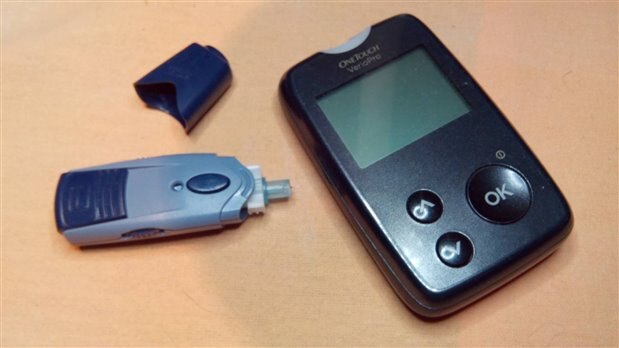
The following image shows a general view of the reference device. it cost on the market if you are not diabetics almost 2/3 of the entire cost of a complete Meditech unit, so I had to spend some time to find a way to have a full working device and accessories with a more reduced investment (about 100$)
image

The analyser (the biggest one in the image above) calculates the glucose percentage in the blood (a small drop of blood is needed from a finger, but we can assume this as non-invasive) The small needle is managed by a simple use mechanical device that "shoots" few mm the needle in the skin. Needles are single-use sterile parts that are the "bullet" of the mechanical device.


Usage steps

The glucose measure in diabetic patients should be done frequently  several times during the day; usually they should measure by their own with a similar device the glucose value in the blood when eating to self-calculate the insulin quantity they should inject to compensate their disease. Meditech glucose probe will replace the measurement device (providing more complete information) and should be able to adopt the same methodology in glucose measurement. This makes simple to use the needles and chemical  reactive already available on the market and worldwide diffused; can be found without difficult anywhere.


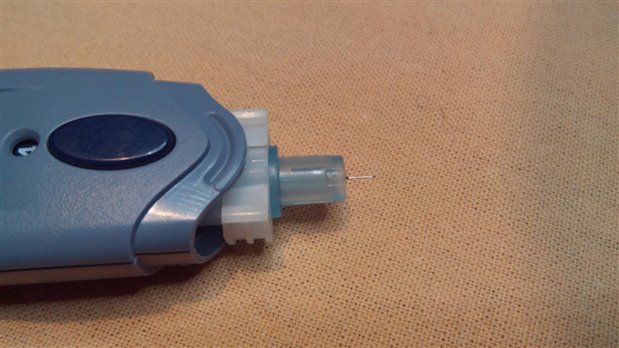
The first step is producing a blood drop with the mechanical "shooting" needle, usually in a finger. Depending on the age of the patient and his body characteristics the needle pressure can be regulated to minimise the pain (that is anyway almost null). See the detail in the image below
image


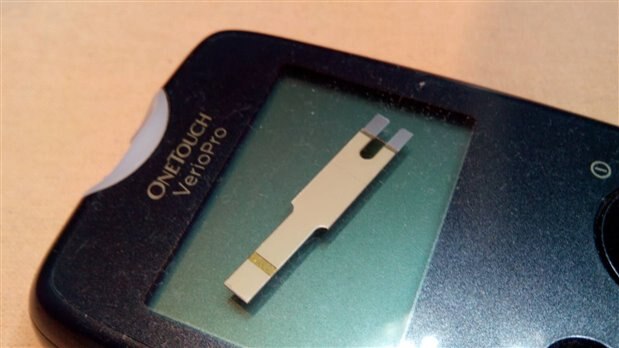
The second step is placing a drop of blood on the reactive test strip, that is another single-use small electrode chemically treated as shown in the detail of the image below.
image

Then, the reading procedure will start. As mentioned, the Meditech glucose measurement circuit will respect the reactive test strip size and contact positions and the accessory components (available in any farmacy as spare parts for few dollars) will be the same, just to grant the full compatibility of the methodology for two reasons: a better comparison testing with volunteers and the best standardised compatibility with the commercial devices.


The Meditech Glucose probe

The approach that will be followed by the Meditech glucose measurement probe will be based on the standard test strip terminals as shown in the PCB terminal layout example below:image



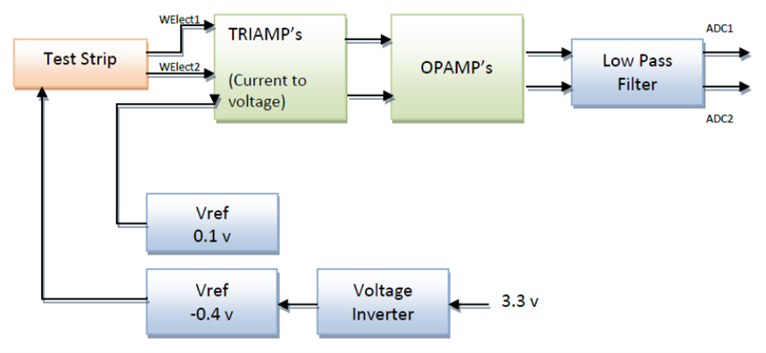
The sensor circuit schematics using the pre-built test strips will be almost simple:
image

The circuit blue blocks are almost common parts based on a low-pass filter similar to the same already used for the Heart Beat sensor and ECG, while the green blocks are a current-to-voltage specific converter IC from Freescale that has been adopted by many other similar measurement devices.

  • Sign in to reply
element14 Community

element14 is the first online community specifically for engineers. Connect with your peers and get expert answers to your questions.

  • Members
  • Learn
  • Technologies
  • Challenges & Projects
  • Products
  • Store
  • About Us
  • Feedback & Support
  • FAQs
  • Terms of Use
  • Privacy Policy
  • Legal and Copyright Notices
  • Sitemap
  • Cookies

An Avnet Company © 2025 Premier Farnell Limited. All Rights Reserved.

Premier Farnell Ltd, registered in England and Wales (no 00876412), registered office: Farnell House, Forge Lane, Leeds LS12 2NE.

ICP 备案号 10220084.

Follow element14

  • X
  • Facebook
  • linkedin
  • YouTube