element14 Community
element14 Community
    Register Log In
  • Site
  • Search
  • Log In Register
  • Community Hub
    Community Hub
    • What's New on element14
    • Feedback and Support
    • Benefits of Membership
    • Personal Blogs
    • Members Area
    • Achievement Levels
  • Learn
    Learn
    • Ask an Expert
    • eBooks
    • element14 presents
    • Learning Center
    • Tech Spotlight
    • STEM Academy
    • Webinars, Training and Events
    • Learning Groups
  • Technologies
    Technologies
    • 3D Printing
    • FPGA
    • Industrial Automation
    • Internet of Things
    • Power & Energy
    • Sensors
    • Technology Groups
  • Challenges & Projects
    Challenges & Projects
    • Design Challenges
    • element14 presents Projects
    • Project14
    • Arduino Projects
    • Raspberry Pi Projects
    • Project Groups
  • Products
    Products
    • Arduino
    • Avnet & Tria Boards Community
    • Dev Tools
    • Manufacturers
    • Multicomp Pro
    • Product Groups
    • Raspberry Pi
    • RoadTests & Reviews
  • About Us
    About the element14 Community
  • Store
    Store
    • Visit Your Store
    • Choose another store...
      • Europe
      •  Austria (German)
      •  Belgium (Dutch, French)
      •  Bulgaria (Bulgarian)
      •  Czech Republic (Czech)
      •  Denmark (Danish)
      •  Estonia (Estonian)
      •  Finland (Finnish)
      •  France (French)
      •  Germany (German)
      •  Hungary (Hungarian)
      •  Ireland
      •  Israel
      •  Italy (Italian)
      •  Latvia (Latvian)
      •  
      •  Lithuania (Lithuanian)
      •  Netherlands (Dutch)
      •  Norway (Norwegian)
      •  Poland (Polish)
      •  Portugal (Portuguese)
      •  Romania (Romanian)
      •  Russia (Russian)
      •  Slovakia (Slovak)
      •  Slovenia (Slovenian)
      •  Spain (Spanish)
      •  Sweden (Swedish)
      •  Switzerland(German, French)
      •  Turkey (Turkish)
      •  United Kingdom
      • Asia Pacific
      •  Australia
      •  China
      •  Hong Kong
      •  India
      •  Japan
      •  Korea (Korean)
      •  Malaysia
      •  New Zealand
      •  Philippines
      •  Singapore
      •  Taiwan
      •  Thailand (Thai)
      •  Vietnam
      • Americas
      •  Brazil (Portuguese)
      •  Canada
      •  Mexico (Spanish)
      •  United States
      Can't find the country/region you're looking for? Visit our export site or find a local distributor.
  • Translate
  • Profile
  • Settings
Smarter Life
  • Challenges & Projects
  • Design Challenges
  • Smarter Life
  • More
  • Cancel
Smarter Life
Blog A Very Compact Christmas Display - Part 037
  • Blog
  • Forum
  • Documents
  • Files
  • Events
  • Mentions
  • Sub-Groups
  • Tags
  • More
  • Cancel
  • New
  • Share
  • More
  • Cancel
Group Actions
  • Group RSS
  • More
  • Cancel
Engagement
  • Author Author: COMPACT
  • Date Created: 22 Dec 2013 4:27 AM Date Created
  • Views 1004 views
  • Likes 2 likes
  • Comments 9 comments
  • psoc4
  • psoc_4
  • smarter_life_challenge
  • psoc_4200
  • smarter_life
  • psoc
Related
Recommended

A Very Compact Christmas Display - Part 037

COMPACT
COMPACT
22 Dec 2013

Pioneering Progress

image

I've been really busy developing and improving my secret circuit.

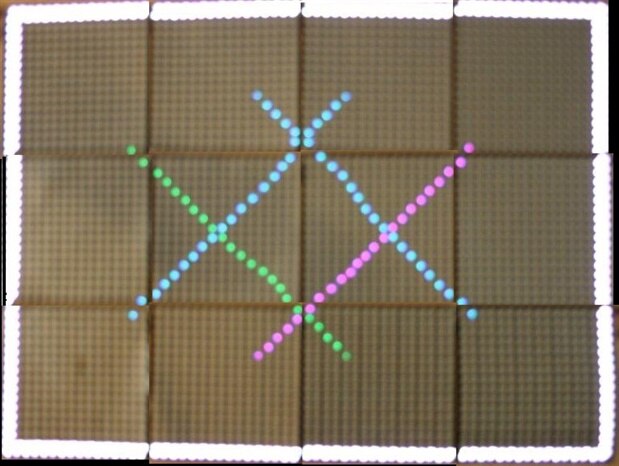
Just as a reminder of what it is, the circuit enables a single PSoC 4 to drive 3,072 24-bit colour LEDs.


Above is pictures a short time lapse photo of the display. I've edited the photo to remove the inter-panel gaps to give an idea of what the next version will look.

These LEDs are set to the 4rd lowest intensity level so it shows you how bright these LEDs illuminate. Hopefully this will be one of the last boring test patterns shown.
 

image


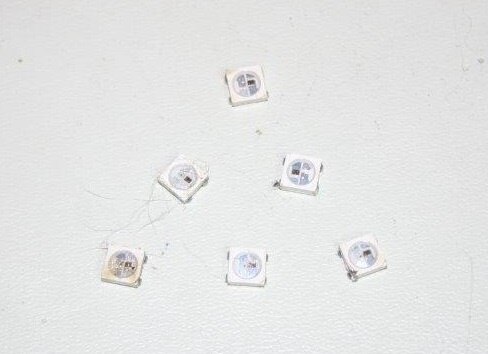
An unexpected issue is the vulnerability and unreliability of the WS2812B LEDs.

They can partially and fully die quite easily with a yet underdetermined cause. From my observations and experimentation the relationship between the input signal and supply voltage is very important. It appears that the Absolute Maximum Voltages are relative.

By partially die I mean that a LED channel stops working. For instance the Green LED can die whilst the Red and Blue remain unaffected and the signalling relay continues to operate.

By fully die I mean that the signalling relay develops a short to GND or other terminal fault.

This is why I always try to have spares available when developing new products. In this case I have 5,060 spare LEDs of which I've already used 9 or so.


With these teething issues nearly sorted it's time to present the Christmas Cheer and other good stuff.

  • Sign in to reply
Parents
  • michaelkellett
    michaelkellett over 12 years ago

    I'm interested in your reliability issues - these parts are pretty cheap and it could be that they are just not very good but 0.3% failure rate after a week or so of intermittent use seems very bad (although it wouldn't shock me for the DOA rate). A more reasonable figue would be down between 10 and 100 ppm which would mean that even at the high end you should only have about 1/3 of  a dead one.

    It might be worth looking at your supply and signal rails very carefully with a reasonable scope while the system is operating - you have a lot of fast switching and plenty of inductance so you may be overvolting  parts from time to time - according to exactly how you drive them.


    MK

    • Cancel
    • Vote Up 0 Vote Down
    • Sign in to reply
    • More
    • Cancel
  • COMPACT
    COMPACT over 12 years ago in reply to michaelkellett

    After reading the WS2812B datasheet I had a hunch that I'd have some problems with experimenting and driving them en masse thus I prepared to have spares on hand.

    Usually an error could result in a cascade effect thus blow up quite a few components in a single event.

    Interestingly the LEDs that did fail were randomly distributed and at different times (not a single event).


    According to the datasheet a WS2812B's VDD can range from 3.5V to 5.3V but more interestingly its absolute maximum input signal voltage cannot exceed VDD+0.5V which is a RELATIVE measurement.

    This is unlike a more conventional components such as a TI PCA9555 or 74xxxx that has its maximum input signal voltage parameters identical to its absolute maximum supply voltage parameters.

    The WS2812B that is most vulnerable to this condition would be the very first one in an array fed by an external source (possibly on a relatively long lead or trace).  I also found it interesting that every array has a 1k series resistor to its first WS2812B. All subsequent WS2812Bs are fed from its upstream WS2812B with a very short signal trace and driven from the same voltage source (give or take a little induced switching noise)..


    If the given information is correct, the WS2812B is vulnerable if its VDD voltage becomes too low making its input signal voltage exceed its maximum.

    e.g. if VDD is 3.5V an input signal of 4.1V would exceed its "ABSOLUTE" maximum.


    I did a bit of experimentation with undervoltage conditions to find that the LED current regulation turns off making all of the LEDS shine really brightly!! (and probably risk damaging them).


    I am driving the WS2812Bs from a PSoC 4 operating at 3.3volts observed the signal through a reasonable scope to find that the signal is acceptably clean. No discernible ringing or voltage over/undershooting.

    As for the power supply I am using a 3-15VDC switching power supply capable of providing 40A. Every WS2812B is decoupled with an adjacent 100n chip capacitor.

    As previously mentioned I do suspect the power distribution and the need to address it.


    There is not as much fast switching as you might guess. A screen refresh is only required as necessary. A perpetual 25/30Hz frame refresh is not necessarily required.


    The bottom line is that these devices are not as electrically power tolerant as LEDs and standard logic families.


    I've just confirmed that I am not alone with blowing up WS2812s. Adafruit have a page mentioning that onrush current is a common killer of these devices. The page is titled Powering Neopixels.

    I could have accumulated damage from many power on cycles.

    • Cancel
    • Vote Up 0 Vote Down
    • Sign in to reply
    • More
    • Cancel
Comment
  • COMPACT
    COMPACT over 12 years ago in reply to michaelkellett

    After reading the WS2812B datasheet I had a hunch that I'd have some problems with experimenting and driving them en masse thus I prepared to have spares on hand.

    Usually an error could result in a cascade effect thus blow up quite a few components in a single event.

    Interestingly the LEDs that did fail were randomly distributed and at different times (not a single event).


    According to the datasheet a WS2812B's VDD can range from 3.5V to 5.3V but more interestingly its absolute maximum input signal voltage cannot exceed VDD+0.5V which is a RELATIVE measurement.

    This is unlike a more conventional components such as a TI PCA9555 or 74xxxx that has its maximum input signal voltage parameters identical to its absolute maximum supply voltage parameters.

    The WS2812B that is most vulnerable to this condition would be the very first one in an array fed by an external source (possibly on a relatively long lead or trace).  I also found it interesting that every array has a 1k series resistor to its first WS2812B. All subsequent WS2812Bs are fed from its upstream WS2812B with a very short signal trace and driven from the same voltage source (give or take a little induced switching noise)..


    If the given information is correct, the WS2812B is vulnerable if its VDD voltage becomes too low making its input signal voltage exceed its maximum.

    e.g. if VDD is 3.5V an input signal of 4.1V would exceed its "ABSOLUTE" maximum.


    I did a bit of experimentation with undervoltage conditions to find that the LED current regulation turns off making all of the LEDS shine really brightly!! (and probably risk damaging them).


    I am driving the WS2812Bs from a PSoC 4 operating at 3.3volts observed the signal through a reasonable scope to find that the signal is acceptably clean. No discernible ringing or voltage over/undershooting.

    As for the power supply I am using a 3-15VDC switching power supply capable of providing 40A. Every WS2812B is decoupled with an adjacent 100n chip capacitor.

    As previously mentioned I do suspect the power distribution and the need to address it.


    There is not as much fast switching as you might guess. A screen refresh is only required as necessary. A perpetual 25/30Hz frame refresh is not necessarily required.


    The bottom line is that these devices are not as electrically power tolerant as LEDs and standard logic families.


    I've just confirmed that I am not alone with blowing up WS2812s. Adafruit have a page mentioning that onrush current is a common killer of these devices. The page is titled Powering Neopixels.

    I could have accumulated damage from many power on cycles.

    • Cancel
    • Vote Up 0 Vote Down
    • Sign in to reply
    • More
    • Cancel
Children
  • COMPACT
    COMPACT over 12 years ago in reply to COMPACT

    An additional comment.

    I've never blown anything up before with my regulated bench power supplies that were used to power the WS2812Bs.

    Adafruit's suggestion of adding large capacitances to the output of regulated switching power supplies is not usual one.

    Particularly adding relatively large 1,000uF capacitor to handle a small string of 60 LEDs.

    If you applied this solution to some 3,000 LEDs I would need 50,000uF.


    It also seems odd that the manufacturers of the LED strings and arrays to not include such capacitors in their products leaving them to be added externally.

    I assume they are aware of these issues and have inbuilt these safeguards in their controller units.


    For older switching power supplies adding large capacitances would overload them and not enabling them to start..

    This is because the capacitance appears as a dead short. The solution was to actually reduce capacitance to a more balanced value to enable operation both the power supply and product.

    • Cancel
    • Vote Up 0 Vote Down
    • Sign in to reply
    • More
    • Cancel
  • COMPACT
    COMPACT over 12 years ago in reply to COMPACT

    Here's an interesting link from Agilent about harmonic power control which some may find interesting.

    http://cp.literature.agilent.com/litweb/pdf/5964-1917E.pdf

    • Cancel
    • Vote Up 0 Vote Down
    • Sign in to reply
    • More
    • Cancel
element14 Community

element14 is the first online community specifically for engineers. Connect with your peers and get expert answers to your questions.

  • Members
  • Learn
  • Technologies
  • Challenges & Projects
  • Products
  • Store
  • About Us
  • Feedback & Support
  • FAQs
  • Terms of Use
  • Privacy Policy
  • Legal and Copyright Notices
  • Sitemap
  • Cookies

An Avnet Company © 2026 Premier Farnell Limited. All Rights Reserved.

Premier Farnell Ltd, registered in England and Wales (no 00876412), registered office: Farnell House, Forge Lane, Leeds LS12 2NE.

ICP 备案号 10220084.

Follow element14

  • X
  • Facebook
  • linkedin
  • YouTube