element14 Community
element14 Community
    Register Log In
  • Site
  • Search
  • Log In Register
  • Community Hub
    Community Hub
    • What's New on element14
    • Feedback and Support
    • Benefits of Membership
    • Personal Blogs
    • Members Area
    • Achievement Levels
  • Learn
    Learn
    • Ask an Expert
    • eBooks
    • element14 presents
    • Learning Center
    • Tech Spotlight
    • STEM Academy
    • Webinars, Training and Events
    • Learning Groups
  • Technologies
    Technologies
    • 3D Printing
    • FPGA
    • Industrial Automation
    • Internet of Things
    • Power & Energy
    • Sensors
    • Technology Groups
  • Challenges & Projects
    Challenges & Projects
    • Design Challenges
    • element14 presents Projects
    • Project14
    • Arduino Projects
    • Raspberry Pi Projects
    • Project Groups
  • Products
    Products
    • Arduino
    • Avnet & Tria Boards Community
    • Dev Tools
    • Manufacturers
    • Multicomp Pro
    • Product Groups
    • Raspberry Pi
    • RoadTests & Reviews
  • About Us
  • Store
    Store
    • Visit Your Store
    • Choose another store...
      • Europe
      •  Austria (German)
      •  Belgium (Dutch, French)
      •  Bulgaria (Bulgarian)
      •  Czech Republic (Czech)
      •  Denmark (Danish)
      •  Estonia (Estonian)
      •  Finland (Finnish)
      •  France (French)
      •  Germany (German)
      •  Hungary (Hungarian)
      •  Ireland
      •  Israel
      •  Italy (Italian)
      •  Latvia (Latvian)
      •  
      •  Lithuania (Lithuanian)
      •  Netherlands (Dutch)
      •  Norway (Norwegian)
      •  Poland (Polish)
      •  Portugal (Portuguese)
      •  Romania (Romanian)
      •  Russia (Russian)
      •  Slovakia (Slovak)
      •  Slovenia (Slovenian)
      •  Spain (Spanish)
      •  Sweden (Swedish)
      •  Switzerland(German, French)
      •  Turkey (Turkish)
      •  United Kingdom
      • Asia Pacific
      •  Australia
      •  China
      •  Hong Kong
      •  India
      •  Korea (Korean)
      •  Malaysia
      •  New Zealand
      •  Philippines
      •  Singapore
      •  Taiwan
      •  Thailand (Thai)
      • Americas
      •  Brazil (Portuguese)
      •  Canada
      •  Mexico (Spanish)
      •  United States
      Can't find the country/region you're looking for? Visit our export site or find a local distributor.
  • Translate
  • Profile
  • Settings
Smarter Life
  • Challenges & Projects
  • Design Challenges
  • Smarter Life
  • More
  • Cancel
Smarter Life
Blog Sample prep
  • Blog
  • Forum
  • Documents
  • Files
  • Events
  • Mentions
  • Sub-Groups
  • Tags
  • More
  • Cancel
  • New
  • Share
  • More
  • Cancel
Group Actions
  • Group RSS
  • More
  • Cancel
Engagement
  • Author Author: wireb
  • Date Created: 4 Nov 2013 2:31 PM Date Created
  • Views 447 views
  • Likes 1 like
  • Comments 2 comments
  • psoc4
  • smarter_life_challenge
  • soil_moisture_sensor
  • diy
  • smarter_life
Related
Recommended

Sample prep

wireb
wireb
4 Nov 2013

Well still dealing with some leg issues and was stranded in bed most of the weekend. But I did make a little progress on the watering system.


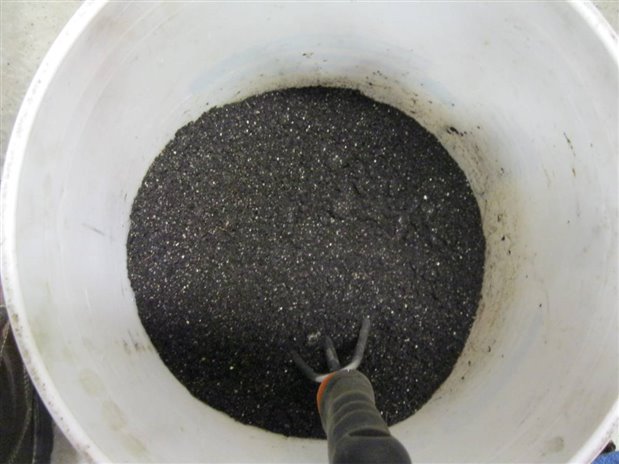
First thing I mixed up a batch of potting soil. I used a 2.5:1 topsoil to vermiculite. Decided to go down this path when reading how most sensors are sensitive to mineral content. Most of my plants are planted in a similar mix so this should be a good representation of the final application. From there I created 3 containers of dirt and weighed them out to ~38.3 oz each. One container is left as is and will be my moist sample. The next container I added 6oz of water and will be the wet sample (I may have added way to much water top is a little muddy). The last container I dumped out in a tray and baked at 350deg F for several hours mixing every so often. This will be the dry sample.


While the third sample was backing I did some playing around with the nominal sample. To start with I created a pair of probes out of some insulated 12 gage copper wire. Using my Sencore Z meter I checked the capacitance of the probes in free air and got around 47pF. When inserted in the dirt I got weird results. About every other time I would get around 189pF and the next the meter would error. Not exactly sure why the meter was acting up. Double checked the probes were fully insulated (coated the cutoff end in enamel and eventually just folded the probe in half so the cut end was not contacting the soil at all.) Basically all I was able to prove at this time was the soil does increase the capacitance between the probes and the value looks to be in the ball park of 200pF for slightly moist soil.


I also tried sticking 2 2" square patches of metal foil tape on the outside of the container. My hope was the increased surface area of the foil tape would result in a larger capacitance value. But I got the opposite result and got a slightly negative value. More than likely the calibration had drifted on my meter slightly and that resulted in the -1.8pF when the foil tape was hooked up. Going to revisit this setup once I get the 555 timer circuit built and tested.


I started looking into using a 555 timer to build a astable oscillator. Going with 200pF as the soil capacitance and 1M ohm resistors for R1 and R2 would result in a 2.5kHz output frequency. Normally I don't see 555 timers used with such small caps or large resistors. I have some concerns that the leakage current from the timer it's self may be a significant issue at this point and may not function properly. Either way I though I would give it a go and see what happens. Unfortunately the leg started to act back up and called it a day.


Next up I want to finish up the 555 circuit and see what sort of results I can get out of simple round probes (wire). If that does not work out will have to come up with a better probe solution. One option is the foil tape on the outside of the container. The other is building a set of flat probes with more surface area that can be installed in the soil. The biggest issue with the flat probes will be making them porous enough that water can disperse into and out of the soil trapped between the probes and waterproof at the same time.

image

image

image


image


  • Sign in to reply
  • wireb
    wireb over 12 years ago in reply to vsluiter

    Yep could. I have quite a few plants I want to monitor and was not planning on putting a micro on each one. If the 555 timer works out each plant probe will have a 555 timer set up to convert the capacitance reading to frequency and the PSOC will count the frequency from all the channels and make decisions. Most of this is just due to cost considerations. The psoc 4 run about $2.50 each in single Q where 555 you can get for as cheap as $0.14 each. Unfortunately using a centeral psoc 4 and running all the cap sense lines back to a central point does not seem viable. At the low values I am trying to measure I am already having issues with body capacitance of me walking by affecting the readings. More to come on my next update. 

    • Cancel
    • Vote Up 0 Vote Down
    • Sign in to reply
    • More
    • Cancel
  • vsluiter
    vsluiter over 12 years ago

    Hello Peter,


    Wouldn't you be able to measure capacitance by making a current source (possible in PSOC analog block), and measure the change in voltage (dV), or the time after which a threshold is reached (using comparator and counter)?

    • Cancel
    • Vote Up 0 Vote Down
    • Sign in to reply
    • More
    • Cancel
element14 Community

element14 is the first online community specifically for engineers. Connect with your peers and get expert answers to your questions.

  • Members
  • Learn
  • Technologies
  • Challenges & Projects
  • Products
  • Store
  • About Us
  • Feedback & Support
  • FAQs
  • Terms of Use
  • Privacy Policy
  • Legal and Copyright Notices
  • Sitemap
  • Cookies

An Avnet Company © 2025 Premier Farnell Limited. All Rights Reserved.

Premier Farnell Ltd, registered in England and Wales (no 00876412), registered office: Farnell House, Forge Lane, Leeds LS12 2NE.

ICP 备案号 10220084.

Follow element14

  • X
  • Facebook
  • linkedin
  • YouTube