element14 Community
element14 Community
    Register Log In
  • Site
  • Search
  • Log In Register
  • Community Hub
    Community Hub
    • What's New on element14
    • Feedback and Support
    • Benefits of Membership
    • Personal Blogs
    • Members Area
    • Achievement Levels
  • Learn
    Learn
    • Ask an Expert
    • eBooks
    • element14 presents
    • Learning Center
    • Tech Spotlight
    • STEM Academy
    • Webinars, Training and Events
    • Learning Groups
  • Technologies
    Technologies
    • 3D Printing
    • FPGA
    • Industrial Automation
    • Internet of Things
    • Power & Energy
    • Sensors
    • Technology Groups
  • Challenges & Projects
    Challenges & Projects
    • Design Challenges
    • element14 presents Projects
    • Project14
    • Arduino Projects
    • Raspberry Pi Projects
    • Project Groups
  • Products
    Products
    • Arduino
    • Avnet & Tria Boards Community
    • Dev Tools
    • Manufacturers
    • Multicomp Pro
    • Product Groups
    • Raspberry Pi
    • RoadTests & Reviews
  • About Us
  • Store
    Store
    • Visit Your Store
    • Choose another store...
      • Europe
      •  Austria (German)
      •  Belgium (Dutch, French)
      •  Bulgaria (Bulgarian)
      •  Czech Republic (Czech)
      •  Denmark (Danish)
      •  Estonia (Estonian)
      •  Finland (Finnish)
      •  France (French)
      •  Germany (German)
      •  Hungary (Hungarian)
      •  Ireland
      •  Israel
      •  Italy (Italian)
      •  Latvia (Latvian)
      •  
      •  Lithuania (Lithuanian)
      •  Netherlands (Dutch)
      •  Norway (Norwegian)
      •  Poland (Polish)
      •  Portugal (Portuguese)
      •  Romania (Romanian)
      •  Russia (Russian)
      •  Slovakia (Slovak)
      •  Slovenia (Slovenian)
      •  Spain (Spanish)
      •  Sweden (Swedish)
      •  Switzerland(German, French)
      •  Turkey (Turkish)
      •  United Kingdom
      • Asia Pacific
      •  Australia
      •  China
      •  Hong Kong
      •  India
      • Japan
      •  Korea (Korean)
      •  Malaysia
      •  New Zealand
      •  Philippines
      •  Singapore
      •  Taiwan
      •  Thailand (Thai)
      • Vietnam
      • Americas
      •  Brazil (Portuguese)
      •  Canada
      •  Mexico (Spanish)
      •  United States
      Can't find the country/region you're looking for? Visit our export site or find a local distributor.
  • Translate
  • Profile
  • Settings
Smarter Life
  • Challenges & Projects
  • Design Challenges
  • Smarter Life
  • More
  • Cancel
Smarter Life
Blog Smarter Life Challenge - Brainwaves based appliance controller - Update 4
  • Blog
  • Forum
  • Documents
  • Files
  • Events
  • Mentions
  • Sub-Groups
  • Tags
  • More
  • Cancel
  • New
  • Share
  • More
  • Cancel
Group Actions
  • Group RSS
  • More
  • Cancel
Engagement
  • Author Author: ciorga
  • Date Created: 18 Nov 2013 6:21 AM Date Created
  • Views 664 views
  • Likes 1 like
  • Comments 6 comments
  • smarter_life_challenge
  • brainwave_controller
  • smarter_life
Related
Recommended

Smarter Life Challenge - Brainwaves based appliance controller - Update 4

ciorga
ciorga
18 Nov 2013

First I want to thank all of you who commented on my last week update; DAB, good suggestion - I researched some commercial head sensors and what they are used for, and it looks like a lot of research groups are looking into processing brain waves or various applications.  Paul, thank you for your comment – yes, I can measure the movement of eyes and I am showing some signals below.  Thank you vsluiter for your comments – yes, facial muscles are driven by electrical signals that are not EEG signals, but I think they are still generated by the brain for the purpose of moving muscles.  I learned that other signals measured in EEG are related to various other functions of the human body, some are related to movements, others to thinking activities, others to controlling various organs, and others to communicating information throughout the human body.  For this product I want to first use a simple to measure and reliable signal to develop the algorithm that decodes the measured signals and sends the control information to an appliance (still thinking what to use at first).  After this step I will expand to other types of appliances, and I will investigate other types of brainwave signals that I can use - I want to look into building capacitive electrodes that can be applied anywhere o the scalp even above hair, and if I can get them to work I will then try to expand and diversify the types of brainwave signals used to control appliances.  So most probably for now I will use some signals that control muscle and eyes movements, which I think I will be able to measure with dry electrodes without gel and skin preparation.  This first approach makes the product easy to use and thus increases the chances to success.  Also, thank you cy.gul for your comment about the features implemented in PsoC 5LP; I was thinking and planning to investigate this when I read in the user guide for the PsoC 4 pioneer kit about the additional PsoC 5 on this board and how this PsoC 5 can be programmed.  Thank you for pointing out the additional capabilities of PSoC 5 – yes, the digital filter and also the sigma-delta converter (that I read about in the datasheet) are important advantages that I should look into.


So this weekend I focused on three things: #1 I improving the active electrodes,  #2 deciding on the location of electrodes on the head, and #3 evaluating what signals I can measure and use for appliance control.


For #1, most of this work was analog circuit design and experiments trying to filter out noise, to compensate for common mode drift, and to reduce the dc offsets.  This was a tedious work building a few circuits and performing various measurements.  Overall I am happy to see that the analog signals are now stable over time and are not so sensitive to body movement.  The current circuit that I am using now is still in “experimental” form but it is close to the final version, so I am still planning to investigate some ways of improvement.  One of the things I have in plan is to replace the gel Ag-AgCl electrodes with dry electrodes.  To do this I need to use a very high input impedance amplifier, which I ordered and received now, so next step will be to create a signal amplifier for dry electrodes.  This will probably take most of my next weekend.


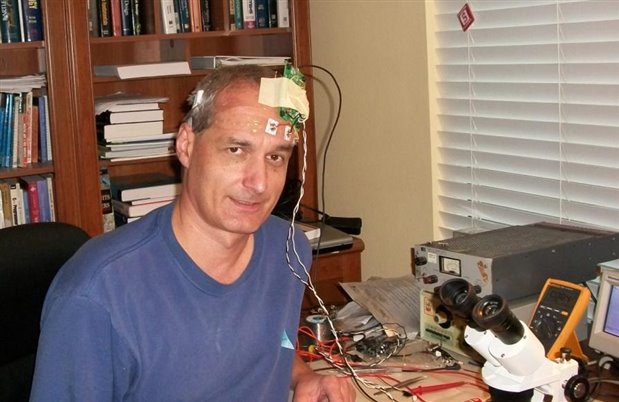
For #2, I looked at many possibilities: EEG sensors placed throughout the scalp need gel and need special preparation of the skin (they are like little needles that are pushed into the skin).  I think these electrodes may work if applied correctly but I don’t see them so practical from an appliance control product perspective.  Another alternative would be electrodes that can be pressed against the scalp using an elastic cap but they also need some gel to insure low impedance to the skin.  These types of electrodes are easier to implement in this product but I still think that they are somehow inconvenient to use.  After I investigated a few other types of electrodes I decided to use dry electrodes applied on the forehead.  The main advantage of this choice is that there is no hair so I can use metallic electrodes applied directly to the skin.  There will be 6 electrodes placed in a row just above the eyebrows.  In the picture below I am wearing three electrodes above the left eye; this is an experiment setup – the following version will have another three electrodes placed above the right eye.
 

image


For #3, I have measured various signals with these three electrodes, and so far I see a few possibilities of signals that I can use for controlling appliances:


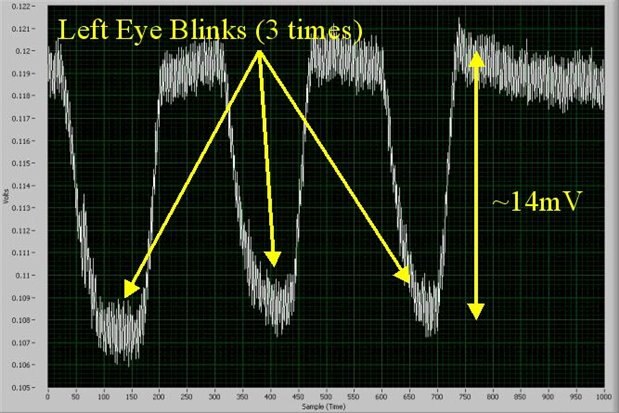
Selective blinking of one eye – each group of three electrodes can pick up the electric signals associated to eye blinking.  Below I am showing the right-eye blinking compared to the left-eye blinking.  It can be noticed that the three electrodes that I am wearing above the left eye can differentiate which eye I am blinking: left-eye signal has an amplitude of about 14mV while right-eye blinking signals have an amplitude of about 4mV.  An identical group of electrodes that I will place above the right eye will measure higher amplitude on the right-eye blinking than on the left-eye blinking.
 

image

image


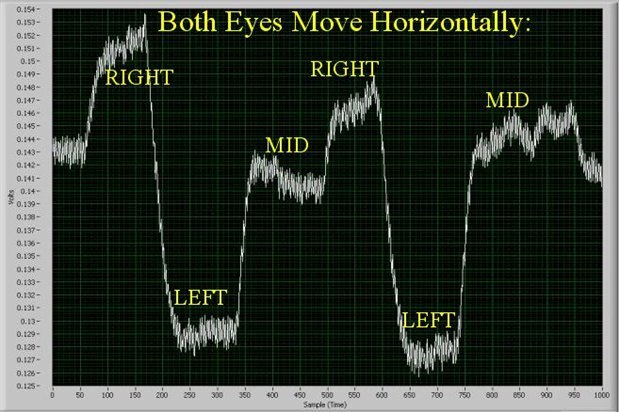
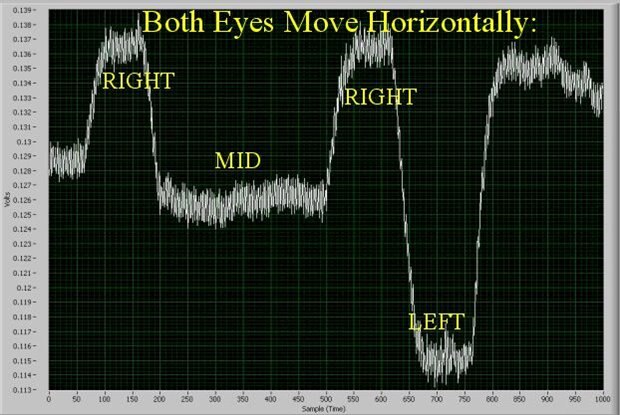
Eye movement – I was able to measure the horizontal movement of both eyes, and I could differentiate the direction of moving from the polarity of the measured pulse.  Here are some examples; when I move the eyes towards the left side I measure a negative pulse and when I move the eyes towards the right side I measure a positive pulse.
 

image


image


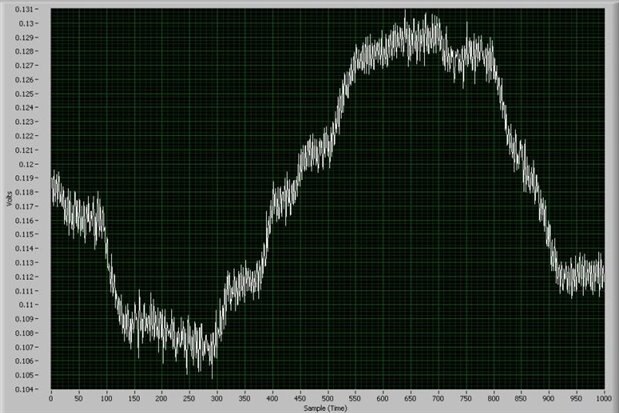
Eye rotating – if I rotate the eyes slowly a full circumference I measure a signal that looks like a sinusoid.  The direction of rotation, clockwise or counter-clock wise, determines the polarity of the “sinusoidal” signal.  Here are two pictures showing the signals I measured for both rotation directions:


Clockwise rotation of both eyes:


image


Counter clockwise rotation of both eyes:
image


So what’s next? I want to finalize the electrodes and amplifier and then I will need to implement a low pass filter and configure the analog to digital converter.  After that I will start working at the algorithm of controlling appliances using these signals.  I hope to complete the analog path in the next two weeks, which will leave me about one month and a half for the algorithm and the controlling transmitter.


So until next week update I wish all of contestants good luck with your projects,

Cosmin

  • Sign in to reply

Top Comments

  • PaulMakesThings
    PaulMakesThings over 12 years ago +1
    I hope you'll post the schematics when you get your design optimized. I would love to try this out for lucid dream induction, which requires REM detection. It already looks to be getting a better signal…
  • ciorga
    ciorga over 12 years ago in reply to cy.gul +1
    Yes, that is a good idea Gagan; I will look into this - the two chips can then communicate through a serial interface.
  • ciorga
    ciorga over 12 years ago in reply to cy.gul

    Yes, that is a good idea Gagan; I will look into this - the two chips can then communicate through a serial interface.

    • Cancel
    • Vote Up +1 Vote Down
    • Sign in to reply
    • More
    • Cancel
  • ciorga
    ciorga over 12 years ago in reply to vsluiter

    Hi Victor,

    Thank you for commenting on my blog; yes, decoding EEG signals is a challenging task, but I think it is only a matter of time until this will become a standard procedure.


    Yes, both opamps will be part of my signal path, one will be a amplifier and the second one a low-pass filter.  Depending on the filter topology I may combine the gain stage with the filtering stage.  They will then feed the signals to the ADC.  The comparator functions will be used to wake-up PSoC from power down mode when a signal is received from electrodes.

    • Cancel
    • Vote Up 0 Vote Down
    • Sign in to reply
    • More
    • Cancel
  • cy.gul
    cy.gul over 12 years ago in reply to vsluiter

    you could put the PSoC in the sensor itself? you'll end up using 2, one for each. but hey, they're cheap!

    • Cancel
    • Vote Up 0 Vote Down
    • Sign in to reply
    • More
    • Cancel
  • vsluiter
    vsluiter over 12 years ago

    Cool to see your progress, I like the illustrations, both the photo as the LabView plots.

    EEG is very difficult, also to correlate which signal "means" what (almost everything should be statistically tested to get no false postives / negatives). Wise choice to use eye muscles.

    One question: would it have been possible to use the opamps in the PSOC for the amplifiers you're making (except for their physical distance from the electrode)?

    • Cancel
    • Vote Up 0 Vote Down
    • Sign in to reply
    • More
    • Cancel
  • DAB
    DAB over 12 years ago

    I found my MindWave Headset.

    It was only about 100 USD when I bought it a couple of years ago.

    It does capture all of the signals you are using with a simple headclip and dry contacts.

    They do have an SDK to get access to all of the raw data, but it looks like your current sensors are able to meet your needs.


    I bought the Headset to see if it could monitor my pain levels.  Sure enough, I was able to watch my concentration ability fade in and out over time.

    I was amazed at how regular my brain cycled in and out of distraction on a fairly regular time.


    I liked your initial results.  I look forward to seeing how successful you are at controlling things with your sensors.


    Thanks

    DAB


    • Cancel
    • Vote Up 0 Vote Down
    • Sign in to reply
    • More
    • Cancel
>
element14 Community

element14 is the first online community specifically for engineers. Connect with your peers and get expert answers to your questions.

  • Members
  • Learn
  • Technologies
  • Challenges & Projects
  • Products
  • Store
  • About Us
  • Feedback & Support
  • FAQs
  • Terms of Use
  • Privacy Policy
  • Legal and Copyright Notices
  • Sitemap
  • Cookies

An Avnet Company © 2025 Premier Farnell Limited. All Rights Reserved.

Premier Farnell Ltd, registered in England and Wales (no 00876412), registered office: Farnell House, Forge Lane, Leeds LS12 2NE.

ICP 备案号 10220084.

Follow element14

  • X
  • Facebook
  • linkedin
  • YouTube