


I received the pioneer kit the other day, it was all pretty quick and easy in terms of getting sample projects up and running so that's great. I'm thinking I'll probably spin a shield with a bunch of hardware options on it to create a solid platform for developing code-wise functionality, there's nothing worse than fighting a fragile hardware when doing that sort of stuff.
On the hardware front I've been selecting a bunch of components for the various functions, some I'm pretty confident of, others I'll be trying out a few different routes before committing:
LEDs
It's very important to get the LED selection right, it will pretty much drive how the light functions and is configured mechanically (ie. it's look and feel), so a lot rides on this (pun intended). Most LED bike lights out there tend to use a single high power LED or an array of say 4 lower power ones. I'm going to steer away from high power LEDs for a number of reasons, the main one being that bright single-point light sources can actually be pretty obnoxious for other road/path users, I want to explore other ways of being noticed that don't involve blinding your fellow on-coming cyclists. I also want to keep along with the idea of this being a universal light ie. one that can be used as a rear facing red or front facing white. To that end I've been exploring two options: a separate red and white LED package for each case Vs a single multi-colour (eg. RGB). I also like the the look of smaller LEDs used in a strip array, with the right diffusing lense material these can end up looking like neon tubing. Along with LED selection comes the question of driving, this will obviously depend on the current required and forward operating voltage (when compared to my chosen power source), as always it won't just be a question of whether unregulated, linear or switching is more suitable, but at what $ cost do these options come.
Movement sensing
My priority here was to find an economical accelerometer solution, I think I've found that in the freescale MMA7361LCR1 (http://www.freescale.com/webapp/sps/site/prod_summary.jsp?code=MMA7361LC&fsrch=1&sr=1) a relatively inexpensive three axis analog output device. Victor pointed me to the Invensense MPU9150 (http://www.invensense.com/mems/gyro/nineaxis.html) which looks pretty amazing, if I can think of a use for the gyro and compass (like that would be hard..) it might find it's way into the end product.
Battery and charging
I've decided to go down the route of a non-serviceable rechargeable battery, originally I was thinking I wanted it both ways (ie. have the option for the user to use standard primary batteries eg. AAA akalines) for flexibility. But for sake of keeping the mechanical requirements simpler, and having a predictable battery characterisation I've decided to use a single LiPo cell, probably 1200mAHr, something like this one:
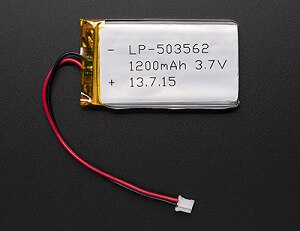
Which is about 35 by 65mm, I'd probably find something slimmer and longer for the final product, but this battery paired with ubiquitous 'USB' charging will be the first stop. My primary candidate for charge control is the Microchip MCP73833, a linear lithium charger (http://www.microchip.com/wwwproducts/Devices.aspx?dDocName=en027785), I'll use IO on the Psoc4 to monitor it's status, the presence of USB voltage, and of course the battery voltage itself (for low battery warnings, and LED drive modification to keep a consistent light output throughout the discharge cycle).
Mechanicals
I know this is a bit out of the scope of the competition, but here are some initial ideas I had for how the light might look and be attached to the bike:

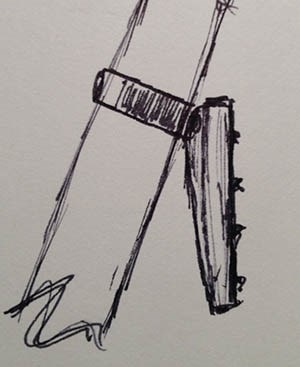
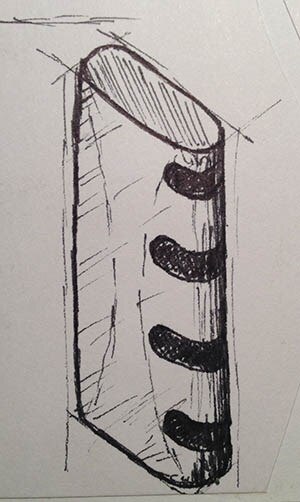
Cheers
A.

