element14 Community
element14 Community
    Register Log In
  • Site
  • Search
  • Log In Register
  • Community Hub
    Community Hub
    • What's New on element14
    • Feedback and Support
    • Benefits of Membership
    • Personal Blogs
    • Members Area
    • Achievement Levels
  • Learn
    Learn
    • Ask an Expert
    • eBooks
    • element14 presents
    • Learning Center
    • Tech Spotlight
    • STEM Academy
    • Webinars, Training and Events
    • Learning Groups
  • Technologies
    Technologies
    • 3D Printing
    • FPGA
    • Industrial Automation
    • Internet of Things
    • Power & Energy
    • Sensors
    • Technology Groups
  • Challenges & Projects
    Challenges & Projects
    • Design Challenges
    • element14 presents Projects
    • Project14
    • Arduino Projects
    • Raspberry Pi Projects
    • Project Groups
  • Products
    Products
    • Arduino
    • Avnet & Tria Boards Community
    • Dev Tools
    • Manufacturers
    • Multicomp Pro
    • Product Groups
    • Raspberry Pi
    • RoadTests & Reviews
  • About Us
  • Store
    Store
    • Visit Your Store
    • Choose another store...
      • Europe
      •  Austria (German)
      •  Belgium (Dutch, French)
      •  Bulgaria (Bulgarian)
      •  Czech Republic (Czech)
      •  Denmark (Danish)
      •  Estonia (Estonian)
      •  Finland (Finnish)
      •  France (French)
      •  Germany (German)
      •  Hungary (Hungarian)
      •  Ireland
      •  Israel
      •  Italy (Italian)
      •  Latvia (Latvian)
      •  
      •  Lithuania (Lithuanian)
      •  Netherlands (Dutch)
      •  Norway (Norwegian)
      •  Poland (Polish)
      •  Portugal (Portuguese)
      •  Romania (Romanian)
      •  Russia (Russian)
      •  Slovakia (Slovak)
      •  Slovenia (Slovenian)
      •  Spain (Spanish)
      •  Sweden (Swedish)
      •  Switzerland(German, French)
      •  Turkey (Turkish)
      •  United Kingdom
      • Asia Pacific
      •  Australia
      •  China
      •  Hong Kong
      •  India
      • Japan
      •  Korea (Korean)
      •  Malaysia
      •  New Zealand
      •  Philippines
      •  Singapore
      •  Taiwan
      •  Thailand (Thai)
      • Vietnam
      • Americas
      •  Brazil (Portuguese)
      •  Canada
      •  Mexico (Spanish)
      •  United States
      Can't find the country/region you're looking for? Visit our export site or find a local distributor.
  • Translate
  • Profile
  • Settings
Sudden Impact Wearables Design Challenge
  • Challenges & Projects
  • Design Challenges
  • Sudden Impact Wearables Design Challenge
  • More
  • Cancel
Sudden Impact Wearables Design Challenge
Blog Wearable Sudden Impact and Health Monitor - Update 11
  • Blog
  • Forum
  • Documents
  • Polls
  • Files
  • Events
  • Mentions
  • Sub-Groups
  • Tags
  • More
  • Cancel
  • New
  • Share
  • More
  • Cancel
Group Actions
  • Group RSS
  • More
  • Cancel
Engagement
  • Author Author: ciorga
  • Date Created: 4 May 2015 5:38 AM Date Created
  • Views 563 views
  • Likes 1 like
  • Comments 1 comment
  • sudden_impact
  • wearable_sudden
  • wearable-sudden
Related
Recommended

Wearable Sudden Impact and Health Monitor - Update 11

ciorga
ciorga
4 May 2015

Here is another update on my "Wearable Sudden Impact and Health Monitor" project.


In this update I will show how I added a measurement feature for body temperature.


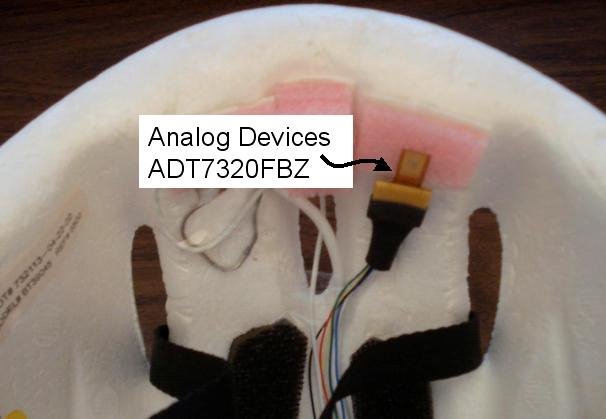
The body temperature is measured using the Analog Devices ADT7320, which is very small (4mm x 4mm) and it is mounted on the front inside the helmet, so that it touches the forehead.  To ensure good contact with the skin, the ADT7320 sensor is placed on a layer of elastic sponge-type material.  This implementation can be seen in the figure below:
image


The ADT7320 temperature sensor is controlled by an Arduino microcontroller through the SPI data bus, which is shared with ADXL375 and ADXL362 sensors as it is shown in the schematic diagram of the main unit, as I am showing in the following picture.

image

Because Arduino operates at 5V and ADXL375 at 3.3V the interface needs level shifters.  I have purchased two BD-LLC inexpensive level shifters, but since the package delivery has been delayed and I didn’t have the patience to wait, I have implemented a temporary “work-around” by adding 1kOhms series resistors on the SPI bus.  The current flowing from 5V output pins of Arduino module and into the ADXL375 tends to increase the voltage up to the point where the ADXL375 input power clamp diodes start to conduct current, at about 0.6V above 3.3V supply. This voltage is acceptable for the gate oxide break-down of input MOS transistors, but the current flowing through the internal clamp diodes may damage the ADXL375 chip.   The 1kOhm series resistor limits the current flowing from 5V supply into the ADXL375 pin to about (5V – 3.9V) /1kOhm = 1.1mA, which is handled without any problem by the internal clamp diodes.  Well, this is the temporary work-around, and I will replace the resistors with the level shifters after I receive the order.


That is it for now; I will come back with new updates as I get more work done.


Best Wishes,

Cosmin

  • Sign in to reply
  • DAB
    DAB over 10 years ago

    Hi Cosmin,


    I am surprised that you did not use a PSOC from Cypress Semiconductor.


    It supports both levels transparently.


    DAB

    • Cancel
    • Vote Up 0 Vote Down
    • Sign in to reply
    • More
    • Cancel
element14 Community

element14 is the first online community specifically for engineers. Connect with your peers and get expert answers to your questions.

  • Members
  • Learn
  • Technologies
  • Challenges & Projects
  • Products
  • Store
  • About Us
  • Feedback & Support
  • FAQs
  • Terms of Use
  • Privacy Policy
  • Legal and Copyright Notices
  • Sitemap
  • Cookies

An Avnet Company © 2026 Premier Farnell Limited. All Rights Reserved.

Premier Farnell Ltd, registered in England and Wales (no 00876412), registered office: Farnell House, Forge Lane, Leeds LS12 2NE.

ICP 备案号 10220084.

Follow element14

  • X
  • Facebook
  • linkedin
  • YouTube