element14 Community
element14 Community
    Register Log In
  • Site
  • Search
  • Log In Register
  • Community Hub
    Community Hub
    • What's New on element14
    • Feedback and Support
    • Benefits of Membership
    • Personal Blogs
    • Members Area
    • Achievement Levels
  • Learn
    Learn
    • Ask an Expert
    • eBooks
    • element14 presents
    • Learning Center
    • Tech Spotlight
    • STEM Academy
    • Webinars, Training and Events
    • Learning Groups
  • Technologies
    Technologies
    • 3D Printing
    • FPGA
    • Industrial Automation
    • Internet of Things
    • Power & Energy
    • Sensors
    • Technology Groups
  • Challenges & Projects
    Challenges & Projects
    • Design Challenges
    • element14 presents Projects
    • Project14
    • Arduino Projects
    • Raspberry Pi Projects
    • Project Groups
  • Products
    Products
    • Arduino
    • Avnet & Tria Boards Community
    • Dev Tools
    • Manufacturers
    • Multicomp Pro
    • Product Groups
    • Raspberry Pi
    • RoadTests & Reviews
  • About Us
  • Store
    Store
    • Visit Your Store
    • Choose another store...
      • Europe
      •  Austria (German)
      •  Belgium (Dutch, French)
      •  Bulgaria (Bulgarian)
      •  Czech Republic (Czech)
      •  Denmark (Danish)
      •  Estonia (Estonian)
      •  Finland (Finnish)
      •  France (French)
      •  Germany (German)
      •  Hungary (Hungarian)
      •  Ireland
      •  Israel
      •  Italy (Italian)
      •  Latvia (Latvian)
      •  
      •  Lithuania (Lithuanian)
      •  Netherlands (Dutch)
      •  Norway (Norwegian)
      •  Poland (Polish)
      •  Portugal (Portuguese)
      •  Romania (Romanian)
      •  Russia (Russian)
      •  Slovakia (Slovak)
      •  Slovenia (Slovenian)
      •  Spain (Spanish)
      •  Sweden (Swedish)
      •  Switzerland(German, French)
      •  Turkey (Turkish)
      •  United Kingdom
      • Asia Pacific
      •  Australia
      •  China
      •  Hong Kong
      •  India
      •  Korea (Korean)
      •  Malaysia
      •  New Zealand
      •  Philippines
      •  Singapore
      •  Taiwan
      •  Thailand (Thai)
      • Americas
      •  Brazil (Portuguese)
      •  Canada
      •  Mexico (Spanish)
      •  United States
      Can't find the country/region you're looking for? Visit our export site or find a local distributor.
  • Translate
  • Profile
  • Settings
Sudden Impact Wearables Design Challenge
  • Challenges & Projects
  • Design Challenges
  • Sudden Impact Wearables Design Challenge
  • More
  • Cancel
Sudden Impact Wearables Design Challenge
Blog Wearable Sudden Impact and Health Monitor - Update 12
  • Blog
  • Forum
  • Documents
  • Polls
  • Files
  • Events
  • Mentions
  • Sub-Groups
  • Tags
  • More
  • Cancel
  • New
  • Share
  • More
  • Cancel
Group Actions
  • Group RSS
  • More
  • Cancel
Engagement
  • Author Author: ciorga
  • Date Created: 5 May 2015 3:58 AM Date Created
  • Views 718 views
  • Likes 2 likes
  • Comments 2 comments
  • sudden_impact
  • wearable_sudden
  • wearable-sudden
Related
Recommended

Wearable Sudden Impact and Health Monitor - Update 12

ciorga
ciorga
5 May 2015

In this update I will show how I added a pulse oximetry measurement feature to my "Wearable Sudden Impact and Health Monitor" project.


The pulse oximetry and heart rate module measures the Oxygen level in the blood and pulse rate.


Typical measurements of Oxygen level is done trough transmittance method where on LED is applied to one side of a finger tip and an optical receiver diode is applied on the other side of the finger tip.  The transmitted light through the finger tissue contains the information about the level of Oxygen in the blood, and it can be retrieved through post processing.  The heart rate can be extracted also from this information.  The problem with this method is that it requires a device around a finger, and in sports this device may degrade the athlete performance in the game.


I have implemented a pulse oximetry technique to measure heart rate and oxygen saturation level.  The pulse oximetry technique interfaces with the human body through one red LED, one infrared LED, and one photodiode. The red and infrared LEDs shine light alternately on a human body tissue (typically a finger) and a photodiode captures the transmitted light through the tissue.  The output of the photodiode is then amplified and routed to an analog to digital converter.  The heart rate is then extracted from the amplitude modulation and the oxygen level from the ratio between the rms values of the recorded signal from the red LED and the rms value of the recorded signal from infrared LED.


Typical placement of sensors is on a finger, the two LEDs on one side and the PIN photodiode on the other side.  The light emitted by LEDs propagates through the finger tissue and it is captured on the other side by the photodiode.  While this technique is very common, it cannot be used well in sports activities because athletes cannot ware sensors on fingers while playing.  So to make this the pulse oximetry measurement available in sports activities a derivative method called reflectance pulse oximetry is used.  The reflectance *** oximety places the LEDs and PIN photodiode in the same side of the skin/tissue and the emitted light scatters through the tissue and part of it reflects back and it is captured by the PIN photodiode. 


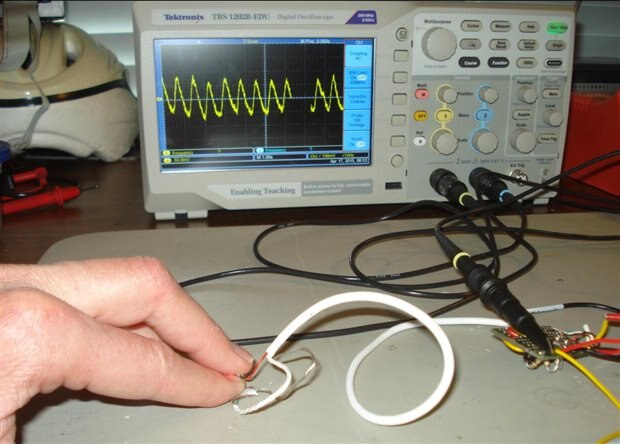
I implemented the schematic shown above using a solder prototype board and I then compared the measurements using the transmittance pulse oximetry on a finger and the reflectance pulse oximetry on my forehead.  The picture below shows the amplifier output signal of the transmittance method measured with the Tektronix 1202B-EDU oscilloscope.
 

image

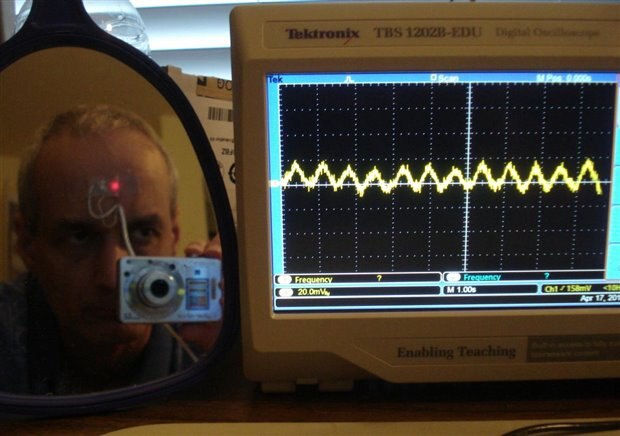
The signal contains the amplitude modulation generated by the heart rate.  The prototype board can be seen on the right side of the picture, where the oscilloscope probe connects.  Next I placed the LEDs and PIN photodiode on my forerhead and I measured the same signal at the output of the front end amplifier, as shown in the picture below.
 

image


The A/D converter records 512 samples over a duration of 10 seconds.  For debug purposes the function above has the possibility to send the recorded samples to a computer through the serial port, and an example of the recorded samples are shown in the figure below.


That is it for now; I will come back with new updates as I get more work done.


Best Wishes,

Cosmin

  • Sign in to reply
  • ciorga
    ciorga over 10 years ago in reply to sunnyiut

    Thank you for the nice comment Md. Kamrul.  I've found the SPO2 method quite powerful in providing health information data.

    Best Wishes,

    Cosmin

    • Cancel
    • Vote Up 0 Vote Down
    • Sign in to reply
    • More
    • Cancel
  • sunnyiut
    sunnyiut over 10 years ago

    WOW!!

    that's great...

    I am also working on the SPO2 module.

    It would be nice to get to know about your findings.

    best of luck

    • Cancel
    • Vote Up 0 Vote Down
    • Sign in to reply
    • More
    • Cancel
element14 Community

element14 is the first online community specifically for engineers. Connect with your peers and get expert answers to your questions.

  • Members
  • Learn
  • Technologies
  • Challenges & Projects
  • Products
  • Store
  • About Us
  • Feedback & Support
  • FAQs
  • Terms of Use
  • Privacy Policy
  • Legal and Copyright Notices
  • Sitemap
  • Cookies

An Avnet Company © 2025 Premier Farnell Limited. All Rights Reserved.

Premier Farnell Ltd, registered in England and Wales (no 00876412), registered office: Farnell House, Forge Lane, Leeds LS12 2NE.

ICP 备案号 10220084.

Follow element14

  • X
  • Facebook
  • linkedin
  • YouTube