element14 Community
element14 Community
    Register Log In
  • Site
  • Search
  • Log In Register
  • Community Hub
    Community Hub
    • What's New on element14
    • Feedback and Support
    • Benefits of Membership
    • Personal Blogs
    • Members Area
    • Achievement Levels
  • Learn
    Learn
    • Ask an Expert
    • eBooks
    • element14 presents
    • Learning Center
    • Tech Spotlight
    • STEM Academy
    • Webinars, Training and Events
    • Learning Groups
  • Technologies
    Technologies
    • 3D Printing
    • FPGA
    • Industrial Automation
    • Internet of Things
    • Power & Energy
    • Sensors
    • Technology Groups
  • Challenges & Projects
    Challenges & Projects
    • Design Challenges
    • element14 presents Projects
    • Project14
    • Arduino Projects
    • Raspberry Pi Projects
    • Project Groups
  • Products
    Products
    • Arduino
    • Avnet & Tria Boards Community
    • Dev Tools
    • Manufacturers
    • Multicomp Pro
    • Product Groups
    • Raspberry Pi
    • RoadTests & Reviews
  • About Us
  • Store
    Store
    • Visit Your Store
    • Choose another store...
      • Europe
      •  Austria (German)
      •  Belgium (Dutch, French)
      •  Bulgaria (Bulgarian)
      •  Czech Republic (Czech)
      •  Denmark (Danish)
      •  Estonia (Estonian)
      •  Finland (Finnish)
      •  France (French)
      •  Germany (German)
      •  Hungary (Hungarian)
      •  Ireland
      •  Israel
      •  Italy (Italian)
      •  Latvia (Latvian)
      •  
      •  Lithuania (Lithuanian)
      •  Netherlands (Dutch)
      •  Norway (Norwegian)
      •  Poland (Polish)
      •  Portugal (Portuguese)
      •  Romania (Romanian)
      •  Russia (Russian)
      •  Slovakia (Slovak)
      •  Slovenia (Slovenian)
      •  Spain (Spanish)
      •  Sweden (Swedish)
      •  Switzerland(German, French)
      •  Turkey (Turkish)
      •  United Kingdom
      • Asia Pacific
      •  Australia
      •  China
      •  Hong Kong
      •  India
      •  Korea (Korean)
      •  Malaysia
      •  New Zealand
      •  Philippines
      •  Singapore
      •  Taiwan
      •  Thailand (Thai)
      • Americas
      •  Brazil (Portuguese)
      •  Canada
      •  Mexico (Spanish)
      •  United States
      Can't find the country/region you're looking for? Visit our export site or find a local distributor.
  • Translate
  • Profile
  • Settings
Sudden Impact Wearables Design Challenge
  • Challenges & Projects
  • Design Challenges
  • Sudden Impact Wearables Design Challenge
  • More
  • Cancel
Sudden Impact Wearables Design Challenge
Blog Wearable Sudden Impact and Health Monitor Part 4
  • Blog
  • Forum
  • Documents
  • Polls
  • Files
  • Events
  • Mentions
  • Sub-Groups
  • Tags
  • More
  • Cancel
  • New
  • Share
  • More
  • Cancel
Group Actions
  • Group RSS
  • More
  • Cancel
Engagement
  • Author Author: ciorga
  • Date Created: 22 Dec 2014 2:52 AM Date Created
  • Views 703 views
  • Likes 2 likes
  • Comments 4 comments
  • sudden_impact
  • wearable_sudden
Related
Recommended

Wearable Sudden Impact and Health Monitor Part 4

ciorga
ciorga
22 Dec 2014

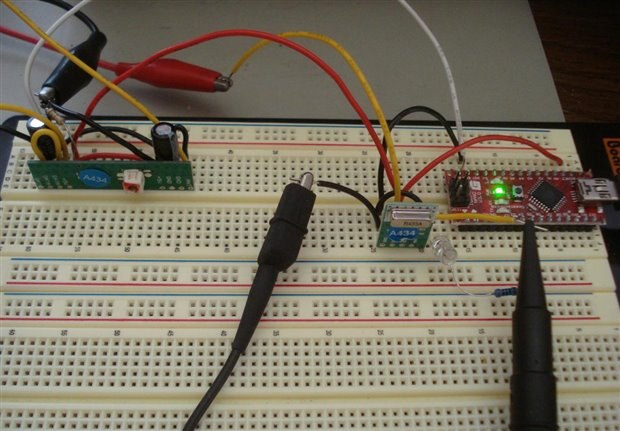
Some of my ordered parts started to arrive, which made me happy and enthusiastic to start doing some work.  My first experiment tried to make a radio link connection between a QAM-TX1 transmitter and a QAM-RX2 receiver.  QAM-TX1 is a complete transmitter hybrid module that operates at 433MHz and it is specified to handle TTL/CMOS data up to 3kHz.  The other module, QAM-RX2 is a complete RF receiver operating also at 433MHz and which provides TTL/CMOS output.   Here is the radio link setup:
 

image


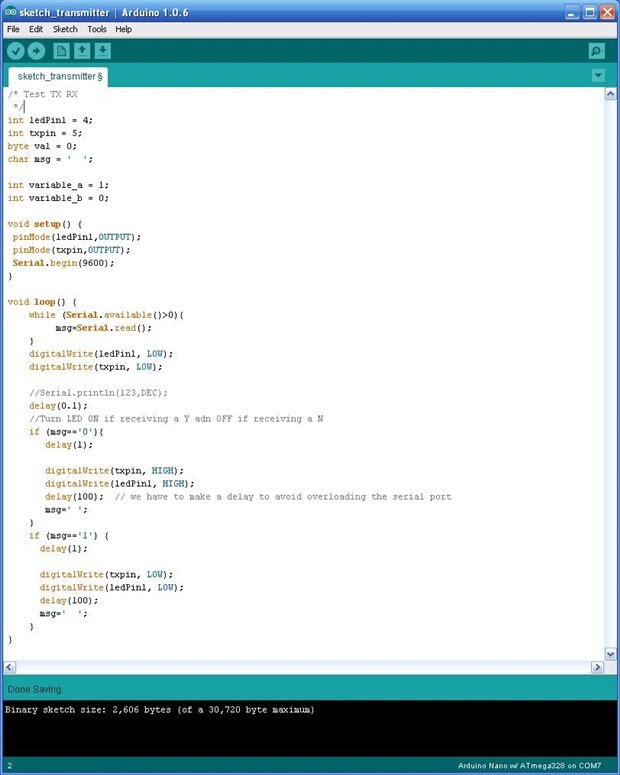
The transmitter is the small module on the right side, connected to the Arduino nano module, and the receiver is the board on the left side.  I have setup a small program running in the Arduino processor to send pseudo random data to the transmitter.  The sketch of that program is shown in the following screenshot:
 

image


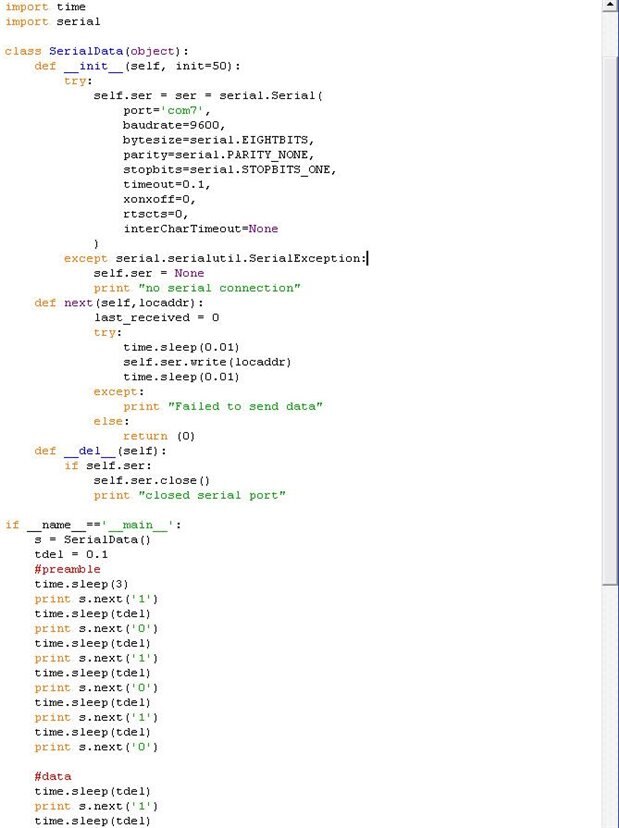
And the Python program that controls the data pattern is shown in the screenshot below:
 

image


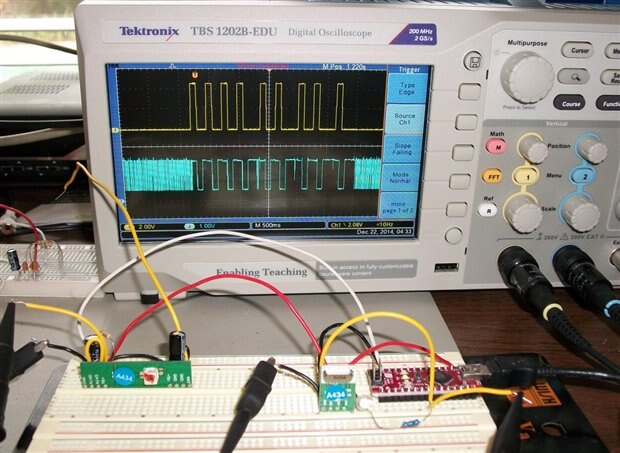
I then used the Tektronix TBS1202B-EDU oscilloscope to probe the input signal into the transmitter and the output signal of the receiver board, as I am showing in the following picture.
 

image


Channel 1 of the oscilloscope (yellow trace) probes the digital pattern generated by the Arduino processor and applied to the input of the transmitter, and channel 2 probes the output of the receiver. 


First thing that I noticed is that before and after the data pattern there is a lot of noise at the receiver output (random pulses), and also during the data pattern there are three regions with glitches.  These regions coincide with the three longer pulses in the pattern. 


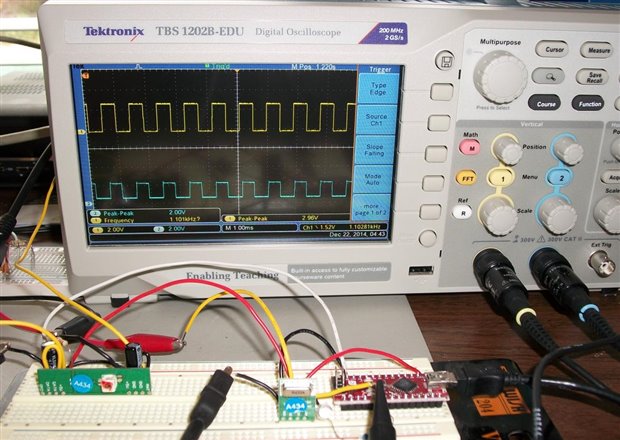
These results were not promising at all, so I continued with some characterization experiments of this RF transmission link.  Next I disconnected the Arduino signal and I applied a square-wave signal from a pulse generator, as I am showing in the figure below::
 

image


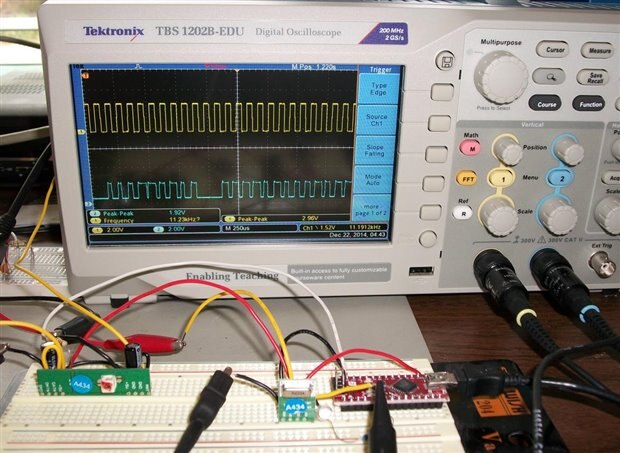
The frequency was 1kHz, and the received signal followed the transmitted signal.  I then increased the frequency to see where the transmission link breaks.  The following picture shows the transmitted and received signals at 11kHz frequency.
 

image


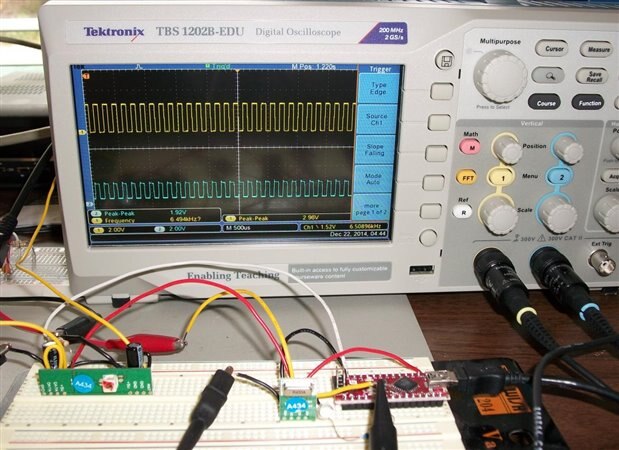
Notice how from time to time some of the received pulses are missing.  Next step, lowering the transmitted frequency I came to the conclusion that at 6.5kHz there are no missing pulses, like I am showing in the picture below:
 

image


So this is the upper frequency limit for square-wave signal, but this does not mean that a random data pattern will transmit without error.  The published highest frequency in the datasheet is 3kHz, so I am happy to see in this experiment that I’ve got it to work up to 6.5kHz. 


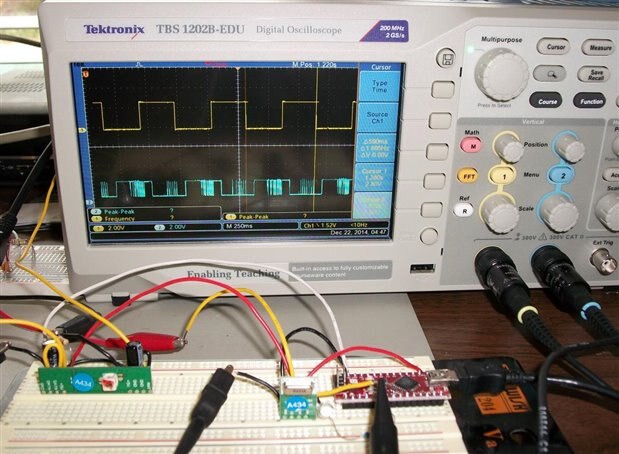
Next I explored that lowest limit of the transmitted frequency, and here are the waveforms at 1.6Hz:
 

image


Notice the glitches that show up about 100ms after each rising and falling edges.  I suspect that the origin of these glitches is a combination of 1/f noise and popcorn noise, which limits the functionality at lower frequencies.


So based on these experiments I think I can use this RF transmission link in my project if I am careful to limit the data rate within the functional bandwidth.


That is all for this update; I will come back with more info after I receive other components (and modules) and I complete more work on this project.


Until then all my best wishes and

Happy Holidays!

Cosmin

  • Sign in to reply

Top Comments

  • ciorga
    ciorga over 10 years ago in reply to tomaja +1
    Hi Dragan, Thank you for the comments; no, I haven't checked the distance range yet. Best Wishes, Cosmin
  • ciorga
    ciorga over 10 years ago in reply to tomaja

    Hi Dragan,

    Thank you for the comments; no, I haven't checked the distance range yet.

    Best Wishes,

    Cosmin

    • Cancel
    • Vote Up +1 Vote Down
    • Sign in to reply
    • More
    • Cancel
  • ciorga
    ciorga over 10 years ago in reply to ravi_butani

    Hi Ravi,

    Thank you for the comments; no, I haven't received the TBS1202B-EDU, that was a different oscilloscope.

    Best Wishes,

    Cosmin

    • Cancel
    • Vote Up 0 Vote Down
    • Sign in to reply
    • More
    • Cancel
  • tomaja
    tomaja over 10 years ago

    Nice post, Cosmin. Easy to follow.

    Did you make distance range test?


    Thanks,

    Dragan

    • Cancel
    • Vote Up 0 Vote Down
    • Sign in to reply
    • More
    • Cancel
  • ravi_butani
    ravi_butani over 10 years ago

    Good Post....

    have you received TBS1202B-EDU scope as a part of sudden impact design challenge?

    • Cancel
    • Vote Up 0 Vote Down
    • Sign in to reply
    • More
    • Cancel
element14 Community

element14 is the first online community specifically for engineers. Connect with your peers and get expert answers to your questions.

  • Members
  • Learn
  • Technologies
  • Challenges & Projects
  • Products
  • Store
  • About Us
  • Feedback & Support
  • FAQs
  • Terms of Use
  • Privacy Policy
  • Legal and Copyright Notices
  • Sitemap
  • Cookies

An Avnet Company © 2025 Premier Farnell Limited. All Rights Reserved.

Premier Farnell Ltd, registered in England and Wales (no 00876412), registered office: Farnell House, Forge Lane, Leeds LS12 2NE.

ICP 备案号 10220084.

Follow element14

  • X
  • Facebook
  • linkedin
  • YouTube