


Hearing Guard System - Noise
One of the main requirements of the Hearing Guard system is to be able to detect noise levels at pre-selected thresholds. This will be performed by the use of an audio input circuit as well as software to provide a visual indicator of the noise level in the area. Having an noise sensor in an area would act as a reminder that hearing protection is required or alert the user that the noise level has reached an unhealthy level and that they need to take the appropriate action.
The issue is that many people who are regularly exposed to extreme noise levels could get accustomed to the noisy environment and may not fully realized the impact that this could have on their hearing. This is where “Situational Awareness” plays a key role. Being aware of the surrounding area and what the noise level is very important. However, many noisy environments may only post signs that Hearing Protection is required but there is no visual indicators present that would show what level the noise is at. Situational Awareness can ensure that when the noise level becomes elevated the proper action is taken to protect from hearing loss. Adding a Noise Level Sensor would provide a visual indicator that the noise level is getting to a dangerous level, thus being aware of the noisy situation would as easy as seeing the noise level indicator.
For anyone who has spent time in a Data Center knowns that the Data Center can get quite noisy. There might be a number of servers with fans blowing, network equipment, analyzers, HVAC systems producing noise, and so on. It might not seem like the noise level is in the Danger Zone, but having to raise ones voice to have a conversation with another employee 3 feet away is a certain indicator that hearing protection is required. Prolonged exposure to this level of noise could lead so some hearing loss or even Tinnitus ( a ringing in the ears).
A data center might have sensors to ensure the equipment does not get too hot or too cold, or to keep track of the humidity level all to protect the equipment in the center. But, what about the worker? Perhaps they are kept at a cozy level along with the equipment in the data center, but what about the hearing? Typically, at least the Data Centers I have worked, there are no sensors to be found to indicate the noise level of the center.

So, what is noise?
According to OSHA:
“Noise and vibration are both fluctuations in the pressure of air (or other media) which affect the human body. Vibrations that are detected by the human ear are classified as sound. We use the term 'noise' to indicate unwanted sound.
Noise and vibration can harm workers when they occur at high levels, or continue for a long time. “
Noise is unwanted sound. This can come from various sources such as Lawn Mowers, Loud Music, Machinery, Noisy vehicles such as a motor cycle pipe, and so on.
The range of hearing for a human is determined by both the pitch of the sound, if it is high or low, and how loud the sound is. Pitch is measured in Hertz(Hz) and the loudness is measured in decibels (dB) named after Alexander Graham Bell. For a person with normal hearing, the range of pitch they can hear starts at 20Hz with the highest comfortable frequency being at 20,000Hz. The hearing is most sensitive around the 2000-5000 Hz frequency range. With regards to loudness, the human ear can typically detect sound at 0dB. The Danger Zone for a person’s hear is at or more than 85d.
OSHA permissible exposure limit (PEL) is 90 dBA for a worker in an 8 hour period
https://www.osha.gov/SLTC/noisehearingconservation/
NIOSH - National Safety and Health (NIOSH) has recommended that workers exposure to noise should be no greater than 85dBA in an hour period.
https://www.cdc.gov/niosh/topics/noise/noisemeter_html/hp0.html
Some Warning Signs that your workplace might be too noisy:
- You hear ringing or humming in your ears when you leave work.
- You have to shout to be heard by a coworker an arm's length away.
- You experience temporary hearing loss when leaving work.
There are many noise levels that individuals are exposed to on a daily basis from club music, to residential noises, or to Heavy Equipment if one works in construction. Some typical Sound Levels are listed below in the chart.
Typical Sound Levels (dB) | |
|---|---|
140 | Threshold of Pain |
130 | Jet Taking Off (200ft away) |
120 | Operating Heavy Equipment |
110 | Night Club w/music |
100 | Construction Site |
90 | Boiler Room |
80 | Freight Train |
70 | Classroom Chatter |
60 | Conversation ( 3ft away) |
50 | Urban Residence |
40 | Soft Whisper (5ft away) |
30 | North Rim of Grand Canyon |
20 | Silent Study Room |
10 |
|
0 | Threshold of Hearing (1000Hz) |
OSHA's concern in this area got one Texas limestone fabricator's attention. On September 11, 2014, OSHA laid some heavy fines because the employer failed to list the warning signs emitted by the noisy machinery on their shop floor. In this instance the company was fined $6500 for not ensuring employees were wearing proper hearing protection while be exposed to a 99.4 dBA for an 8 hour period.
This is where the Hearing Guard System would fit in. The goal of the Hearing Guard System (HGS) is to provide an easy to use noise level sensor that would work both as an individual Noise Level Sensor as well as a data collection system to track any noisy trends. This data could provide valuable data to a company as well as safety individuals so the noisy area could be evaluated to identify trouble areas and to implement any adjustments to the area to prevent over exposure to dangerous noise levels.
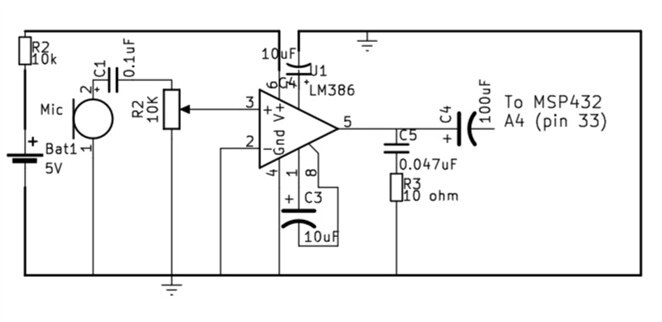
Currently, the audio circuit that I have been working with includes a LM386 and an Electret Mic connected to a MSP432 via A4 and processed to produce an output fed to a LED Bar Graph as an indicator of the noise level the mic is picking up. This is a variation of a Non-Inverting Op AMP. The sound is detected by the Electret Mic connected to pin 3 of the LM386 via c1 and R2. The audio is processed through the OP AMP and then fed back out on pin 5 which is connected to A4 ADC analog input channel 4 (Pin 33) of the MSP432. Once the audio is detected, it is processed and fed back out on pins 23-32 which are connected to the LED Bar Graph as a visual of the audio output. Eventually this will light the wearable with Green, Yellow, Orange or Red depending on the Noise level as well as display on the Sharp LCD, but this is what I have started for now.
Hearing Guard System - Audio Circuit
Hardware Used
MSP-EXP432P401RLaunchpad
LED Bar Graph Array 10 segment
1 x 10K Resistor
1 x 10 Ohm Resistor
1 x 10K Potentiometer
1 x 100uF Electrolytic Capacitor
2 x 10uF Electrolytic Capacitor
1 x 0.047 Ceramic Capacitor
1 x 0.1uF Capacitor
Video of what I have thus far
Top Comments