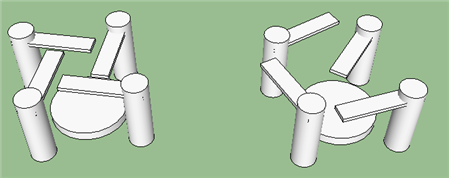
My idea would b to use a rotating drum containing different fillaments around to the position required, kinda like a cd changer but for the heat nozzle.
That is a great idea. I could see a couple things that would cause problems. You would have to find some easy way to feed the filament into the geared extruder as this can be a pain and not easy to do. I could also see an issue with getting the colors to change when needed as there will be a little filament left in the extruder before the next colors gets fed. A rotating head with multiple hot ends might work better but then your looking at having to mod the firmware. Still a great idea.
Nate
Initially I had the same idea after watching the episode on the Double Decker Printer. My second thought was a bit different and more along the lines of the Double Decker Printer but still quite different.
Instead of building the Y-carrige with the extruder locked into the carrige, have it where it can be inserted and removed like a desktop injet cartridge.
The inside of the extruder cartridge is where it becomes a bit more complex.
To start you would include the extruder, the idle wheel, filament clamp, and a drive gear. Now one or more cartridges may need to be idle at several points during a print. To acomodate this you would need to retract the extruder and the drive gear. Using a drop spring mount inside the cartridge along with a servo or set of servos to press the extruder down would see to extending and retracting.
Then comes the y-carrige. The drive motor would transfer power to a drive shaft which would transfer the power to the drive gear inside the extruder cartridge when it's not idle. Then horizontally several docks would allow an extruder cartridge to be locked into place.
When printing, a "core" filament should be printed first for each layer. To switch to a new filament, retract the current print head, move the y-carrige to line the dock for the next print point, drop the new active dock, resume printing layer.
Updated Thoughts:
But still... hmmm...Rotating...rotating....ROTATING!
Instead of a 3d square grid, why not a cylindrical building system?
The build table would be built like a turn table surrounded by z-axis towers each on their own turn table. A curve or arc arm mounted on the z-axis tower would hold the extruder. These arms will need to be long enough to reach over the center of the turn table so that the center of an object could be filled.
This would replace the x and y-axis with a polar grid being drawn by an arc.
Message was edited by: Matthew Scott
I have seen a multi-filiment setup before, and what it does is it has 3 different stepper motors for each fillament, and they move seperately to mix, or just push one color at a time through the extruder. Here's a link - http://richrap.blogspot.com/2012/08/3-way-quick-fit-extruder-and-colour.html
Mixing colors is not precise and not the only reason you'd want to have a controled separation of materials.
If you were to look at 4d printing, more precise control is needed for printing individual objects.
4 d printing occurs when an object is printed with 2 or more filaments that react in such a way as to change the shape of the final object after it is finished printing. http://www.youtube.com/watch?v=RfW1NYvV0PM and http://www.youtube.com/watch?v=0gMCZFHv9v8 provide the example of water controlled 4d printing. As they said in the fist video it's hard to control the print. Separating the extruder system gives this control.
A 3D print head is more than just a nozzle. It's a heater, a heater block, and somewhere a motor feeding the filament. All of these parts take space that would have to be accoutned for. Also, anyone who's changed filament colors can tell you that you need to waste at least a meter of extruded material to properly clear the nozzle.
In my mind mixing filaments for colors is a dead end. I think the solution lies in adding colors either after extrusion or as close to the end of the nozzle as possible. Maybe 4 pigment needles could be positioned at the end of the extruder so that they penetrate a transparent filament upon extrusion just a little and inject pigment in a controlled fashon. Of course this means a very VERY small build since most nozzles are already 0.4mm wide on the exit side. Maybe a wider nozzle could be used for the experiment phase but even then we're talking nanometer tolerances. This also means a pigment that can tollerate the high heats of extrusion. But theoretically if this works we could have true full color prints with photo level skinned details.
I've seen nozzles that mix colors but it's a slow change, you couldn't rely on it for "RBG" printing.
Also, it might be easier to move the printed piece / platform, NOT the nozzles ?