element14 Community
element14 Community
    Register Log In
  • Site
  • Search
  • Log In Register
  • Community Hub
    Community Hub
    • What's New on element14
    • Feedback and Support
    • Benefits of Membership
    • Personal Blogs
    • Members Area
    • Achievement Levels
  • Learn
    Learn
    • Ask an Expert
    • eBooks
    • element14 presents
    • Learning Center
    • Tech Spotlight
    • STEM Academy
    • Webinars, Training and Events
    • Learning Groups
  • Technologies
    Technologies
    • 3D Printing
    • FPGA
    • Industrial Automation
    • Internet of Things
    • Power & Energy
    • Sensors
    • Technology Groups
  • Challenges & Projects
    Challenges & Projects
    • Design Challenges
    • element14 presents Projects
    • Project14
    • Arduino Projects
    • Raspberry Pi Projects
    • Project Groups
  • Products
    Products
    • Arduino
    • Avnet & Tria Boards Community
    • Dev Tools
    • Manufacturers
    • Multicomp Pro
    • Product Groups
    • Raspberry Pi
    • RoadTests & Reviews
  • About Us
  • Store
    Store
    • Visit Your Store
    • Choose another store...
      • Europe
      •  Austria (German)
      •  Belgium (Dutch, French)
      •  Bulgaria (Bulgarian)
      •  Czech Republic (Czech)
      •  Denmark (Danish)
      •  Estonia (Estonian)
      •  Finland (Finnish)
      •  France (French)
      •  Germany (German)
      •  Hungary (Hungarian)
      •  Ireland
      •  Israel
      •  Italy (Italian)
      •  Latvia (Latvian)
      •  
      •  Lithuania (Lithuanian)
      •  Netherlands (Dutch)
      •  Norway (Norwegian)
      •  Poland (Polish)
      •  Portugal (Portuguese)
      •  Romania (Romanian)
      •  Russia (Russian)
      •  Slovakia (Slovak)
      •  Slovenia (Slovenian)
      •  Spain (Spanish)
      •  Sweden (Swedish)
      •  Switzerland(German, French)
      •  Turkey (Turkish)
      •  United Kingdom
      • Asia Pacific
      •  Australia
      •  China
      •  Hong Kong
      •  India
      • Japan
      •  Korea (Korean)
      •  Malaysia
      •  New Zealand
      •  Philippines
      •  Singapore
      •  Taiwan
      •  Thailand (Thai)
      • Vietnam
      • Americas
      •  Brazil (Portuguese)
      •  Canada
      •  Mexico (Spanish)
      •  United States
      Can't find the country/region you're looking for? Visit our export site or find a local distributor.
  • Translate
  • Profile
  • Settings
element14's The Ben Heck Show
  • Challenges & Projects
  • element14 presents
  • element14's The Ben Heck Show
  • More
  • Cancel
element14's The Ben Heck Show
Forum Question concerning power for Raspbery Pi
  • Blog
  • Forum
  • Documents
  • Polls
  • Files
  • Members
  • Mentions
  • Sub-Groups
  • Tags
  • More
  • Cancel
  • New
Join element14's The Ben Heck Show to participate - click to join for free!
Actions
  • Share
  • More
  • Cancel
Forum Thread Details
  • Replies 9 replies
  • Subscribers 31 subscribers
  • Views 891 views
  • Users 0 members are here
Related

Question concerning power for Raspbery Pi

toxxn
toxxn over 12 years ago

I am making a power supply for the Raspberry Pi I am getting. The reason I am making one rather than using just a standard Micro USB is because I am custom soldering a pcb with a switch to turn on/off the Pi along with a 12v LED to indicate the device is on, and a 4.3 in TFT LCD that is also 12v. Since the LED and TFT LCD I am using both use 12v and the Pi doesnt, I needed to lower the voltage from 12v to 5v so that I can power everything at once with ONE plug. I read up on the the correct voltage to use, which is 5v at 700mA at the least (although some have argued you that barely powers the device and recommend at least 5v 1000mA). My question is, will 5v 500mA work? I have a spare plugin/ car usb charger combo that is AC 100-240v/ DC 12-24v 50/60Hz input to DC 5v 500mA output. I wanted to use this to lower the 12v volts needed for the rest of the project to 5v that is needed for the Pi, however I have no idea if it will work and I dont want to scrap my spare charger if it wont.


Any help/ suggestions/ answers would be appreciated.


Note: If its any help to the above question, I plan to use ALL usb devices through a hub.

  • Sign in to reply
  • Cancel
  • toxxn
    toxxn over 12 years ago

    So I was searching around ebay, and I found this:

    http://cgi.ebay.com/ws/eBayISAPI.dll?ViewItem&item=321180084219


    It's a KIS3R33S 5V USB 7V-24V to 5V 3A Step-Down Buck Module.

    This would allow me to do away with the 12V to 5V charge I have mentioned in my original post as well as have a more compact setup, and still allow me to jumping down the voltage from 12 to 5.

    I am concerned however. The Raspberry Pi Model B inputs 5V 700mA (3.5W) and it states in the ebay auction it has a continuous output of 3A however it also says: "4A(Spike/Short time)".

    I am concerned that with it spikeing 4A I might fry the Pi. Would this Module be safe to power the Pi?

    • Cancel
    • Vote Up 0 Vote Down
    • Sign in to reply
    • Cancel
  • tpcipri
    tpcipri over 12 years ago in reply to toxxn

    Don't worry about the continuous 3A and 4A spike. The 3A rating means the regulator can regulate with a 3A continuous load. The 4A spike means that it will regulate with load surges up to 4A. Another way to put it is that the buck module will regulate as long as your load (Raspberry Pi unit) needs less than 3A. You might see 4A when the Raspberry Pi module is turned on or plugged in and the capacitors start charging but normally you will be under 700mA load on the regulator.

    • Cancel
    • Vote Up 0 Vote Down
    • Sign in to reply
    • Cancel
  • toxxn
    toxxn over 12 years ago in reply to tpcipri

    So basically I could go for an even higher miliampere/ampere and the Pi would be uneffected so long as the voltage is 5V as it only draws the current it needs.

    That would be convienant in the case I decide to completely do an all-in-one power supply powering the TFT LCD with 12V and jumping it down to 5V with the Buck Module so I could power the Pi and the USB Hub all with one plug-in rather than 3 seperate ones. I think this may be my goal, I plan to recyle my old iPod box as it seems a perfect fit for what I need. I may use my other iPod box to make a Pi encloser so the power supply and pi encloser realativly match each other.


    Thank you for the info!

    • Cancel
    • Vote Up 0 Vote Down
    • Sign in to reply
    • Cancel
  • tpcipri
    tpcipri over 12 years ago in reply to toxxn

    Yes, you will have about 2 Amps available for powering USB devices. Don't forget that the 12V supply has to have enough current to supply the 12V portion plus the 5V portion. Good luck with your design.

    • Cancel
    • Vote Up 0 Vote Down
    • Sign in to reply
    • Cancel
  • jeffclough
    jeffclough over 12 years ago

    Cory,

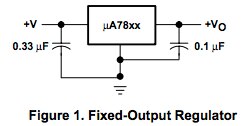
    I've used the 7805 for many years to power my TTL projects. They're dead simple to use, provide up to 1.5A, and they're dirt cheap. Feed it 12V and it will give you 5V. (But do read the specs on whatever specific device you get.)


    https://www.sparkfun.com/datasheets/Components/LM7805.pdf


    image


    --Jeff

    • Cancel
    • Vote Up 0 Vote Down
    • Sign in to reply
    • Cancel
  • tpcipri
    tpcipri over 12 years ago in reply to jeffclough

    The 7805 will work but is lossy (18W input power vs. 7.5W output power) and will need a heat sink to dissipate the 12W difference. Not good for battery operation. Pros are there are multiple sources and been around forever making it a good candidate for new products that have a long life cycle and reliable power source.


    At 96% efficiency the KISR33 will have input power requirement of around 8W and will half the energy usage from a battery. The actual performance may be less than 96% because efficiency depends on a number of variables such as input voltage and load current but the efficiency is almost always better than linear regulators.

    • Cancel
    • Vote Up 0 Vote Down
    • Sign in to reply
    • Cancel
  • toxxn
    toxxn over 12 years ago in reply to tpcipri

    I thought about using the 7805, but the reason I did not is as you explained. I believe is was Revision 3 that did some videos on making a usb battery pack that I watched, where they used the 7805 and it would not power some devices.

    '

    I went ahead and ordered the KIS3R33S Step-Down Module considering it already has a female USB port and is easy to set up.


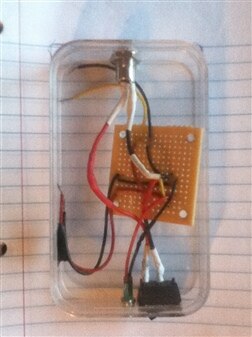
    Here is a sneak peak at what I currently have finished of my custom power supply.

    image

    As you can see its not complete. I am waiting on the KISR33 to arrive and I havnt yet ordered the TFT LCD I am going to use.

    To simply run down on whats going on, I used a basic prototyping board to wire everything up. Power goes into the Size M DC Power Jack that can be seen on the left side. The positive wire runs to the switch you can see on the right which then runs to the PCB. The negative wire from the DC Power Jack runs directly to the PCB beside the postive connetion. (No worries, there is no short) The LED has a built in resister which you can kind of make out on its negative wire, this i connected directly to the power supplied to the board. The Black and Yellow wire you see to the left is the wire I will be using for the TFT LCD which is a direct 12v so its also connected to the power supplied to the PCB. The red and black on the bottom will go to the KISR33. Everything is encased in a recycled iPod touch box.


    IF anyone can spot any errors in my work or have any suggestion, please let me know. I know I am a beginner, so any critisicm and helpfull recommendations are welcomed.


    My only concern right now is the power cord I am currently using, (recycled I.T.E Power Supply I am not sure went to) is your basic 110-120VAC 60hz 190mA input with an output of 12V DC 750mA. I am worried that 750mA would only be enough current to efficiantly power the Pi, not the TFT LCD alongside it. Thoughts?

    • Cancel
    • Vote Up 0 Vote Down
    • Sign in to reply
    • Cancel
  • tpcipri
    tpcipri over 12 years ago in reply to toxxn

    You are right to be concerned about your 12V supply. You can calculate the power requirement by adding the loads.


    LCD Power + Pi Power + USB Power

                        75 %


    LCD Poweryou can get from the datasheet

    Pi Power = Pi chip max operating  current * 5V / efficiency (I would leave margins and use efficiency of 75%)

    USB Power = 2A * 5V (max per 2.0 spec) / efficiency


    You will need minimally a 12V/10W power supply just for max USB power requirements. Everything else should be fairly low power.


    I would look for a 12V/15W power supply which will be about double what your have.

    • Cancel
    • Vote Up 0 Vote Down
    • Sign in to reply
    • Cancel
  • toxxn
    toxxn over 12 years ago in reply to tpcipri

    Thank you for the info, I will look around for a 12v 1500mA - 2000mA supply.

    • Cancel
    • Vote Up 0 Vote Down
    • Sign in to reply
    • Cancel
element14 Community

element14 is the first online community specifically for engineers. Connect with your peers and get expert answers to your questions.

  • Members
  • Learn
  • Technologies
  • Challenges & Projects
  • Products
  • Store
  • About Us
  • Feedback & Support
  • FAQs
  • Terms of Use
  • Privacy Policy
  • Legal and Copyright Notices
  • Sitemap
  • Cookies

An Avnet Company © 2025 Premier Farnell Limited. All Rights Reserved.

Premier Farnell Ltd, registered in England and Wales (no 00876412), registered office: Farnell House, Forge Lane, Leeds LS12 2NE.

ICP 备案号 10220084.

Follow element14

  • X
  • Facebook
  • linkedin
  • YouTube