element14 Community
element14 Community
    Register Log In
  • Site
  • Search
  • Log In Register
  • Community Hub
    Community Hub
    • What's New on element14
    • Feedback and Support
    • Benefits of Membership
    • Personal Blogs
    • Members Area
    • Achievement Levels
  • Learn
    Learn
    • Ask an Expert
    • eBooks
    • element14 presents
    • Learning Center
    • Tech Spotlight
    • STEM Academy
    • Webinars, Training and Events
    • Learning Groups
  • Technologies
    Technologies
    • 3D Printing
    • FPGA
    • Industrial Automation
    • Internet of Things
    • Power & Energy
    • Sensors
    • Technology Groups
  • Challenges & Projects
    Challenges & Projects
    • Design Challenges
    • element14 presents Projects
    • Project14
    • Arduino Projects
    • Raspberry Pi Projects
    • Project Groups
  • Products
    Products
    • Arduino
    • Avnet & Tria Boards Community
    • Dev Tools
    • Manufacturers
    • Multicomp Pro
    • Product Groups
    • Raspberry Pi
    • RoadTests & Reviews
  • About Us
  • Store
    Store
    • Visit Your Store
    • Choose another store...
      • Europe
      •  Austria (German)
      •  Belgium (Dutch, French)
      •  Bulgaria (Bulgarian)
      •  Czech Republic (Czech)
      •  Denmark (Danish)
      •  Estonia (Estonian)
      •  Finland (Finnish)
      •  France (French)
      •  Germany (German)
      •  Hungary (Hungarian)
      •  Ireland
      •  Israel
      •  Italy (Italian)
      •  Latvia (Latvian)
      •  
      •  Lithuania (Lithuanian)
      •  Netherlands (Dutch)
      •  Norway (Norwegian)
      •  Poland (Polish)
      •  Portugal (Portuguese)
      •  Romania (Romanian)
      •  Russia (Russian)
      •  Slovakia (Slovak)
      •  Slovenia (Slovenian)
      •  Spain (Spanish)
      •  Sweden (Swedish)
      •  Switzerland(German, French)
      •  Turkey (Turkish)
      •  United Kingdom
      • Asia Pacific
      •  Australia
      •  China
      •  Hong Kong
      •  India
      • Japan
      •  Korea (Korean)
      •  Malaysia
      •  New Zealand
      •  Philippines
      •  Singapore
      •  Taiwan
      •  Thailand (Thai)
      • Vietnam
      • Americas
      •  Brazil (Portuguese)
      •  Canada
      •  Mexico (Spanish)
      •  United States
      Can't find the country/region you're looking for? Visit our export site or find a local distributor.
  • Translate
  • Profile
  • Settings
element14's The Ben Heck Show
  • Challenges & Projects
  • element14 presents
  • element14's The Ben Heck Show
  • More
  • Cancel
element14's The Ben Heck Show
Forum Cheap Sylvania 7" Netbooks... GPIO goldmine or Hackable Pi Laptop?
  • Blog
  • Forum
  • Documents
  • Polls
  • Files
  • Members
  • Mentions
  • Sub-Groups
  • Tags
  • More
  • Cancel
  • New
Join element14's The Ben Heck Show to participate - click to join for free!
Actions
  • Share
  • More
  • Cancel
Forum Thread Details
  • State Not Answered
  • Replies 3 replies
  • Subscribers 30 subscribers
  • Views 733 views
  • Users 0 members are here
  • hack
  • portable
  • hardware
  • mods
  • raspberry_pi
  • viewer_challenge
  • challenge
  • raspberry_pi_camera
  • ben
Related

Cheap Sylvania 7" Netbooks... GPIO goldmine or Hackable Pi Laptop?

sudos
sudos over 12 years ago

Hello goers of Element14, and Ben, if you're peeping in here every so often! long time viewer here with something interesting, I think.


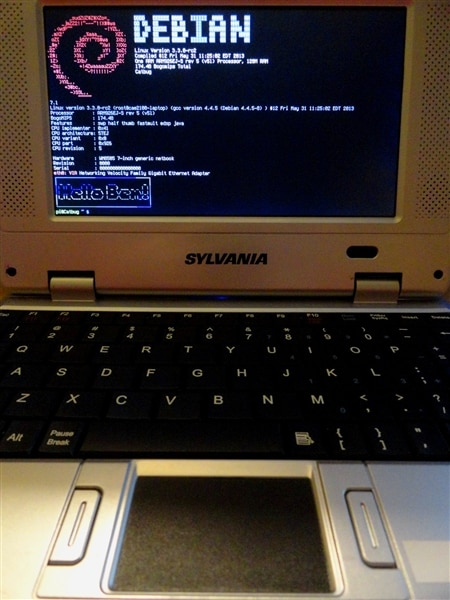
I have one of these Sylvania SYNET7 generic chinese CVS-sold 7" netbooks in my posession. Recently, I took interest in it after it had been sitting for some time, and loaded up Raspbian Wheezy Softfloat (2013-05-29-wheezy-armel.img) with a custom kernel, found here: https://cae2100.wordpress.com/2013/06/26/well-ive-been-talking-about-designing-my-own/

There are also instructions on that blog which give the step-by-step for getting the flash card prepped to be used in such a system.


It's based on a junky WonderMedia wm8505, ARMv5 running someplace in the 250MHz range. it also only posesses 128MB of RAM. Originally, these run either Windows CE or Android. Mine ran CE and had the NAND Flash chip onboard go faulty, so running Linux via an SD card is the only viable option still holding it together. Supposedly the third revision of the board negates the NAND for a USB flashdrive, but these cheaply-made junk drives seem to have problems with Linux loaded on them, however it should be fairly easy to replace and drop in say a MicroSD reader with a 32GB MicroSD card and be good to go while keeping the SD card slot free. The screen is 800x480, and is sharp at that. has a pretty nice viewing angle as well for something made so cheaply. seems to also have a Gigabit NIC onboard as well, another surprise for something so cheaply made.
 

image


So I had two ideas sprout from this-- One, it has some GPIO traces, most notably one to switch on and off the internal WiFi dongle (mine is dead and needs to be replaced) embedded in the lid, and I'd expect more. As I can't find a schematic for the board (and knowing me, I probably won't) I can't map out the GPIO pins that are available to poke and prod around with. Attached is a semi-decentish picture of the motherboard underside of my version, found from Google. There seems to be an unused USB port there on the top left next to the white battery connector as well... Also what look to be unused mPCIe solder pads on the board? hmm...

So the idea here would be to break out all the GPIO pins not currently in use by internals and make then accessible on the outside of the device via some sort of a jumper block and some ribbon cable... but a schematic would have to be found to break them ALL out. in this case, it'd be say, an interesting development netbook, and while running Linux, maybe the brains for some sort of 3D printer or other weird creation?


The other idea would be to remove the current motherboard, or as much of it as feasibly possible, drop in a raspi or cubieboard2 with unneeded components removed or relocated (there's a LOT of unused space on the back and sides, and on either side of the screen by the teeny speakers as well, possibly an excuse to make use of a Pi camera board?). I'd think the cubieboard2 would be better suited since it's much more powerful than the Pi with all the fixings still... but the Pi is cheaper. so it'd be a lot better in terms of price.


I'd say the second idea would be more of an interesting challenge for Ben, if it's considered feasible. it's the right thickness, at least, to house a Pi with modification to the ports, and the netbooks themselves are a dime a dozen used, in all walks of life, from different brands using the same cheapo design and hardware in all cases... but in the end, they're full of all sorts of fun stuff to play with! I'd also like to know if anyone else out there in the community may have one of these doing anything interesting.So far my only use for it is as a communications device to talk to some friends via irssi and not really much more, since my SD card is slow and that makes the swap slow, so running X is a pain. a faster SD card would give faster swap and therefore allow for a fasteer UI experience, but I don't see the need if I can just use wicd-curses to connect to an access point and go from there in CLI.

Attachments:
image
  • Sign in to reply
  • Cancel
  • sudos
    0 sudos over 12 years ago

    So I let this soak in for a little while, but I received a notification this morning about a reply on that wordpress blog page where I got the kernel. Here's a relevant excerpt:

    I use mine to no end to run my arduino + robots with because of the really long battery life that it has. Also use it for messing with python scripts and writing code for the rpi since the code compiled on the netbook will run fine on the rpi, only a little slower than as if it were compiled on the rpi itself with hardfloat eabi. I had the same issue with the internal wifi card, and it eventually died bc they dont solder the wires onto the card itself very well, and the wires tend to fray from being bumpped around and the +5v ran into the data lines, and shorted everything out on mine, so I just removed it and use a cheapy wifi adapter from ebay that I had bought for the raspberry pi.


    so it seems that one can compile actual code to run on the Raspi on this little netbook,  and it'll run on it fine albeit a bit slow. cheapie USB WiFi adapter: Check. long battery life? Check. and the battery is a dumb battery, completely upgradeable or negatable depending on the project... could probably use it as a power input source instead of the adapter jack to keep something utilizing it looking clean. 


    I'll just let that soak in a bit more, this is getting interesting.

    • Cancel
    • Vote Up 0 Vote Down
    • Sign in to reply
    • Verify Answer
    • Cancel
  • jds123
    0 jds123 over 12 years ago in reply to sudos

    there is another usb spot, where it says USBWiFi, and there appears to be an UART connector down twords the bottom with a ground, txd, rxd, and 3v.

    • Cancel
    • Vote Up 0 Vote Down
    • Sign in to reply
    • Verify Answer
    • Cancel
  • sudos
    0 sudos over 12 years ago in reply to jds123

    The spot labeled USBWIFI is where the 802.11g USB Ralink-based card in the screen housing connects to. note the top pin is not +5v but is instead labeled something else. The other three are standard USB, however. That pin goes to a GPIO switch which sends the +5v signal if told to. all the rest are normal USB ports.


    the UART port there, didn't even see, however looking around it has been mentioned in comments on a few blog sites.

    • Cancel
    • Vote Up 0 Vote Down
    • Sign in to reply
    • Verify Answer
    • Cancel
element14 Community

element14 is the first online community specifically for engineers. Connect with your peers and get expert answers to your questions.

  • Members
  • Learn
  • Technologies
  • Challenges & Projects
  • Products
  • Store
  • About Us
  • Feedback & Support
  • FAQs
  • Terms of Use
  • Privacy Policy
  • Legal and Copyright Notices
  • Sitemap
  • Cookies

An Avnet Company © 2026 Premier Farnell Limited. All Rights Reserved.

Premier Farnell Ltd, registered in England and Wales (no 00876412), registered office: Farnell House, Forge Lane, Leeds LS12 2NE.

ICP 备案号 10220084.

Follow element14

  • X
  • Facebook
  • linkedin
  • YouTube