element14 Community
element14 Community
    Register Log In
  • Site
  • Search
  • Log In Register
  • Community Hub
    Community Hub
    • What's New on element14
    • Feedback and Support
    • Benefits of Membership
    • Personal Blogs
    • Members Area
    • Achievement Levels
  • Learn
    Learn
    • Ask an Expert
    • eBooks
    • element14 presents
    • Learning Center
    • Tech Spotlight
    • STEM Academy
    • Webinars, Training and Events
    • Learning Groups
  • Technologies
    Technologies
    • 3D Printing
    • FPGA
    • Industrial Automation
    • Internet of Things
    • Power & Energy
    • Sensors
    • Technology Groups
  • Challenges & Projects
    Challenges & Projects
    • Design Challenges
    • element14 presents Projects
    • Project14
    • Arduino Projects
    • Raspberry Pi Projects
    • Project Groups
  • Products
    Products
    • Arduino
    • Avnet & Tria Boards Community
    • Dev Tools
    • Manufacturers
    • Multicomp Pro
    • Product Groups
    • Raspberry Pi
    • RoadTests & Reviews
  • About Us
  • Store
    Store
    • Visit Your Store
    • Choose another store...
      • Europe
      •  Austria (German)
      •  Belgium (Dutch, French)
      •  Bulgaria (Bulgarian)
      •  Czech Republic (Czech)
      •  Denmark (Danish)
      •  Estonia (Estonian)
      •  Finland (Finnish)
      •  France (French)
      •  Germany (German)
      •  Hungary (Hungarian)
      •  Ireland
      •  Israel
      •  Italy (Italian)
      •  Latvia (Latvian)
      •  
      •  Lithuania (Lithuanian)
      •  Netherlands (Dutch)
      •  Norway (Norwegian)
      •  Poland (Polish)
      •  Portugal (Portuguese)
      •  Romania (Romanian)
      •  Russia (Russian)
      •  Slovakia (Slovak)
      •  Slovenia (Slovenian)
      •  Spain (Spanish)
      •  Sweden (Swedish)
      •  Switzerland(German, French)
      •  Turkey (Turkish)
      •  United Kingdom
      • Asia Pacific
      •  Australia
      •  China
      •  Hong Kong
      •  India
      • Japan
      •  Korea (Korean)
      •  Malaysia
      •  New Zealand
      •  Philippines
      •  Singapore
      •  Taiwan
      •  Thailand (Thai)
      • Vietnam
      • Americas
      •  Brazil (Portuguese)
      •  Canada
      •  Mexico (Spanish)
      •  United States
      Can't find the country/region you're looking for? Visit our export site or find a local distributor.
  • Translate
  • Profile
  • Settings
WorkBench Wednesdays
  • Challenges & Projects
  • element14 presents
  • WorkBench Wednesdays
  • More
  • Cancel
WorkBench Wednesdays
Blog I need your ideas on how to test flux!
  • Blog
  • Forum
  • Documents
  • Quiz
  • Events
  • Polls
  • Files
  • Members
  • Mentions
  • Sub-Groups
  • Tags
  • More
  • Cancel
  • New
Join WorkBench Wednesdays to participate - click to join for free!
  • Share
  • More
  • Cancel
Group Actions
  • Group RSS
  • More
  • Cancel
Engagement
  • Author Author: baldengineer
  • Date Created: 25 May 2022 4:44 PM Date Created
  • Views 6137 views
  • Likes 10 likes
  • Comments 24 comments
  • soldering
  • flux
Related
Recommended

I need your ideas on how to test flux!

baldengineer
baldengineer
25 May 2022

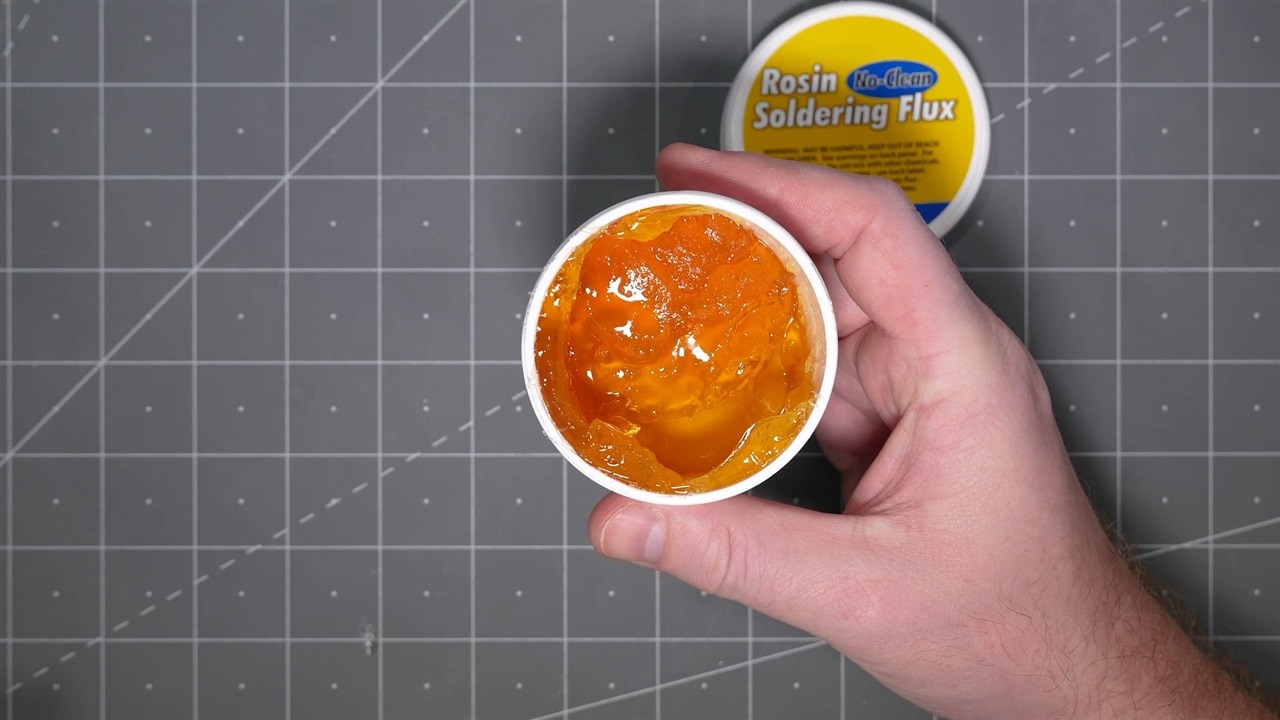
Bucket of Flux Paste

I have been thinking about an episode that compares different types of flux. Primarily I want to compare rosen, water-soluble, and no clean.

I need your help with at least two aspects.

First, what to cover. The two key areas I am thinking about are how effective are each and how difficult are they to clean? Are there any other areas we should explore?

Second, how to do the testing. My thought was to sand the finish off some scrap PCBs and expose them to moisture to generate some corrosion. Is there another way to simulate joints that require cleaning? Maybe an additional test needs to be soldering new components/PCBs for comparison?

Ultimately, I can solder parts to those PCBs and then compare the resulting solder joints with a microscope.

I'm open to the community's thoughts on what to test and how. So let me know what you think!

  • Sign in to reply

Top Comments

  • Jan Cumps
    Jan Cumps over 3 years ago in reply to baldengineer +1
    (... and shelf life + storage requirements? For those that don't use a lot of flux it is a thing.)
  • shabaz
    shabaz over 3 years ago in reply to indeterminatus +1
    Regarding: If it makes any difference at all, what about health hazards? Are all fumes somewhat equally bad? It can take decades before health problems appear. Case in point is Parkinsons, where…
  • Jan Cumps
    Jan Cumps over 3 years ago in reply to baldengineer

    yes. For solder paste, you have to purchase a different item for lead-free vs leaded applications. Because the viscosity at the solder temperature has to be optimal.
    If you use for-leaded paste in lead-free work, it is way to fluid at the temperatures used.
    If you use for-lead-free in leaded work, it isn't fluid enough.


    These pastes have - on purpose - a narrow temperature range of application. If they would have a broader range, physical symptoms would occur at the wrong time and components would either flow away or not center at the right moment.

    • Cancel
    • Vote Up 0 Vote Down
    • Sign in to reply
    • More
    • Cancel
  • baldengineer
    baldengineer over 3 years ago in reply to DAB

    Another great point/idea! Temperature. Thanks @DAB.

    • Cancel
    • Vote Up 0 Vote Down
    • Sign in to reply
    • More
    • Cancel
  • DAB
    DAB over 3 years ago

    You could look at the different types of metals that each type of flux can clean.

    You could also look at the temperatures at which the flux actually need to attain before it supports the soldering.

    Something like the rule of thumb for plumbing flux, where you wait until the flux bubbles before you apply the solder.

    • Cancel
    • Vote Up 0 Vote Down
    • Sign in to reply
    • More
    • Cancel
  • baldengineer
    baldengineer over 3 years ago in reply to michaelkellett

    > "I don't think there is much point in testing flux on deliberately chosen bad parts"

    The purpose is to show extremes.

    • Cancel
    • Vote Up 0 Vote Down
    • Sign in to reply
    • More
    • Cancel
  • michaelkellett
    michaelkellett over 3 years ago

    I don't think there is much point in testing flux on deliberately chosen bad parts  - the solution to that problem is not to use bad parts !

    On the other hand testing on a nice new gold plated pcb maybe gives the flux little chance to show its goodness.

    So I suggest hand soldering 0603 surface mount caps and resistors and TQFP packages (by "drag" soldering) on new but cheap solder levelled or immersion silver coated boards.

    I use very runny (like water) flux applied with a paint brush. (Warburtons Future 315). It's sold as no clean but I almost always clean using Safewash (water soluble soap) in an ultrasonic cleaner and rinse with tap and then 2 flushes of de-ionised water.

    For re-work I might just use IPA as Shabaz suggests.

    I've had Doug's problem with residues being OK until they absorb moisture.

    MK

    • Cancel
    • Vote Up 0 Vote Down
    • Sign in to reply
    • More
    • Cancel
<>
element14 Community

element14 is the first online community specifically for engineers. Connect with your peers and get expert answers to your questions.

  • Members
  • Learn
  • Technologies
  • Challenges & Projects
  • Products
  • Store
  • About Us
  • Feedback & Support
  • FAQs
  • Terms of Use
  • Privacy Policy
  • Legal and Copyright Notices
  • Sitemap
  • Cookies

An Avnet Company © 2026 Premier Farnell Limited. All Rights Reserved.

Premier Farnell Ltd, registered in England and Wales (no 00876412), registered office: Farnell House, Forge Lane, Leeds LS12 2NE.

ICP 备案号 10220084.

Follow element14

  • X
  • Facebook
  • linkedin
  • YouTube