


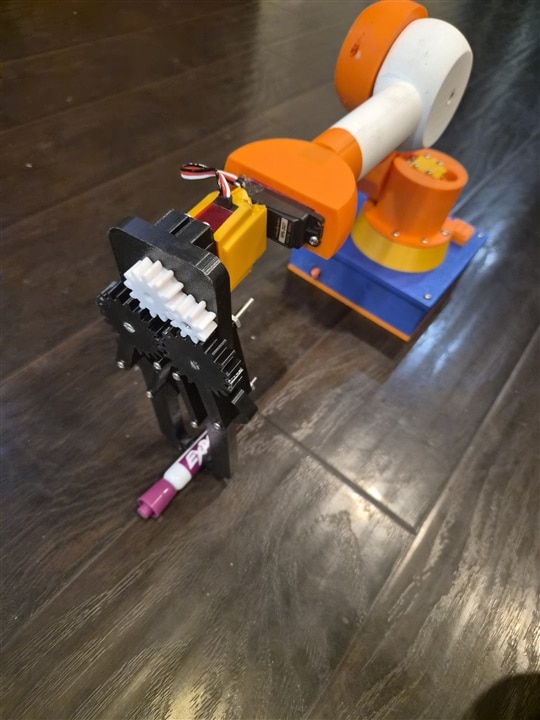
AEGIS is a fully custom-designed robotic arm that I designed, 3D printed, assembled, and programmed from the ground up over the past month. My inspiration came from JARVIS in Iron Man—the idea of building an intelligent robotic assistant that can understand its environment and work alongside people. While AEGIS is only the first step toward that vision, it represents the foundation for a future AI-powered robotic assistant.
Built around an Arduino Uno R3 and a PCA9685 servo controller, the arm uses five high-torque digital servos capable of lifting objects weighing up to 20 kg (55.1 lbs). Rather than relying on a stationary bench power supply, I engineered the system to run from a 7.4V 2S 50C LiPo battery, making the arm completely portable while still supplying the high current required by the servos.
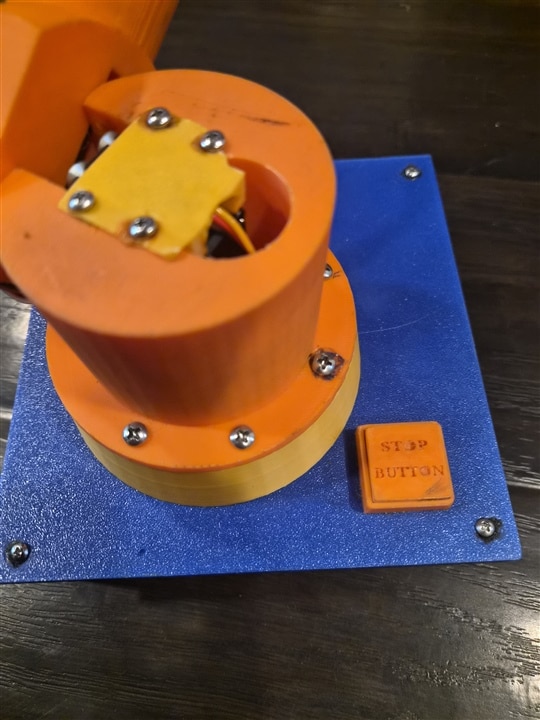
The arm is controlled through custom Arduino software that converts desired joint angles into calibrated servo positions, allowing every joint to be individually controlled. An emergency stop button is built into the system, instantly halting any autonomous motion and returning the arm to a safe home position. While the arm is currently controlled from a computer for development and calibration, my next milestone is to integrate dual joysticks for intuitive manual control without requiring a PC.
One of the biggest engineering challenges was calibrating five independent servos so that every commanded angle corresponded to the arm's true physical position. Because each servo had slight manufacturing tolerances and different horn mounting positions, I developed custom software offsets and calibration routines for each joint. I also discovered that one joint exhibited a non-linear relationship between commanded and actual angle, requiring mathematical correction rather than a simple offset.
Power management became another major challenge. The large high-torque servos produced significant current spikes that caused unexpected voltage drops and even damaged one Arduino's USB interface during development. To solve this, I redesigned the power distribution system using a dedicated high-current distribution block, separate logic and servo power paths, and large electrolytic capacitors to stabilize the supply during heavy loads.
Mechanical integration presented its own challenges. As higher-torque servos were introduced, the arm required repeated recalibration, updated mounting geometry, and software adjustments to maintain accurate motion. I also implemented software-controlled servo limits and began developing forward-kinematic calculations to prevent the arm from colliding with the ground or itself during operation.
This project is still actively evolving. My long-term vision is to transform AEGIS from a manually controlled robotic arm into an intelligent robotic assistant inspired by JARVIS. Future development will include dual-joystick control, an onboard camera, and AI-based computer vision capable of identifying, locating, and autonomously manipulating objects. Eventually, I plan to integrate large language models and computer vision so the arm can respond to voice commands, understand its surroundings, and perform useful tasks autonomously.
Although AEGIS already demonstrates precise multi-axis motion, this project is ultimately about learning robotics through iterative engineering—designing, testing, failing, improving, and continuously refining every mechanical, electrical, and software component into a capable intelligent robotic system. .



Top Comments