


![TARANGA – an improvised phonocardiography [PCG]](https://community-storage.element14.com/communityserver-components-secureimagefileviewer/communityserver/blogs/components/weblogfiles/00/00/00/04/91/2671.IMG_2206.HEIC.png-1440x400x2.png?sv=2016-05-31&sr=b&sig=6qY0kE56jWzu8cKTuEvPxTSWBwRnfu1oAZtW56ComSU%3D&se=2026-10-02T23%3A59%3A59Z&sp=r&_=aDRrjkj6++ljWUy3cA5bKQ==)
It's about how our research group at the University of Dhaka turned an ordinary stethoscope chestpiece into a digital phonocardiograph at a low cost which gradually turned into a training tool for the biomedical engineers.
Barely changed in the two centuries since René Laennec first rolled a sheet of paper into a tube and pressed it against a patient's chest, the stethoscope is medicine's most basic instrument — and also one of its most subjective. This project is based on the stethoscope, a very basic device that every doctor’s firsthand tool to listen to the heart and lung sounds of patients.
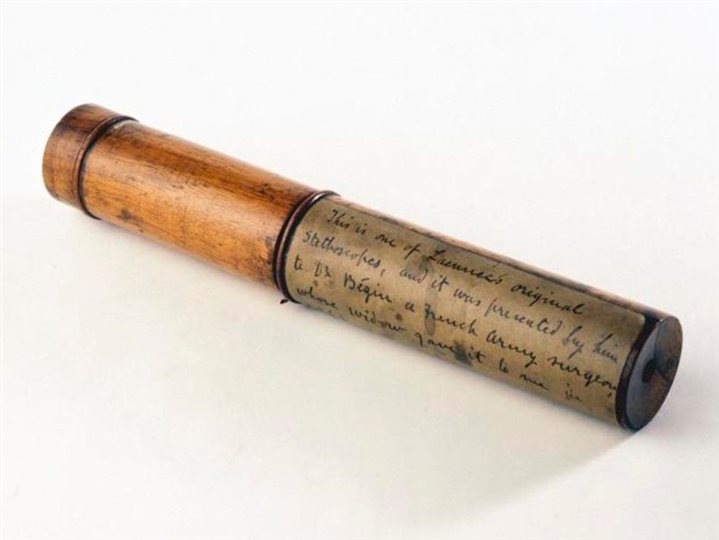

The sound doctors hear — and everyone else misses!!
A cardiologist with twenty years of practice can hear the difference between a healthy "lub-dub" and the faint whoosh of a mitral regurgitation murmur. A first-year biomedical engineering student, listening through the same earpieces, usually just hears... a heartbeat. There's no waveform to point at, no way to freeze the moment, no way to compare "this murmur" against "that murmur" side by side. You either develop the ear over years of clinical exposure, or you don't.
That gap — between what an experienced clinician's ear can do and what a student can actually see and measure — is where this project, TARANGA ("waves," in Bangla), began.
What TARANGA actually is
At its heart, TARANGA is a phonocardiograph: a device that captures the acoustic vibrations produced by the heart's valves and the flow of blood through it, and turns them into a visual, time-frequency waveform instead of just a sound in someone's ear. It's built around a completely conventional stethoscope chestpiece — the same kind found in any clinic — but with an electret microphone embedded inside, so that the same vibrations a doctor hears can also be digitised, amplified, filtered, and displayed.
The idea wasn't to replace the conventional stethoscope. It was to make it more teachable.
It all started inside a tiny research lab of the Department of Biomedical Physics and Technology at the University of Dhaka, a department that has spent decades building electromedical devices from scratch for a country — and a region — where imported diagnostic equipment is often too expensive, too fragile for the field, or simply unavailable. The same lab has, over the years, produced ECG, EMG, nerve conduction velocity (NCV), iontophoresis, PEMF, and dynamic pedograph systems for diabetic foot ulcer prevention — all designed around one constraint: build it locally, keep it affordable, and make it robust enough for real classrooms and real clinics.
Phonocardiography was a natural next step. Heart and lung sound analysis is a core skill biomedical engineering students are expected to understand — not just biologically, but as a signal processing problem. And you can't teach signal processing on a sound nobody can see.
Act One: does this even work?
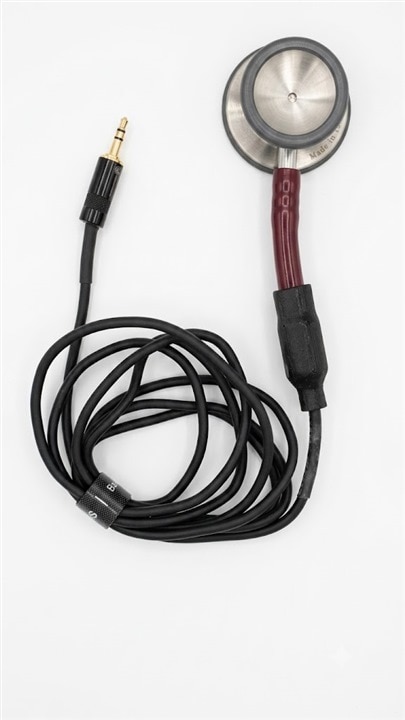
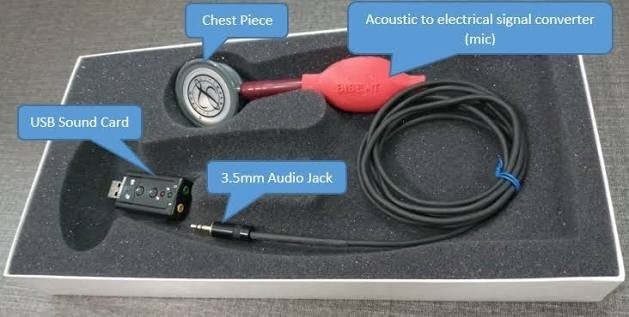
The first prototype was deliberately minimal — almost stubbornly so. An electret microphone was fitted inside a standard stethoscope chestpiece, and its output was run straight into a PC's sound card through a 3.5 mm stereo jack. No amplifier. No filter. No enclosure to speak of.
It was a proof of concept, nothing more — but it answered the only question that mattered at that stage: can an ordinary chestpiece, with a cheap microphone glued inside it, actually pick up heart sounds well enough to be recorded and analysed on a PC? It could. That was enough to justify going further.
Cross section view:
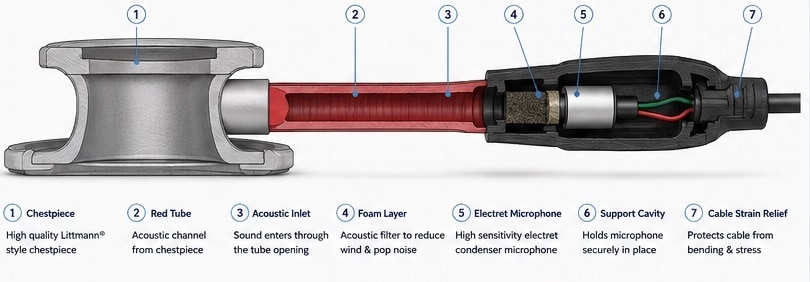
image generated using Ai to demonstrate the concept
Act Two: making the signal usable
A raw microphone signal straight into a sound card is noisy, weak, and full of everything except the heart sound you actually want — handling noise, ambient room noise, electrical hum. The second phase existed to solve exactly that problem.
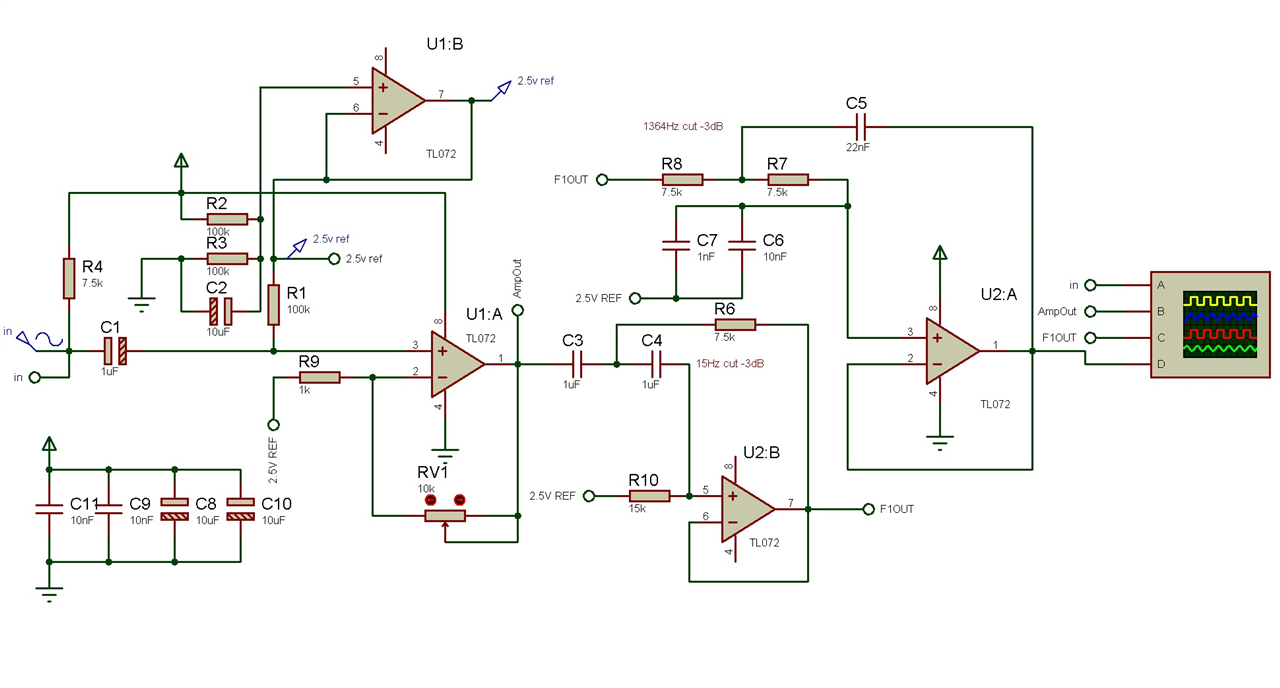
The microphone signal was preamplified and filtered before being fed into a dedicated USB sound card, rather than the PC's built-in (and usually poor-quality) audio input. This is also where the project's core electronics — the block that would later become the heart of the final kit — took shape:
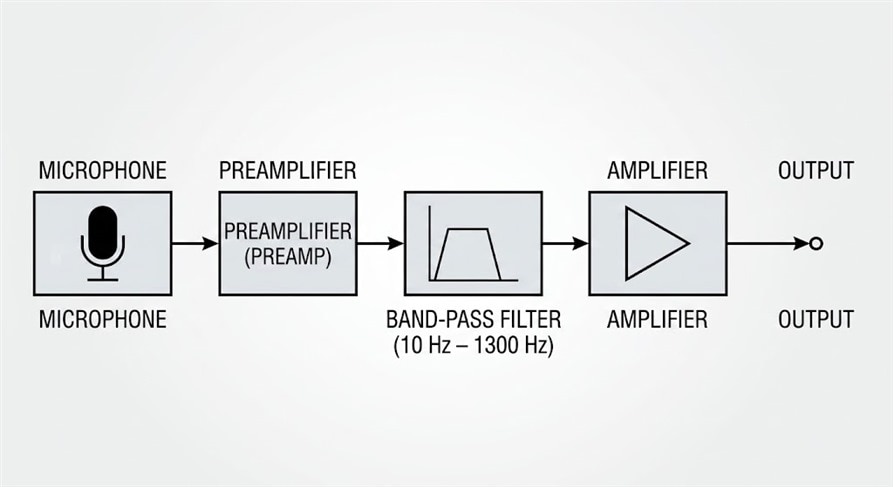
Heart and lung sounds live almost entirely in this band. S1 and S2 sit around 30–70 Hz, gallops (S3/S4) drop as low as 20 Hz, and murmurs and breath sounds spread broadband up toward 600–2000 Hz. Filtering to this window, before amplification, meant the signal reaching the PC was finally clean enough to actually study.
The attached clips demonstrate the filtered heart and lung sound which are clean and the background noise and humming are reduced significantly. The web app has been developed by Zihad Tarafder from our team. Thihs app has been incorporated into the University Telemedicine Program later on.
Act Three: from lab bench to training kit
The final phase moved the project from "does it work in our lab" to "can a student anywhere use this in a classroom" — and that meant leaving the university department for BiBEAT Limited, a non-shareholding, non-profit spinoff company founded to carry research from the Biomedical Physics and Technology department out into wider use. BiBEAT's entire reason for existing is this last, often-neglected step: turning a working lab prototype into something reproducible, documented, and scalable.
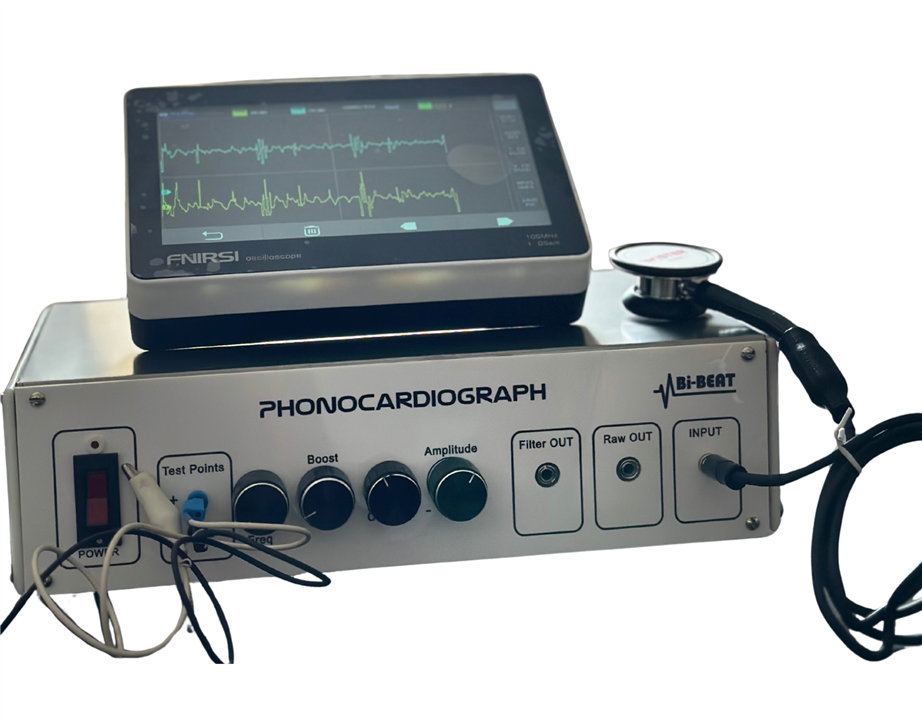
The result is the BiBEAT Phonocardiograph Trainer Kit — a compact panel that takes the same electret-mic stethoscope and wraps it in a proper front end:
- Input — for the electret mic-based stethoscope
- Raw OUT — the unfiltered, LM386-amplified microphone signal
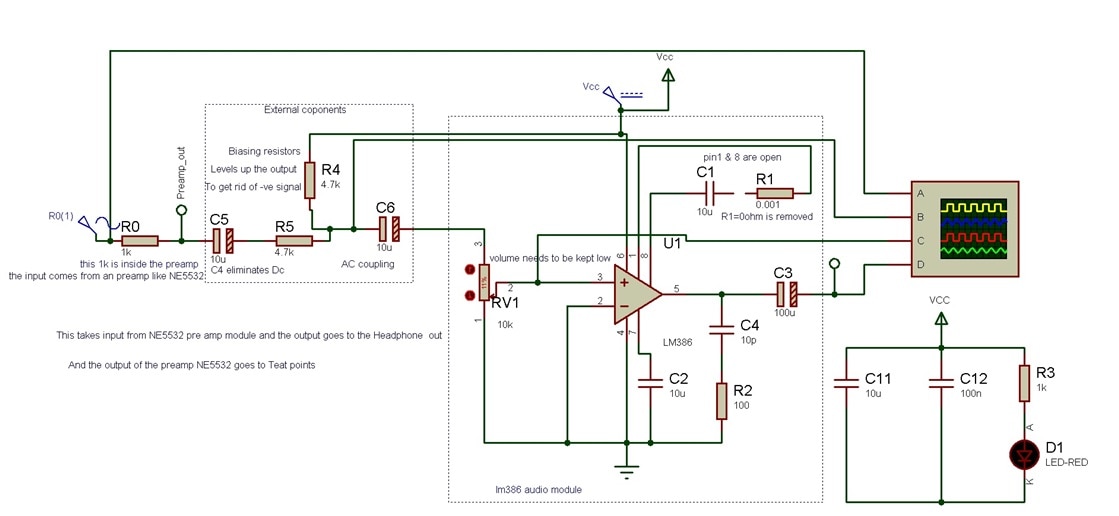
- Filter OUT — the tone-filtered, cleaned-up output
- Amplitude — output gain control
- Boost switches — three selectable frequency emphases:
- Cardiac (low-frequency emphasis, for heart sounds)
- Lungs (mid-frequency band)
- High Freq (crackles and bowel sounds)
- Test Points — direct oscilloscope probe access
- Power switch
In the lab setup shown below, the kit's Filter OUT feeds a USB sound card into a PC running Audacity, while the Test Points connect directly to an oscilloscope for real-time waveform viewing — so a student can watch a live trace while they're listening, and then go back afterward and pull the recording apart offline.
What a student actually does with it
This is the part that, to me, is the whole point of the project — not the circuit, but what it lets someone learn.
Experiment 1 — Identifying heart sounds.
Chestpiece on the chest, oscilloscope running. Students watch S1 and S2 appear as distinct events on the trace, adjust the cardiac boost, and use an FFT to compare the frequency content of each — turning "lub-dub" from something you memorise into something you measure.


Heart sound with cardiac boost at low Heart sound with cardiac boost at high
**yellow is the raw sound, blue is the filtered output
Experiment 2 — Lung sound analysis.
Switching to the Lungs band, students record normal breathing and compare vesicular sounds, wheezes, and crackles — sounds that are notoriously hard to distinguish by ear alone until you've heard hundreds of real patients, but become far more approachable once you can see their waveform shapes side by side.


Lung sound with low boost Lung sound with high boost
**yellow is the raw sound, blue is the filtered output
Experiment 3 — Abdominal sounds.
Switching to High Freq, the same setup picks up bowel peristalsis.


Experiment 4 — Frequency sweep comparison.
Toggling between filter bands on the same recorded source, to directly see how each boost setting reshapes the same signal.
On the software side, the workflow runs entirely on Audacity — a free, open source and platform independent audio analysis software. It records a 30-second heart sound sample, and then removing background noise using Audacity's noise-profile tool: selecting a short quiet segment (often the first couple of seconds before the chestpiece even touches the chest), sampling its noise profile, and subtracting that profile from the whole recording. From there, high-pass and low-pass filtering, and equalisation. That lets students isolate exactly the frequency range they're studying.
Why build this at all, instead of buying a commercial trainer
A commercial digital stethoscope training system exists, but it's expensive, closed, and usually imported — none of which serves a biomedical engineering program that needs a dozen units for a lab class, or a research group in a lower-resource setting that wants to understand (and modify) exactly what's happening inside the box. Building it around a standard chestpiece and off-the-shelf components like the TL072, LM386 keeps the bill of materials low, keeps repair local, and — just as importantly — keeps the internals transparent enough that engineering students can study the device itself, not just what it measures.
Top Comments