element14 Community
element14 Community
    Register Log In
  • Site
  • Search
  • Log In Register
  • Community Hub
    Community Hub
    • What's New on element14
    • Feedback and Support
    • Benefits of Membership
    • Personal Blogs
    • Members Area
    • Achievement Levels
  • Learn
    Learn
    • Ask an Expert
    • eBooks
    • element14 presents
    • Learning Center
    • Tech Spotlight
    • STEM Academy
    • Webinars, Training and Events
    • Learning Groups
  • Technologies
    Technologies
    • 3D Printing
    • FPGA
    • Industrial Automation
    • Internet of Things
    • Power & Energy
    • Sensors
    • Technology Groups
  • Challenges & Projects
    Challenges & Projects
    • Design Challenges
    • element14 presents Projects
    • Project14
    • Arduino Projects
    • Raspberry Pi Projects
    • Project Groups
  • Products
    Products
    • Arduino
    • Avnet & Tria Boards Community
    • Dev Tools
    • Manufacturers
    • Multicomp Pro
    • Product Groups
    • Raspberry Pi
    • RoadTests & Reviews
  • About Us
    About the element14 Community
  • Store
    Store
    • Visit Your Store
    • Choose another store...
      • Europe
      •  Austria (German)
      •  Belgium (Dutch, French)
      •  Bulgaria (Bulgarian)
      •  Czech Republic (Czech)
      •  Denmark (Danish)
      •  Estonia (Estonian)
      •  Finland (Finnish)
      •  France (French)
      •  Germany (German)
      •  Hungary (Hungarian)
      •  Ireland
      •  Israel
      •  Italy (Italian)
      •  Latvia (Latvian)
      •  
      •  Lithuania (Lithuanian)
      •  Netherlands (Dutch)
      •  Norway (Norwegian)
      •  Poland (Polish)
      •  Portugal (Portuguese)
      •  Romania (Romanian)
      •  Russia (Russian)
      •  Slovakia (Slovak)
      •  Slovenia (Slovenian)
      •  Spain (Spanish)
      •  Sweden (Swedish)
      •  Switzerland(German, French)
      •  Turkey (Turkish)
      •  United Kingdom
      • Asia Pacific
      •  Australia
      •  China
      •  Hong Kong
      •  India
      •  Japan
      •  Korea (Korean)
      •  Malaysia
      •  New Zealand
      •  Philippines
      •  Singapore
      •  Taiwan
      •  Thailand (Thai)
      •  Vietnam
      • Americas
      •  Brazil (Portuguese)
      •  Canada
      •  Mexico (Spanish)
      •  United States
      Can't find the country/region you're looking for? Visit our export site or find a local distributor.
  • Translate
  • Profile
  • Settings
Mixing Electronics & Water
  • Challenges & Projects
  • Project14
  • Mixing Electronics & Water
  • More
  • Cancel
Mixing Electronics & Water
Blog (Semi)Automated Plant Irrigation System
  • Blog
  • Forum
  • Documents
  • Events
  • Polls
  • Files
  • Members
  • Mentions
  • Sub-Groups
  • Tags
  • More
  • Cancel
  • New
Join Mixing Electronics & Water to participate - click to join for free!
  • Share
  • More
  • Cancel
Group Actions
  • Group RSS
  • More
  • Cancel
Engagement
  • Author Author: urkraft
  • Date Created: 1 Feb 2018 9:50 PM Date Created
  • Views 8805 views
  • Likes 17 likes
  • Comments 81 comments
  • ardintermediate
  • arduino_projects
  • conservation_projects
  • mixewaterch
  • openarduinoch
Related
Recommended

(Semi)Automated Plant Irrigation System

urkraft
urkraft
1 Feb 2018

Semi-automated Plant Irrigation System

Summary

This is an automated system for watering my olive tree.


The main components are:

  • A soil moisture sensor
  • A 10 gallon bucket of water with a water level sensor
  • An Adafruit Feather HUZZAH ESP8266 microcontroller (hereafter referred to as “feather”)
  • A peristaltic water pump


The two sensors are connected to inputs of the feather, and the water pump is controlled by an output signal from the feather. There are two built in LED’s on the feather:

  • Red: used to indicate that the soil is dry enough to warrant watering
  • Blue: Used to indicate that the bucket is empty (requires a refill of water)


There are three criteria which all have to be met in order to turn on the pump (and water the plant):

  1. There must be water in the bucket
  2. The lack of moisture in the soil must be greater than a specified threshold value
  3. A specified minimum amount of time must have elapsed since the pump was last turned off while watering.


Any one of the following criteria will cause the pump to be turned off:

  • No water left in the bucket
  • The moisture level of the soil is higher than a specified threshold value (this criteria also triggers starting of the timer which keeps track of the amount of time that has elapsed since the pump was turned off).


Basically, the feather just goes in a loop checking the criteria above and taking the necessary action. Each loop iteration takes approximately 20-30 seconds to complete.


A feature that I would also like to implement is to have the system send me a message whenever it detects that the water bucket is empty (and possibly send a new reminder each day for a week before giving up). Unfortunately I have not found any official libraries with SMTP capabilities that I can use to accomplish this, so I do not know when or if I will be able to accomplish this goal.


I have tested the system quite a bit while implementing it (during the last 2 days) and feel confident that I have found and fixed all of the problems I have encountered along the way, but experience has taught me that the test of time is a very important test – and that test has only just begun.


Parts used

  • 1 Adafruit Feather HUZZAH ESP8266 (https://learn.adafruit.com/adafruit-feather-huzzah-esp8266/overview)
  • 1 5v 2.1A DC power supply w/micro usb contact (for the HUZZAH)
  • 1 12v 1A DC power supply (https://www.kjell.com/no/produkter/elektro-og-verktoy/stromforsyning/stromforsyning/ac-dc/fast-utgangsspenning/ac-dc-stromadapter-12-v-(dc)-12-w-p44382)
  • 1 power jack for the 12v power supply
  • 1 soil moisture sensor (https://www.kjell.com/no/produkter/elektro-og-verktoy/arduino/moduler/luxorparts-jordfuktmaler-p87941)
  • 1 water level switch NC (https://www.kjell.com/no/produkter/elektro-og-verktoy/elektronikk/electromechanics/strombrytere/nivabrytere/nivastrombryter-nc-p36037)
  • 1 22k ohm 1/8w resistor
  • 2 10k 1/8w resistor
  • 1 33 ohm 1/4w resistor
  • 2 1N4001 diodes
  • 1 Peristaltic Pump (https://www.kjell.com/no/produkter/elektro-og-verktoy/elektronikk/electromechanics/motorer/luxorparts-vaeskepumpe-peristaltisk-p90782)
  • 1 VR05R241A single pole DIL relay (https://www.kjell.com/no/produkter/elektro-og-verktoy/elektronikk/electromechanics/releer/1-polet-dil-rele-5-v-dc-0-5-a-30-v-p36110)
  • 1 Breadboard
  • Assorted jumper wires


Schematic Drawing

image

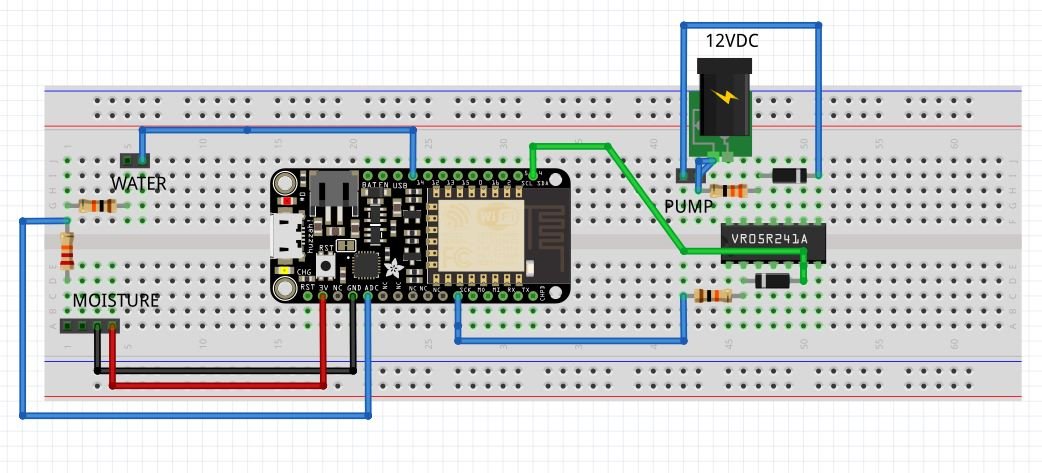
Breadboard

image

Code

#include 

//==========
// CONSTANTS
//==========

// wifi
const char* MY_SSID     = "";
const char* PASSWORD = "";

// I/O
const int LED = 0;  // (Output) indicates pump status (pump ON => LOW signal => lit)
const int PUMP = 4; // (Output) turns water pump on (set LOW) and off (set HIGH)
const int WATER_EMPTY_LED = 2;  // (Output) indicates water reservoir status 
                                // (empty => LOW signal => lit)
const int WATER_LEVEL = 14;  // (Input) to detect water in reservoir (water => HIGH)

// A0 : ADC (Analog Input) used to read soil humidity: high value => dry, low value => wet 
// Max value is approx. 825 - bone dry
// Min value is approx. 470 - drowning in water
const int PUMP_ON_THRESHOLD = 700;  // ADC input value >= this value => Turn on water pump
const int PUMP_OFF_THRESHOLD = 650; // ADC input value <= this value => Turn off water pump
                                    // (and do not turn on again for at least a day)
const long MINIMUM_TIME = 1000 * 60 * 60 * 24; // minimum time between watering (1 day)

//==========
// VARIABLES
//==========

// timing
unsigned long previousMillis = 0;
unsigned long currentMillis = 0;

// soil moisture reading
int moisture = 800; // previous 
int tmpMoisture = 0;  //  new (temporary)

//======
// SETUP
//======

void setup() {
  // initialize Serial
  Serial.begin(115200);
  delay(100);

  Serial.println();
  Serial.println();
  Serial.print("Connecting to ");
  Serial.println(MY_SSID);

  // initialize info
  WiFi.begin(MY_SSID, PASSWORD);
  WiFi.config(IPAddress(192, 168, 33, 95), IPAddress(192, 168, 33, 1), IPAddress(192, 168, 33, 1));
  
  while (WiFi.status() != WL_CONNECTED) {
    delay(500);
    Serial.print(".");
  }

  Serial.println("");
  Serial.println("WiFi connected");  
  Serial.println("IP address: ");
  Serial.println(WiFi.localIP());

  Serial.println();
  Serial.println();

  Serial.println("Soil moisture sensor");

  // initialize IO
  pinMode(WATER_LEVEL, INPUT);
  pinMode(PUMP, OUTPUT);
  digitalWrite(PUMP, HIGH);
  pinMode(LED, OUTPUT);
  digitalWrite(LED, HIGH);
  pinMode(WATER_EMPTY_LED, OUTPUT);
  digitalWrite(WATER_EMPTY_LED, HIGH);
  delay(2000); // give soil moisture sensor a chance to stabilize
}

void loop() {
  
  // check water reservoir
  while (digitalRead(WATER_LEVEL) == LOW) {  // water reservoir is empty 
    digitalWrite(WATER_EMPTY_LED, LOW);  // turn on the WATER_EMPTY_LED
    digitalWrite(PUMP, HIGH);  // make sure the water pump is turned off
    Serial.println("No water in reservoir => fill it up!");
    soil_moisture(false); // get soil moisture reading and update the soil moisture indicator LED
    // future code to send message at appropriate intervals goes here ...
    delay(10000); // allow moisture sensor to stabilize before next reading
  }
  digitalWrite(WATER_EMPTY_LED, HIGH); // The reservoir has water => turn off the WATER_EMPTY_LED
  soil_moisture(true);  // get the soil moisture reading and do appropriate actions
  delay(10000); // make sure that the moisture sensor gets time to stabilize before next reading
}


void soil_moisture(bool waterAvailable) {
  tmpMoisture = analogRead(A0); // take a soil moisture reading
  if (tmpMoisture != moisture) {  
    // only do the following if the moisture level has changed
    moisture = tmpMoisture;
    // print the moisture data to the serial interface ...
    Serial.print("moisture = ");
    Serial.println(moisture);
    if (moisture >= PUMP_ON_THRESHOLD) { // soil is dry enough for watering ...
      digitalWrite(LED, LOW); // turn on the indicator LED ...
      Serial.print("Dry threshold reached - ");
      if (waterAvailable) { // water is in the reservoir => OK to continue ...
        Serial.print("and water is available - ");
        currentMillis = millis();
        if ((previousMillis == 0) or (currentMillis - previousMillis >= MINIMUM_TIME)) {
          // the appropriate amount of time has transpired since the last watering => OK to water
          digitalWrite(PUMP, LOW);  // turn on pump
          Serial.println("water the plant!");
        } else {
          // not enough time has transpired since last watering => need to wait before watering
          Serial.println("but wait a bit longer.");
        }
      } else {
        // water reservoir is empty ...
        Serial.println("but the water reservoir is empty - fill it up!");
      }
    } else if (moisture <= PUMP_OFF_THRESHOLD) {
        // soil is moist enough ...
        digitalWrite(LED, HIGH);  // turn off the indicator LED
        digitalWrite(PUMP, HIGH); // make sure the water pump is off
        // update previousMillis. Want to wait at least MINIMUM_TIME before next watering
        previousMillis = millis();
        Serial.println("The soil moisture level is high - turning off the water pump.");
    } else {
      // moisture level between thresholds - no action necessary
      Serial.println("The soil moisture level is adequate - no action is being taken.");
    }
  }
}


You don't have permission to edit metadata of this video.
Edit media
x
image
Upload Preview
image

  • Sign in to reply

Top Comments

  • urkraft
    urkraft over 8 years ago +7
    Status update: Here is a picture of the latest breadboard configuration (although i would be amazed if it would be helpful to anyone as it looks like a rats nest). It is now connected to all the sensors…
  • ntewinkel
    ntewinkel over 8 years ago in reply to urkraft +5
    Thanks Raymond! Hey I just found a case - it fits inside a TicTac container! -Nico
  • ntewinkel
    ntewinkel over 7 years ago in reply to urkraft +5
    What if you replaced the corroded prongs with copper (or copper plated) nails ($5 for a bag here at Home Depot)? Or you could probably use a few cutoff bits of copper house wiring (likely free even at…
Parents
  • ntewinkel
    ntewinkel over 8 years ago

    This is really interesting, thanks Raymond!


    I started a project like this for my greenhouse several years ago but ended up just running it all as a timer.

    It controls a couple of relays that run the water and fertilizer pumps.

    The original implementation had a lot of sensors, and I was able to upload a saved-to-SRAM stored list to my laptop via Bluetooth. But the Bluetooth range was just a little too short, and the sensors were not very reliable - I think the length of wire I was using was causing issues.


    I should try all that again now that WiFi is cheap and plentiful image


    ps, A peristaltic pump like you have will probably be a much better fertilizer pump than my basic little 9volt water pump.


    pps, I powered up my Digistump Oak recently, but it appears to be unresponsive. Sigh. I'll try a Huzzah or WeMos D1 next. Someone also pointed out the WiFi Witti.


    ppps, What are you using for server side for the Huzzah? For my little barebones ESP-01 I wrote a couple of simple scripts to get/set values in a server text (JSON) file. I'd be happy to share them with you.


    Cheers,

    -Nico

    • Cancel
    • Vote Up +2 Vote Down
    • Sign in to reply
    • More
    • Cancel
  • urkraft
    urkraft over 8 years ago in reply to ntewinkel

    Thanks Nico,


    The only WiFi thing that i did with the feather on this project was to set it up for a static IP address in my network. I was planning on getting it to send me e-mails directly when the water reservoir was empty, but did not get far with that. When i also tried attaching the OLED display to it and was not able to get that working there i decided to just start using it as it was to water my plant while i tried moving the project over to an Arduino Uno. I had already used the OLED display successfully on the Uno a long time ago.


    Another reason why i was interested in moving the project over to the Uno was that i have already successfully produced custom solutions for other projects using just the ATMega328p micro controller and a bare minimum of components after getting them functioning on an Uno first. The cost of the necessary components for a custom solution is usually much less than an Uno. One negative thing about projects on other platforms like the feather or Raspberry Pi's is that if i want to use what i have built i will have to replace the platform because i do not have the ability to make a custom replacement.


    I believe that once i get everything planned working on the Uno i will be able to find a solution for messaging from that platform. For example: I have already successfully used a bluetooth tranceiver in another Uno based project. Perhaps i can also use one in this project to implement messaging via one of my Raspberry Pi servers that i use for my security system (it sends me e-mails with pictures taken triggered by PIR sensors when armed).


    I have seen projects that others have made using the feather as a server to publish data, but i have not found any SMTP libraries for use with it. Because of that as well as not getting my OLED display to work with it and the fact that i will have to dedicate the feather to this project if i chose that route i have decided to pursue a Uno based solution for now - but i hope that i can contact you for help in the future for the information you have offered.


    Thank you.


    Regards,

    -raymond

    • Cancel
    • Vote Up +2 Vote Down
    • Sign in to reply
    • More
    • Cancel
  • ntewinkel
    ntewinkel over 8 years ago in reply to urkraft

    Hi Raymond,


    This just in - I got my little ESP-01 programmed to where it now (standalone) connects to my WiFi router and sends a sensor value up to my server (on the Internet, not just internal). For testing I just loop through some numbers, and have a webpage that refreshes every 2 seconds to show the updates. Pretty cool how that tiny inexpensive little thing can do all that!

    Biggest limitation seems to be that it only really has 1 pin easily accessible (2 with a bit more effort). Which is fine for a specialized sensor, especially considering the price (which apparently has gone up 30 cents since my previous comment, haha). (The WeMos and Witty have a lot more IO pins.)


    I still need to figure out a nice way to power it, as it has nothing on board to deal with that.


    Cheers,

    -Nico

    • Cancel
    • Vote Up +2 Vote Down
    • Sign in to reply
    • More
    • Cancel
  • urkraft
    urkraft over 8 years ago in reply to ntewinkel

    Hello Nico,


    Congratulations! I was playing around with my ESP-01 yesterday for a few hours but have not managed to program it yet. I was trying to use a method described at geekstips.com, but using my Arduino USB 2 Serial unit with the ESP-01. I have double checked and triple checked my connections but have not found mistakes. One thing that i have noticed that is a bit worrying is that there are no LEDs that are lit on the ESP-01 when powered on.


    I have found a few recipes for programming it with an UNO, and i started preparing for trying doing it that way by freeing up one of my UNO's. Any suggestions from you about how you programmed your ESP-01 would be very welcome!


    Regards,

    -raymond

    • Cancel
    • Vote Up 0 Vote Down
    • Sign in to reply
    • More
    • Cancel
  • urkraft
    urkraft over 8 years ago in reply to ntewinkel

    Hello again Nico,


    Turns out i could not get my ESP-01 working with an UNO either image. I have absolutely no experience with this unit and am way too tired to play around with it any more right now. I did observe that the blue LED on the ESP-01 blinked when i connected the RST and EN lines to ground, though.


    -raymond

    • Cancel
    • Vote Up 0 Vote Down
    • Sign in to reply
    • More
    • Cancel
  • urkraft
    urkraft over 8 years ago in reply to ntewinkel

    Hello again Nico,


    I finally managed to compile and upload code to my ESP-01 just now. LOTS of problems that had to be resolved in order to achieve that. Just sending this quick note in case you may be working on trying to document how you got yours programmed to help me. I will try to document what i have learned later.


    -raymond

    • Cancel
    • Vote Up +2 Vote Down
    • Sign in to reply
    • More
    • Cancel
  • ntewinkel
    ntewinkel over 8 years ago in reply to urkraft

    Thanks Raymond, Good to hear, and yes I was going to send a pic of the connections, which is what was causing mine to not work for a while - the online examples all seem to be slightly different.


    Feeling a little under the weather, so I'm moving slower than usual. Thankfully it's a holiday here today so I can take it easy for the most part.


    -Nico

    • Cancel
    • Vote Up +1 Vote Down
    • Sign in to reply
    • More
    • Cancel
Comment
  • ntewinkel
    ntewinkel over 8 years ago in reply to urkraft

    Thanks Raymond, Good to hear, and yes I was going to send a pic of the connections, which is what was causing mine to not work for a while - the online examples all seem to be slightly different.


    Feeling a little under the weather, so I'm moving slower than usual. Thankfully it's a holiday here today so I can take it easy for the most part.


    -Nico

    • Cancel
    • Vote Up +1 Vote Down
    • Sign in to reply
    • More
    • Cancel
Children
  • urkraft
    urkraft over 8 years ago in reply to ntewinkel

    Thanks Nico,


    Yes, best to take it easy. Hope you are better soon!


    -raymond

    • Cancel
    • Vote Up 0 Vote Down
    • Sign in to reply
    • More
    • Cancel
element14 Community

element14 is the first online community specifically for engineers. Connect with your peers and get expert answers to your questions.

  • Members
  • Learn
  • Technologies
  • Challenges & Projects
  • Products
  • Store
  • About Us
  • Feedback & Support
  • FAQs
  • Terms of Use
  • Privacy Policy
  • Legal and Copyright Notices
  • Sitemap
  • Cookies

An Avnet Company © 2026 Premier Farnell Limited. All Rights Reserved.

Premier Farnell Ltd, registered in England and Wales (no 00876412), registered office: Farnell House, Forge Lane, Leeds LS12 2NE.

ICP 备案号 10220084.

Follow element14

  • X
  • Facebook
  • linkedin
  • YouTube