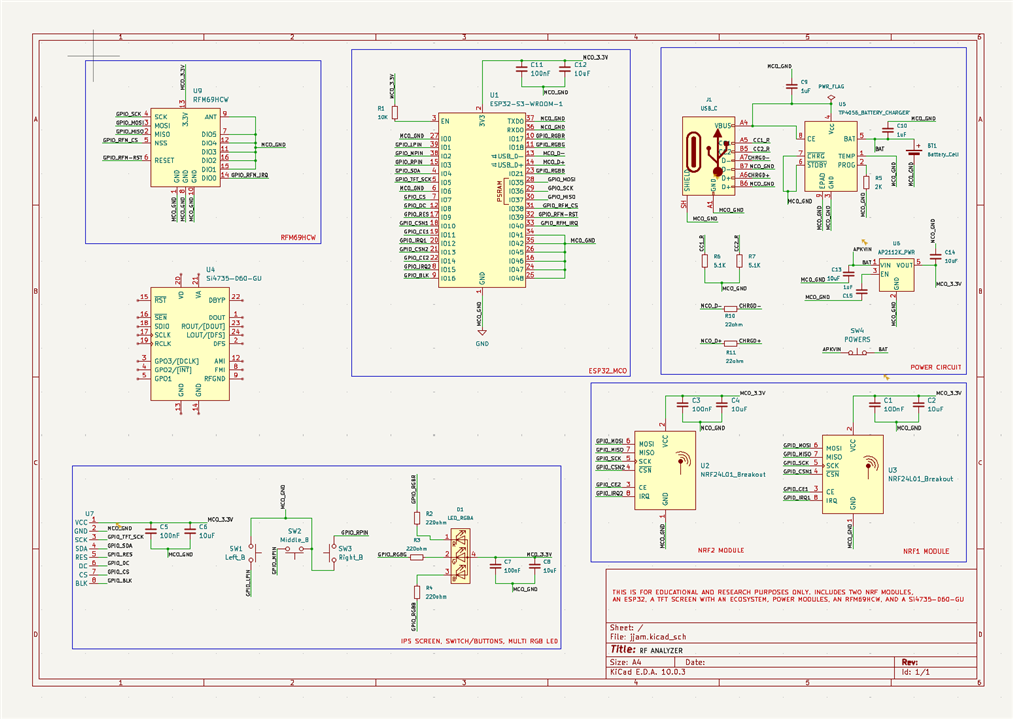
Hey everyone! This project has actually been an ongoing journey for me — it started as a simple prototype built with breakout modules on a breadboard a long time ago, where I was experimenting with nRF24L01 radio modules and getting a feel for how RF communication works at a basic level. That early prototype taught me a lot, but this event made me realize that I wanted to take it much further and build something more sophisticated, more capable. So that's exactly what I'm doing now. I'm currently designing a fully custom PCB handheld multi-band RF analysis and packet communication device built around an ESP32-S3 microcontroller, combining four radio modules — two nRF24L01s for 2.4GHz packet communication, an RFM69HCW for 433MHz and 915MHz sub-gigahertz bands, and a Si4735 for wideband AM, FM, shortwave, and longwave reception — all displayed on a 1.3 inch TFT screen with a rechargeable lithium battery system. Together this covers everything from 150KHz all the way up to 2.525GHz, giving the device the ability to detect signals from IoT sensors, key fobs, weather stations, garage doors, WiFi networks, Bluetooth devices, and even international shortwave radio broadcasts. The schematic is being designed in KiCad and I'm approaching the PCB layout phase, which is honestly where the real challenge begins — routing RF traces, managing antenna placement, and keeping signal integrity clean across multiple radio modules on a 3.3 by 2 inch board is no small task. This project fits this competition's theme perfectly because it is genuinely a project in progress — I have the working prototype that proved the concept, and now I am in the middle of building the real thing. Winning any of the available prizes would directly accelerate this build. An oscilloscope would be invaluable for verifying SPI signal integrity and checking RF trace behavior, a waveform generator would let me properly test receiver sensitivity on each module, a digital multimeter would help me debug power delivery on what is a pretty dense and power-sensitive board, and the Arduino would give me a rapid prototyping platform to validate firmware logic before committing it to the ESP32. I'm an electrical engineering student at Embry-Riddle Aeronautical University and this project represents exactly the kind of hands-on RF and embedded systems work I want to keep pushing forward — any of these tools would go straight to finishing it.