


I have one project that was really rewarding from an electronics perspective but really underwhelming in the presentation department. I am hoping that this Spring Clean challenge will provide the incentive to remedy this.
Eight years back I bought something called the Retro Port Adapter. I guess it can be described as an after-market accessory for the Super Nintendo that allows it to play original NES games. This objective is stated concisely enough on the product label as: PLAY YOUR NES GAMES ON YOUR SNES.
In terms of the picture below, imagine the bottom part of the adapter plugging directly into the Super Nintendo's cartridge slot. The top part of the adapter, meanwhile, receives an original NES game cartridge.

At some stage I decided to pop the cover and try to understand its inner workings. The short version of the story is that the Retro Port Adapter contains an NES-on-a-chip, which squeezes all the functionality of the original NES onto a single device. The Super Nintendo itself doesn't do much other than read from its controllers and write to a few addresses that are decoded on the Retro Port Adapter. In fact the Super Nintendo does not produce the video signal. The video instead comes from a TRRS (tip-ring-ring-sleeve) jack on the side of the Retro Port Adapter.
For the long version of the story you have the option to listen to this long-drawn out explanation from a younger and less jaded version of me. Remember, I said this was optional.
Once I had learned the secrets under the hood, it occurred to me that the Retro Port Adapter could be transformed into a stand-alone NES clone and that is what I set out to do. My approach in this endeavor is illustrated in the diagram below.
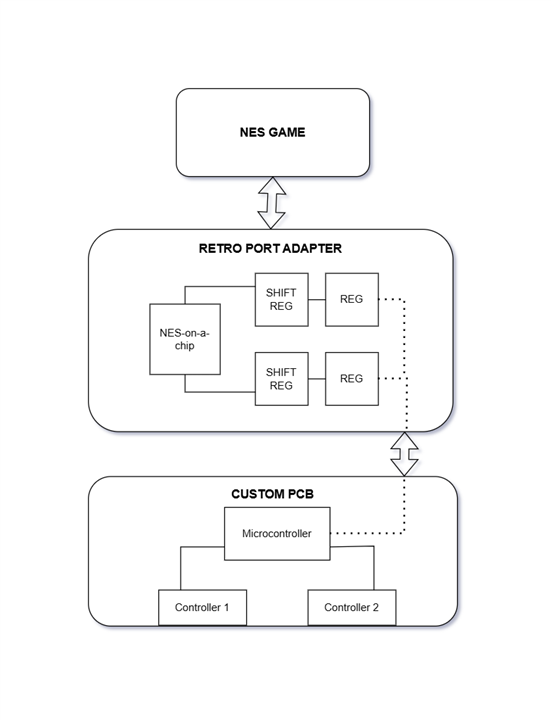
The key facets of the design are as follows:
| 1 | a microcontroller is required to carry out the functions originally performed by the Super Nintendo |
| 2 | the two NES controllers must be read out in a serial fashion just like in the original NES |
| 3 | the microcontroller acts as the master of the Super Nintendo cartridge bus |
| 4 | in its role as master, the microcontroller would require dedicated I/O for the 8-bit data-bus, read/write strobes, and select address lines |
| 5 | (after reading from the controllers) the microcontroller will write to the two holding registers that reside on the Retro Port Adapter |
For the microcontroller I used a little dev board called the Teensy++. The nice thing about this board is that its I/O support 5V logic which is great for projects that target retro electronics.

Earlier I had said that this project was underwhelming when it came to presentation. Well, I was being nice. It is ugly and what's more it was always ugly. It was even an ugly baby. This is evident in the photo below that was taken in the initial prototype stages.

That was the beginnings, but even after toiling away this is what I ended up with.
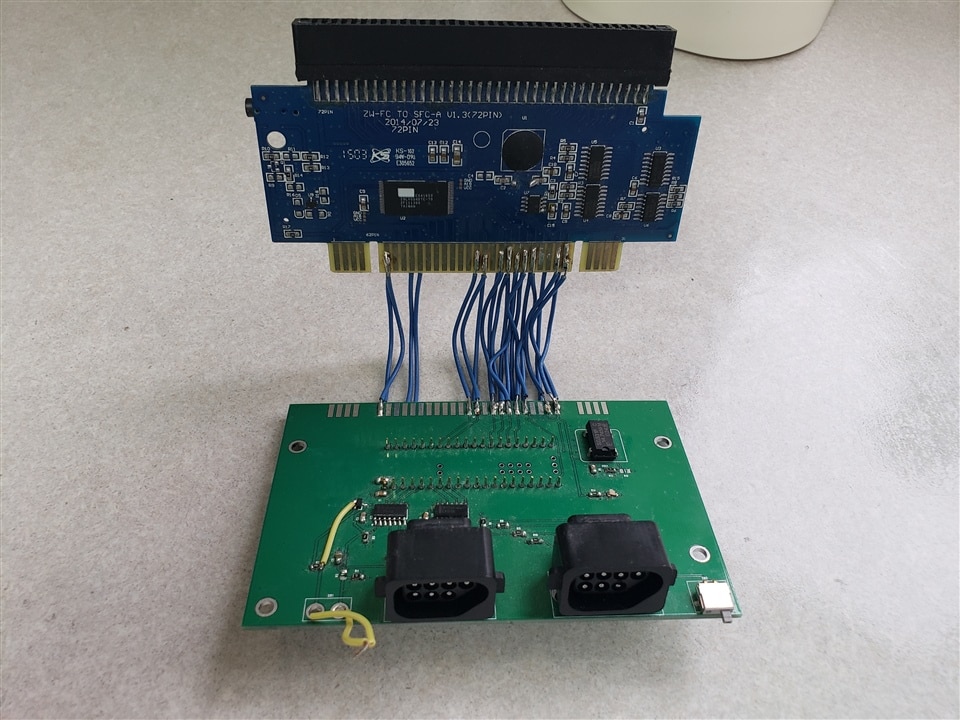
And you know what? It is still ugly.
At any rate, lets get acquainted with this Frankenstein monster.
| Blue Board | this is the Retro Port Adapter without its plastic shell. The black clump conceals the infamous NES-On-a-Chip device |
| Green Board | this is a custom board that ties everything together. It includes two controllers and a site for the Teensy++ microcontroller board |
| Teensy++ | the Teensy++ resides on the underside of the Green Board. Its position can be worked out from the through-hole pin pattern in the photo above |
It's not all doom and gloom, though. There are some silver linings. For instance, those 22 AWG wires are so strong they serve as a support structure for the Retro Port Adapter PCB.
The real positive though is that, ugly or not, this 'thing' actually worked.
Here is another poorly produced video from 8 years back demonstrating functionality.
This project proved to be a really good exercise in reverse engineering. Repurposing the product to make a stand-alone NES clone was very satisfying. However, its final form with two boards connected precariously together made it far from inviting. In the end the project was put in a drawer and all but forgotten.
When the Spring Clean challenge was announced I wondered if this project could be revisited. Was there a way to bring it new life?
| How this project fits the Spring Clean theme: |
| Although electrically complete, this project from 8 years back is in a sorry state when it comes to usability and aesthetics. This Spring Clean challenge affords the opportunity to address these short comings and transform this project into something that is both inviting and fun. |
At a bare minimum, I recognized that some form of enclosure was needed to house the electronics, and these were the objectives I came up with:
| 1 | a housing or container was needed to hide the electronics |
| 2 | openings are required in the housing for the game controllers, power cable and AV cable |
| 3 | a good game should be chosen to be permanently installed (after all, those 22 AWG wires aren't rigid enough to handle the repeated swapping of game carts) |
| 4 | make it fun and appealing |
After some thought I settled on Maniac Mansion, which is one of my favorite games from my younger years. From there I came up with tentacle. You see, Maniac Mansion contains a number of anthropomorphized tentacle characters including the green tentacle pictured below.

I resolved then to print some kind of tentacle container. However, I had never worked on a 3D design before so I was both excited and a little nervous at the prospect. I installed Autodesk Fusion and went to work on the base. Since I don't have my own 3D printer I used a local service and here is the result.
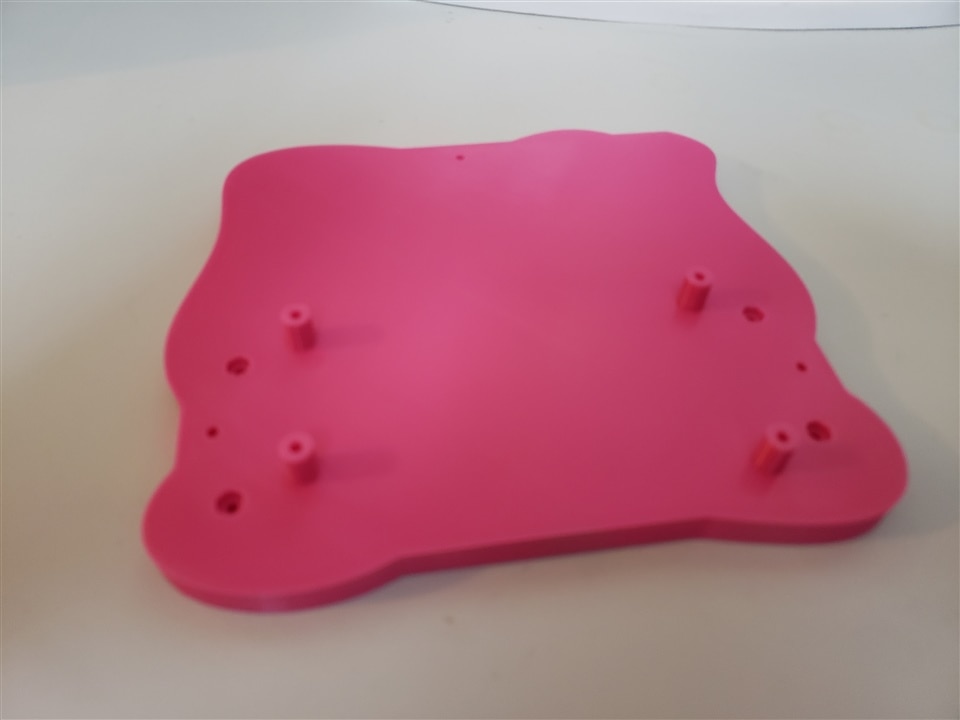
The printer used a 0.2mm nozzle and overall I was impressed with the build quality. It was done in PLA but the 3D print lines were less pronounced than examples I've seen in the past.
You will notice that there are 4 posts. These were added to elevate the green board. Well, that was the plan anyway, but in my haste I accidentally added them when the model was flipped. This caused their XY positions to be mirrored, so it was back to the drawing board.
This is the revised base in Fusion:
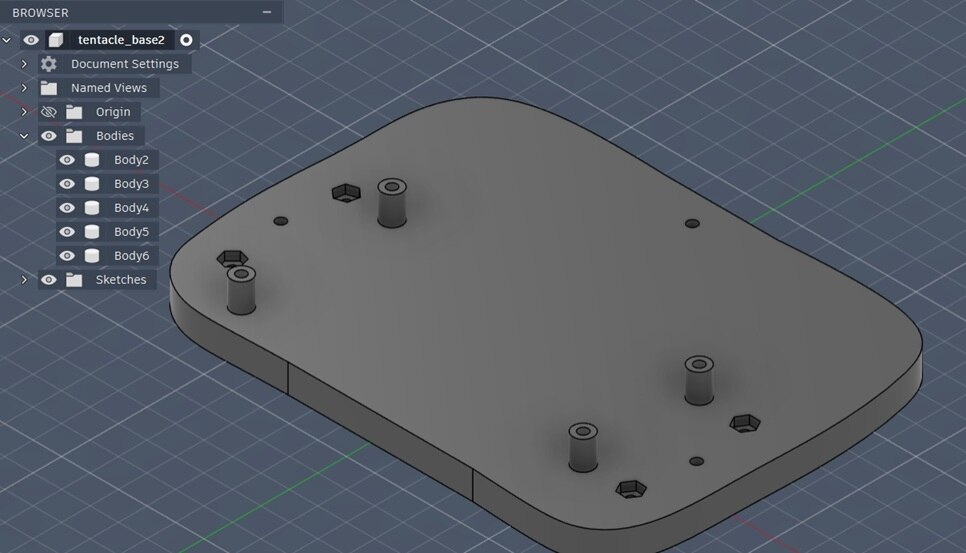
I designed nut-traps on both sides of the base. The ones on the reverse side, which are not visible in this view, are used to fasten the board and secure the base to the shell.
The shell itself is pictured below:
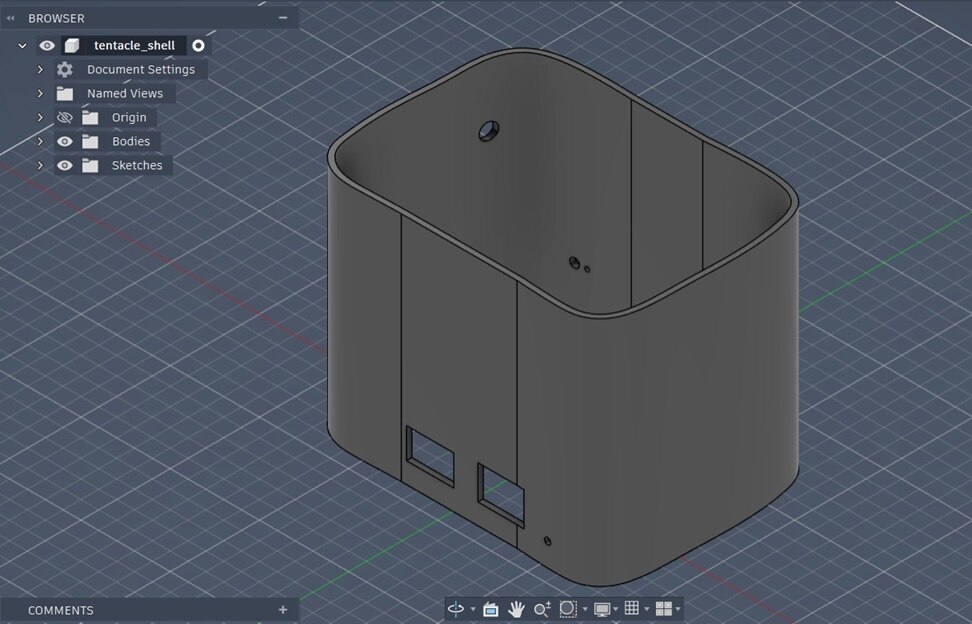
Unlike the blob-like shape of the first iteration, this time I opted for a simpler geometric shape.
This is what the new base looked like upon receipt:
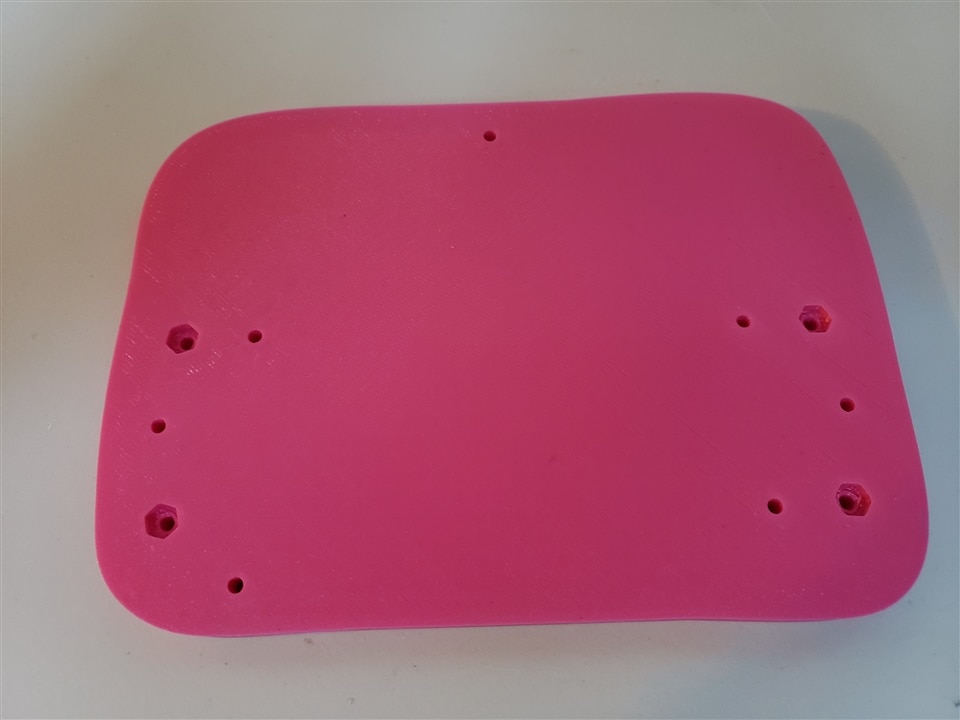
Overall I was happy with the results. However, I made an amateur mistake and it cost me my posts. In the design process when I was extruding the posts I forgot to select the option to join them to the main body. As a consequence they were not included when I exported to STL.
Here is how the shell turned out:
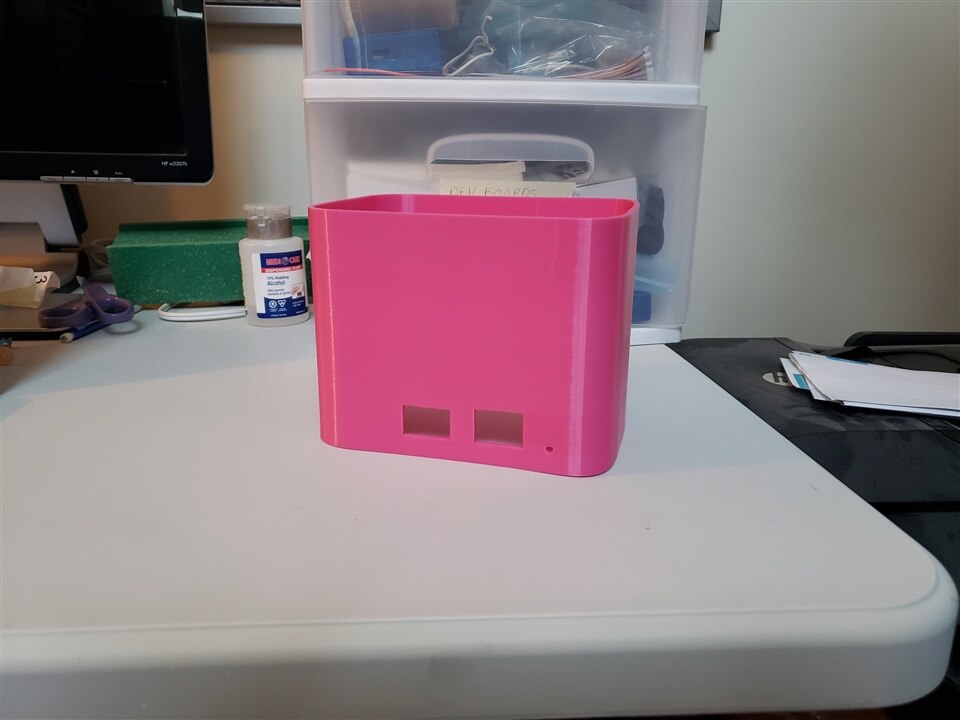
I had become accustomed to seeing so many 3D printed parts in bland colors, so seeing this shell in a bright and bold pink was a revelation.
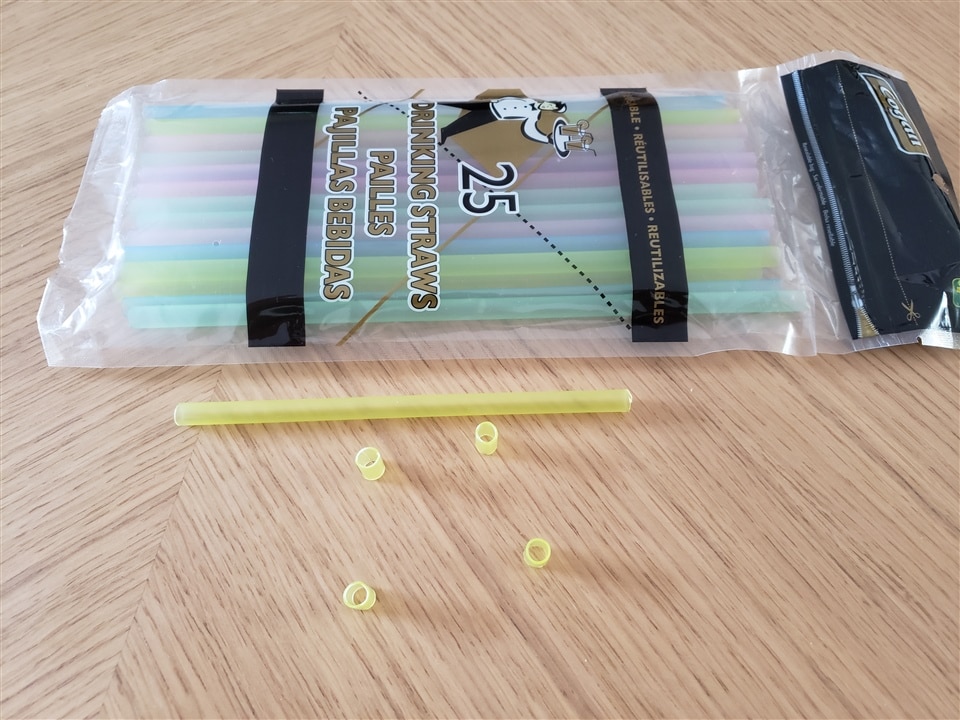
My first challenge was dealing with the missing posts. I figured that 1cm nylon spacers would serve as a suitable substitute, but finding them in a brick and mortar store was another matter altogether. In the end I bought some reusable straws and cut them to length. I filled the straws with rolled paper to limit the space around the screws.
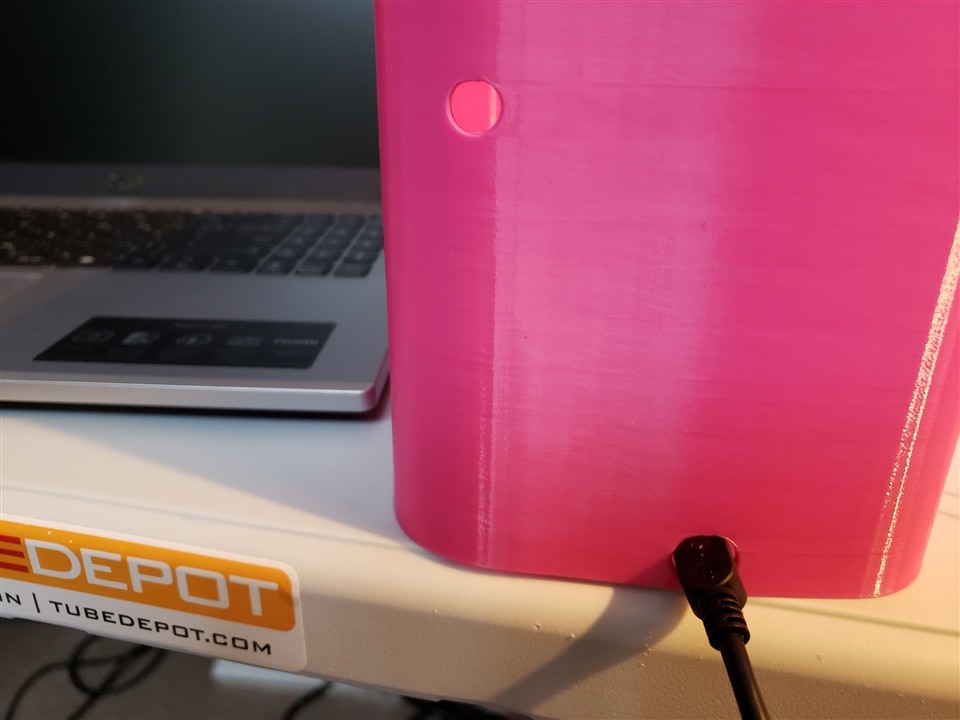
The effects of gravity caused some of the holes in the shell to deform slightly. It was necessary, for instance to file down the hole for the toggle switch and installing the mini USB power cable took a bit of elbow grease.
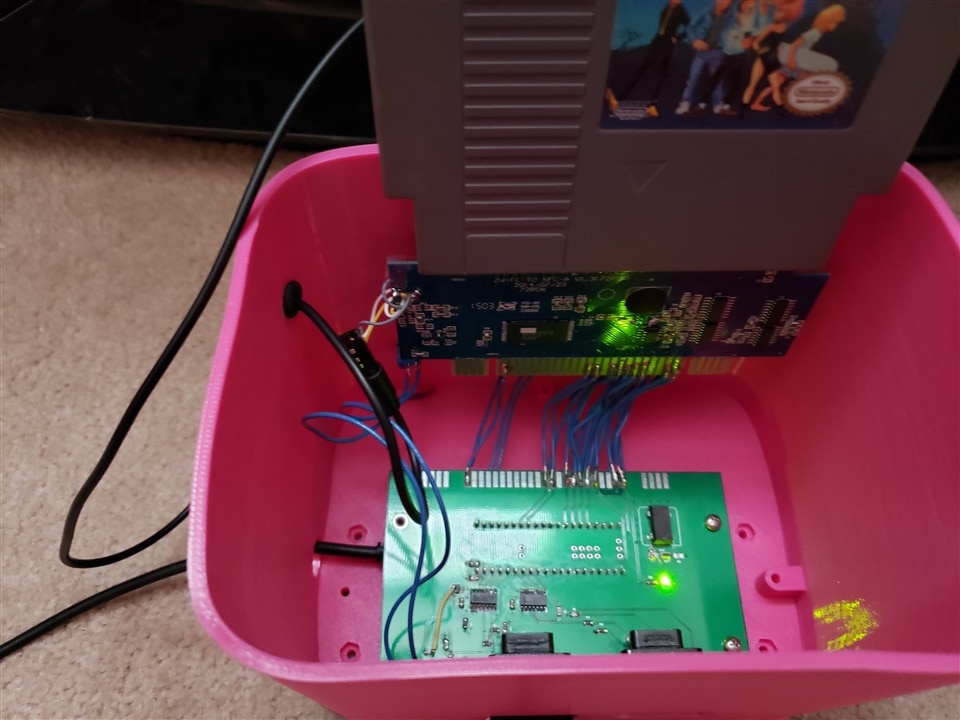
From there it didn't take too long to install the board into the housing.
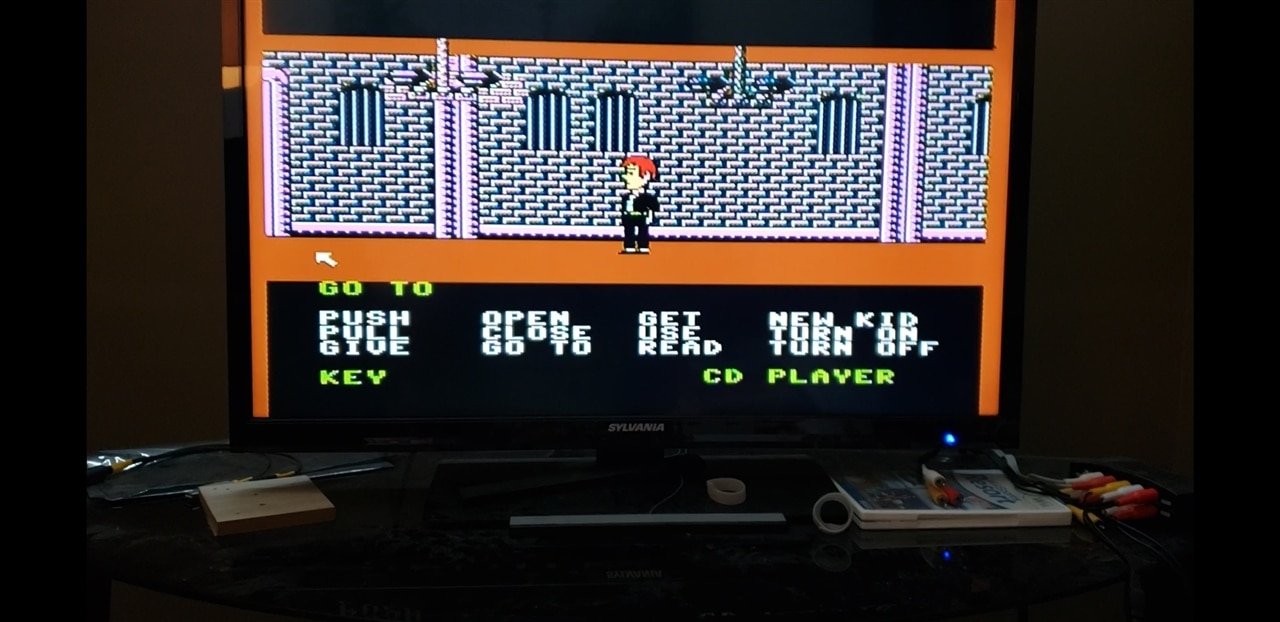
A quick functional test revealed that the game was working and I played just long enough to end up in the dungeon.
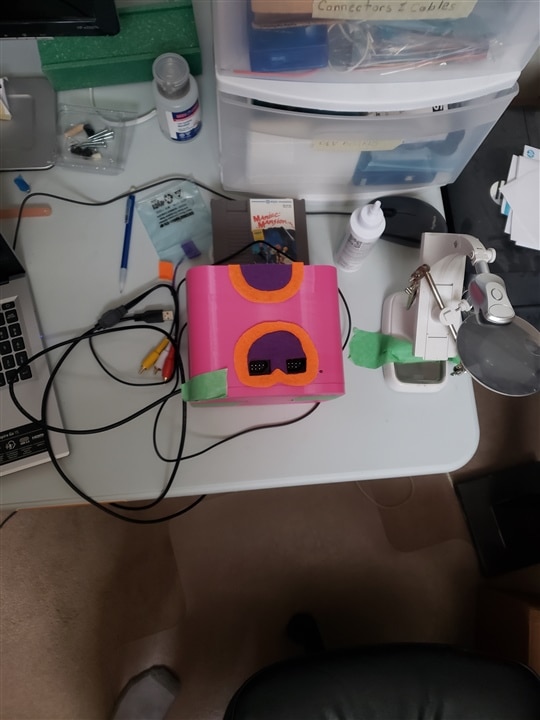
Originally I had considered painting the tentacle's markings but the pink glossy finish gave me second thoughts. At some point I decided that felt would do the job and also provide a bit of depth (i.e. make the features jump out a bit). The white bottle in the picture below is Aleene's Felt & Foam Tacky Glue. It was good for bonding fabric to fabric and fabric to PLA.
I wasn't quite done with the felt. I used some to make a lid and give the impression that the tentacle was severed cleanly with a bone saw. Yes, I know that tentacles are invertebrates.
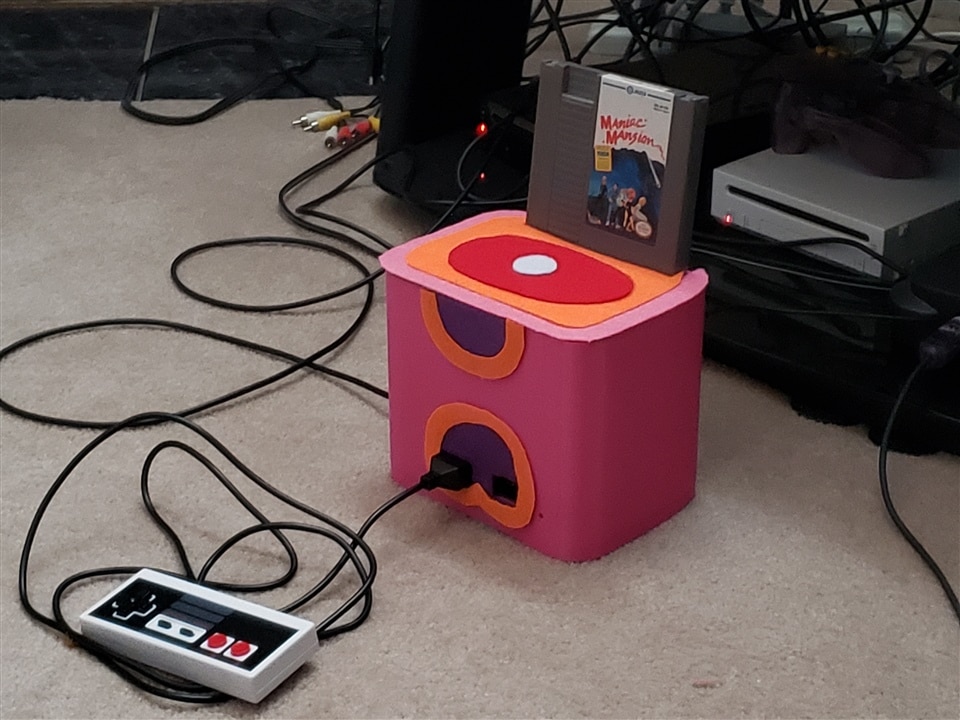
Anyway - let's see it in action.
Initially when the Spring Clean challenge was announced I didn't think I had a suitable project on the back burner. Eventually though, I remembered this diamond in the rough from 8 years back. In the end I am so glad I participated in this challenge.
While it could be said all I did was make a bucket with velvet patches, the experience meant much more to me than that. It connected me to the past, first by revisiting an 8 year old project, and then again when I played the game itself.
The challenge was also a learning experience in that it served as an introduction to 3D design and now I know just enough Autodesk Fusion to be dangerous.
Finally, thank you element14. The various design challenges you put forth offer participants an opportunity to grow and refine their skillsets, and this one was especially enriching for me.


