


First of all, this is not an entry in this competition as it is in no way related to electronics, and to make it clearer, I submitted it outside of the expected dates on purpose.
However, as it was discussed in the forum and because it seemed some of you might be interested in what I was up to this spring, here is a little recap.
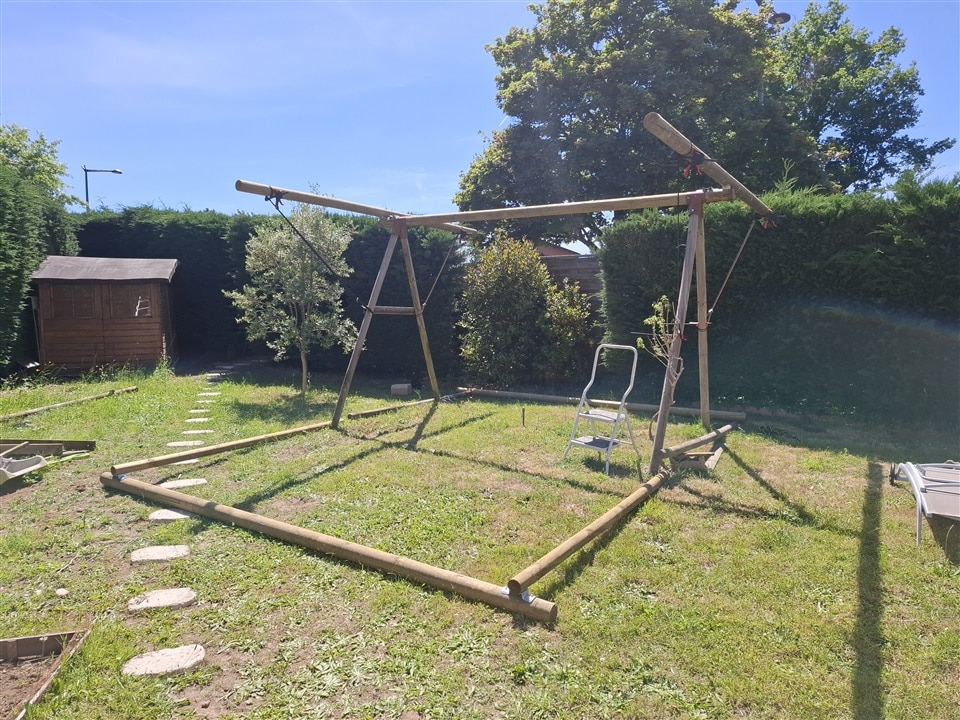
Back when my kids were younger, we bought a wooden swing and slide “playground” that was anchored to the ground with four cement blocks. As they overgrew it, it has been sitting there without much use and because of a design flaw, it even started to bend on itself as can be seen on this picture:
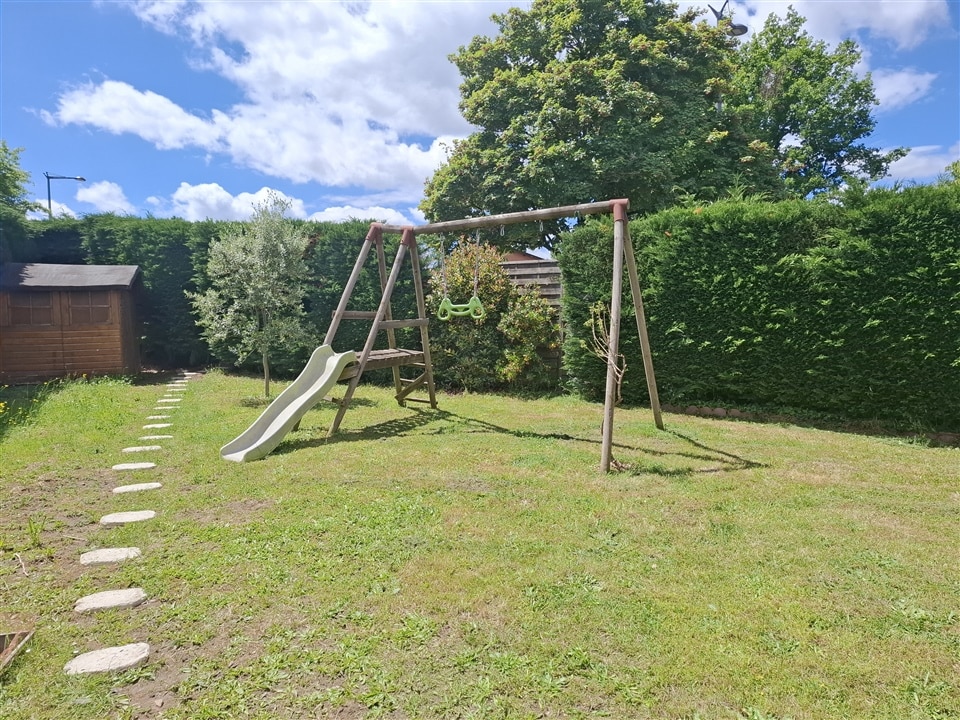
The bend at the top is due to the fact that the manufacturer did not provide a single beam for the top, but rather one long and one very small that are “joined” by the metal piece in the middle. As it turns out, and that was visible early in the life of this installation, this led to some bending, which thankfully never turned into a full blow security risk.
Two years ago, I stumbled on a social media post that showed the conversion of a similar playset to a pergola/gazebo where one could place a few nice outdoor chairs to enjoy the long summer nights.
This got me thinking as to how I could apply the same concept to my slightly different situation, and with the help of both Google Earth and FreeCAD, I came up with three potential arrangements, bearing in mind that this should reuse wood as much as possible while being reasonable in cost.
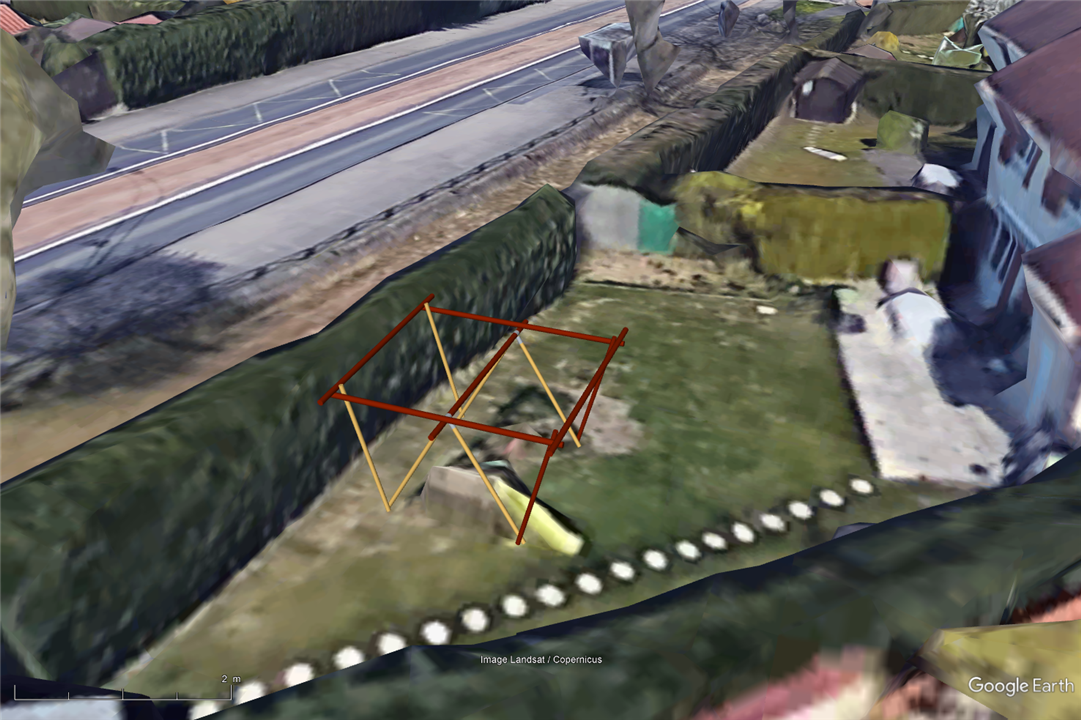
On the following pictures, the existing wood is in yellow while new one is in brown.
The first idea was to “suspend” the roof with chains so that it could slightly move with the wind, while not obstructing passage around the existing legs:
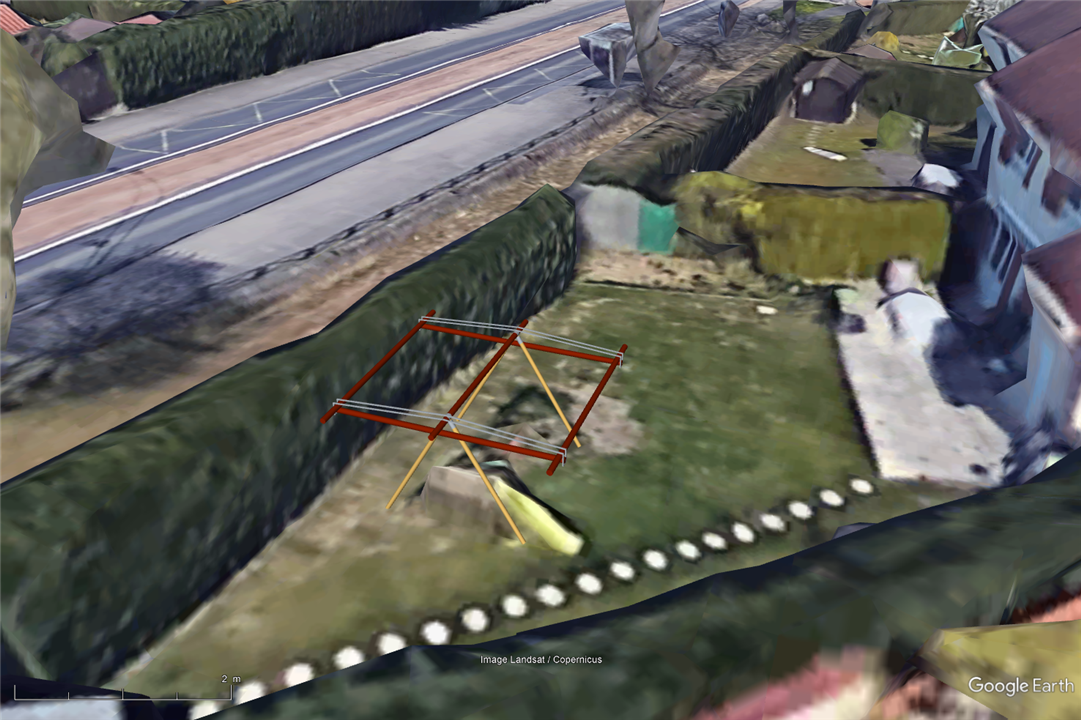
This one has the highest cost and I was doubtful of its stability, on top of making the roof go quite low at around 2m from the ground. This led me to this second design:

This reused even more wood and the stability would be greater, but creating the joints a mid-height on the existing legs was a mind puzzle for me. I mean, I could always use metal plates and bolts, but it felt like it would apply lots of pressure at the midpoint of a beam, which to me is the exact location of its weakest point.
And so the final design is the one that I find stronger as it looks like an inverted version of the triangular truss that is present under my tile roof. Sure, it needs more “new” wood than the others, but I’m more confident about its durability.
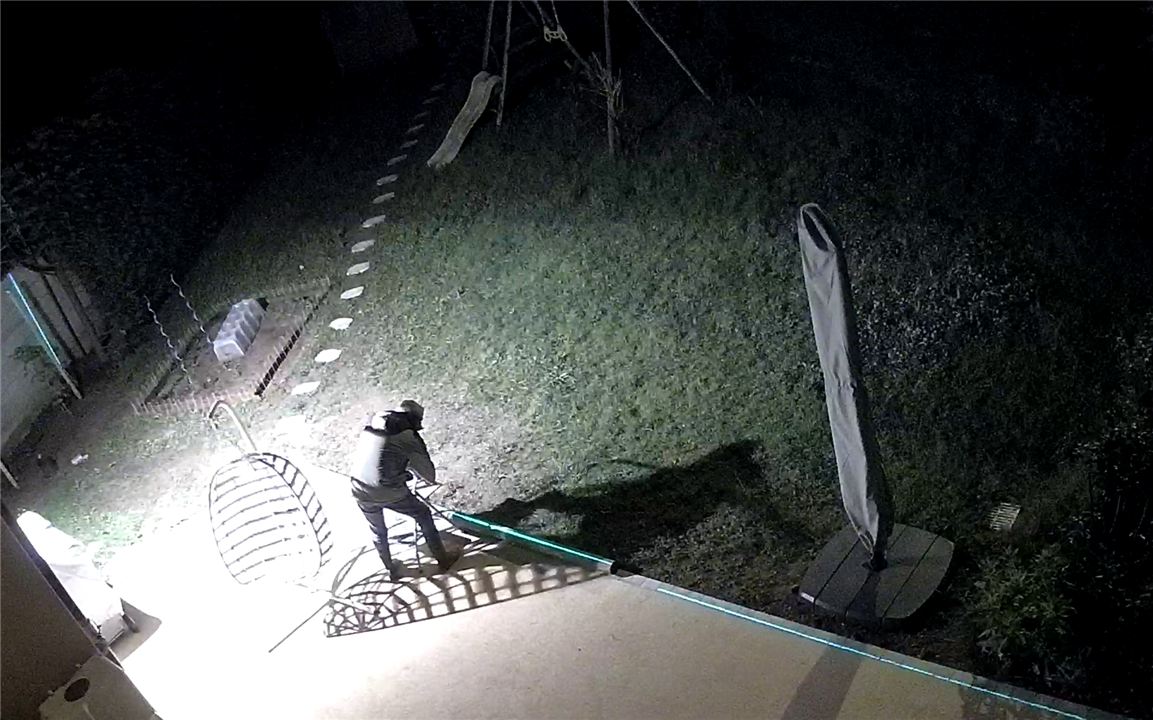
With all this decided, and with a bit of patience to get the various parts delivered or picked up, I worked in steps. The first one was to mark each beam with a line centered on the same side, and for this I used my 3-plane laser level. This had to be done at night because even if it’s using a green laser, it was not visible enough during the day.
| {gallery}Build steps |
|---|
|
IMAGE TITLE: |
|
IMAGE TITLE: |
|
IMAGE TITLE: |
|
IMAGE TITLE: |
|
IMAGE TITLE: |


One thing that occurred during those times is that the top beam was a bit too wide for the metal connectors. I mean, they both are supposed to be 10cm diameter, but somehow one side would not fit through. This was solved by generously applying “tractor grease” (lithium grease leftovers from the auto repair shop) to both the beam extremity and the metal connector inside, helping everything to slide in.
Now that the structure was in place, it was time to prepare the “roof” with some wire framing meant to receive it. The tensioning springs are reused from the late trampoline, long gone to the waste center but of which I kept pieces “just in case”.
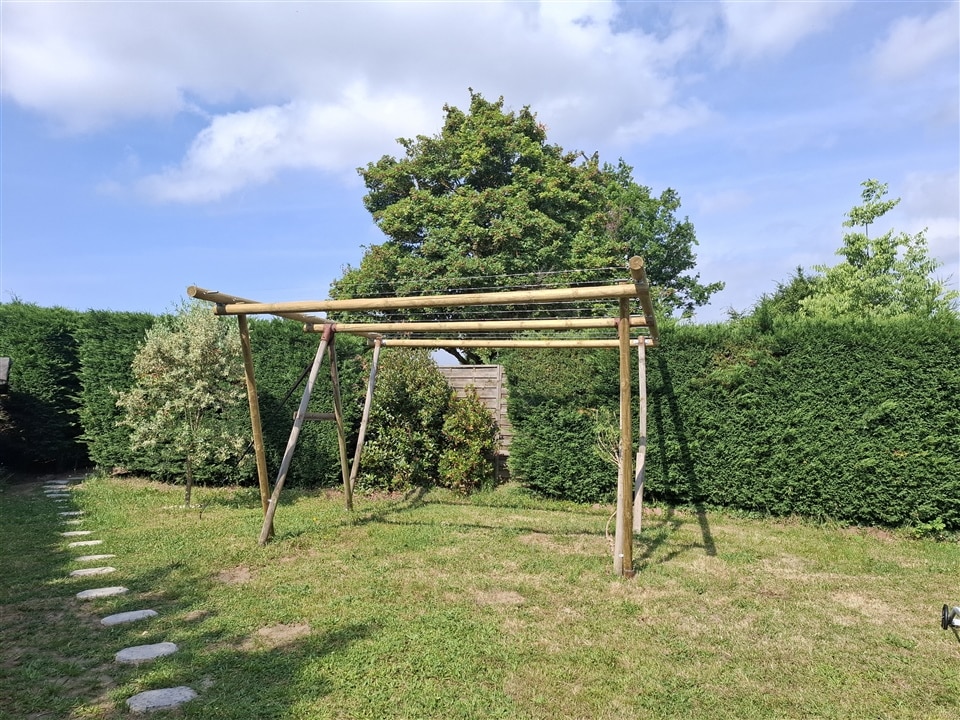
And three week-ends after starting the works, it was finally time to install reed screening on top:
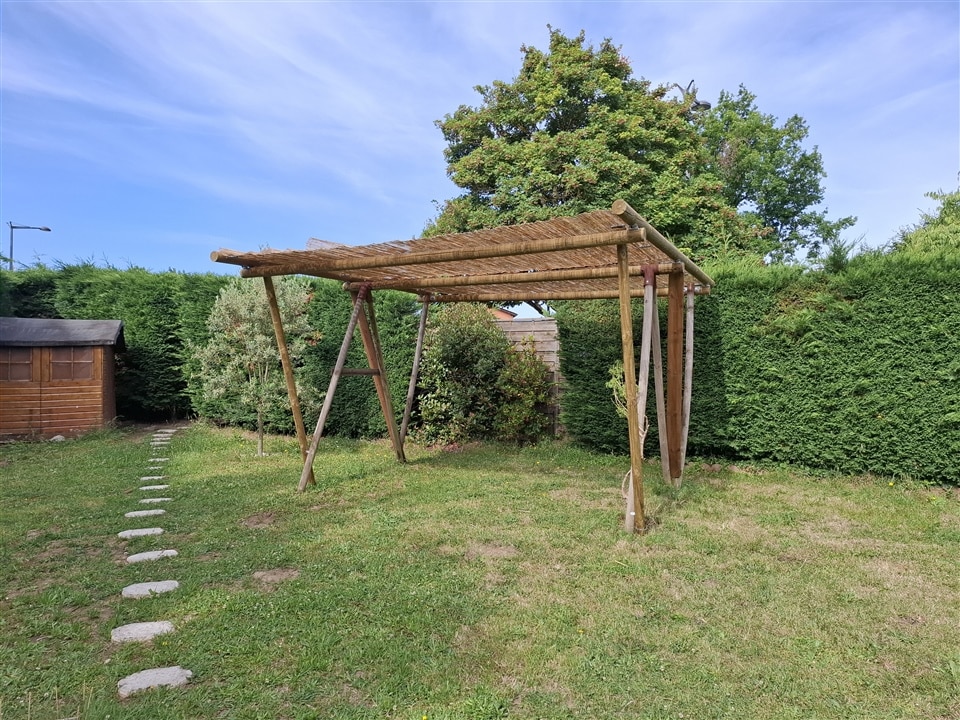
As you may notice, two large boards have been added diagonally on the exterior. This was needed because the entire structure had a tendency to strafe to the right, potentially leading to a whole collapse over time. The two boards are there to rigidify the entire frame and even if the angle is not that big, they appear to work their purpose just fine.
You may also see that the three horizontal parallel beams are all under the reed screening while the 3D rendering showed only the middle one. That’s because the rendering is based on an ideal world where the terrain is perfectly flat and the original playset had been installed perfectly square. But such is life that nothing’s perfect, so I had to adjust to reality while putting it all together.
In the end, I’m quite pleased with the result, the only remaining thing is to hook up the 4mx4m mosquito net with carabiniers onto the wire hooks so that it can be removed and stored away safely during harsher weather.
And if you are into timelapse videos, here are more than 7 cumulated work hours condensed in a few seconds:
All in all, this cost about 375€ which I find reasonable for a sturdy 4mx4m pergola.
I hope you enjoyed this recap as much as I enjoyed building this.
Top Comments