


Many of you have received a new Raspberry Pi in the past week. In a previous blog post, I talked about moving from getting a package in the mail to getting started on something.
As I have experienced it, that journey is usually built around a project, or something you want to do. My house is full of projects that are in various stages of completion (some much further than others). Some of those projects started out of necessity, "I want that toilet to stop leaking....NOW". Others were born out of whimsy, "I want to build a model of a Blue Angel for my son's room." In both (and all other cases I can think of) they start with an 'I want...' statement.
Let me give you an example of a technology project that I recently completed, that followed a project lifecycle.
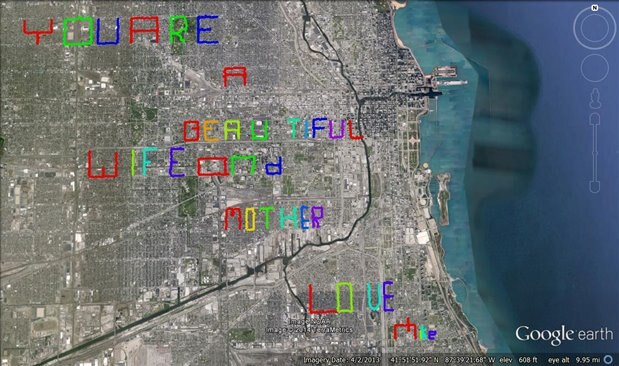
I saw Where People Run, a data visualization project where somebody mapped thousands of GPS run traces in various cities. I thought it was cool, and I run. So I got the idea that I could manipulate my runs so that my GPS data made various shapes and letters. Then I got to an 'I want' statement. "I want to write a letter to my wife using my GPS data to spell out words." The idea was simple, and based on what I saw on Where People Run, I knew the technical pieces existed and that I could eventually figure it out.
I started in April and finished it on June 17th. It took 46 miles of running, and about 6 hours of running time. I saw more than a dozen neighborhoods in Chicago. I am really proud of this project, and I had a ton of fun doing it.
Click here to read more about it. The picture below sums it up. Each letter is about a half-mile high.
When you start a project, you don't necessarily need to know everything about how to complete it. It can help with efficiency, sure. But if waited on technical expertise to complete this project, it never would have happened. I was about 75% of the way done with all of my running before I figured out how to lay it out on a map. I set out trying to do it in R, like I saw on the website, but I ended up doing it with Google Earth. These things weren't clear when I drafted an 'I want' statement, but I wasn't going to wait for clarity before I got started. Worst case scenario: I go for a bunch of runs. That's not so bad.
Now that you have a good tool, it would be a good time to think about what you want, and how that tool could (or could not) be useful.